HYUNDAI IONIQ OFFERS BUYERS CHOICE
OF THREE FUEL-EFFICIENT POWER TRAINS
About at the midpoint of its first generation that was introduced for the 2017 model year, Hyundai’s 2020 Ioniq hatchback gets a refreshing that keeps it at the forefront of its class.
It is offered with one of three, fuel-sipping powertrains — traditional gas-electric hybrid, plug-in hybrid, and all-electric — and at prices that, at least by today’s standards, won’t break your bank account.
The Ioniq (Hyundai prefers IONIQ but I’m running low on capital letters) Hybrid starts at $24,155 (including delivery charges) for the base Blue trim. Upgraded SE models start at $26,105, SEL at $29,355, and the top-of-the-line Limited at $31,155.
The Hybrid comes with with a 1.6-liter 4-cylinder gas engine combined with a 32-kW electric motor mated to a 6-speed, dual-clutch transmission that shifts so smoothly you might think it is a CVT.
Horsepower and torque numbers for the combined gas-electric system are 139 horsepower and 195 pound-feet, respectively, with fuel economy checking in a 55 miles-per-gallon city and 54 highway, saving you an estimated $3,750 in fuel costs over a 5-year period (if you trust the government’s numbers).
The Hybrid Blue gets a slightly higher fuel number (58 mpg), and the Plug-In offers a bit more horsepower (156) but the same torque number (195). The Plug-In has a top all-electric range of 29 miles, but the Electric Ioniq claims a range of 170 miles.
MSRPs for the Ioniq Plug-In are $27,230 (SE), $30,230 (SEL), and $36,380 (Limited). MSRPs for the Ioniq Electric are $34,000 (SE) and $39,560 (Limited).
This review is based on the Hybrid HEV Limited.
Hyundai gave all trims upgrades such as a new grille, new front and rear bumper fascias, LED head, tail, and daytime running lights, new wheel designs, and new side sill moldings for 2020.
Interior enhacements include a new console upper cover, new center LCD information screen, dark chrome instrument panel trim, touchdown heating and cooling controls, and new ambient lighting.
Some of the touchscreen controls can be a bit fussy, and I resorted to using the voice command system to change radio stations and that worked fine.
 Many of the features that once were available as option packages are now standard on the Limited, including the 10.25-inch screen navigation system, adaptive cruise control with Stop-and-Go, Harmon-Kardon Premium sound system, front parking sensors, lane follow assist, and forward collision avoidance with Pedestrian Detection.
In addition, no charge features on the Limited include 17-inch alloy wheels, blind-spot alert, power tilt-and-slide sunroof, an electric parking brake, auto hold, power driver’s seat with lumbar support, leather seating surfaces, heated front seats, ambient LED lighting, cargo cover, Android Auto and Apple CarPlan, and Hundai’s Blue Link connectivity system (think OnStar).
 The Ioniq has a nicely appointed, spacious interior with up to 42.2 inches of legroom up front and 35.7 for the second row.
Cargo space is a generous 23.5 cubic feet, a big plus over hybrid sedans.
All in all, the Ioniq has to be on your list if you are searching for a hybrid that looks mainstream.
What I liked about the 2020 Hyundai Ioniq HEV Limited: Superb exterior styling and a roomy interior featuring high-quality materials rate high. The plentiful technological features are all user-friendly. The ride is smooth and comfortable, and fuel mileage is excellent.
What I didn’t like about the 2020 Hyundai Ioniq HEV Limited: Road noise seemed to be on the high side, but it’s not a big issue. A bit more healthier throttle response would be nice, but performance is livened up when in Sport mode.
Would I buy the 2020 Hyundai Ioniq HEV Limted? Yes. Few hybrid-only vehicles have the all-around sex appeal that the Ioniq does. Most simply look dorky perhaps in a futile attempt to project a futuristic image.
HYUNDAI TINKERS WITH EQUIPMENT UPDATES ON VELOSTER HATCHBACK FOR 2020
After a redesign for 2019, not a whole lot was left for Hyundai to do with its sporty little Veloster hatchback for 2020.
It still retains the innovative three-door design with one coupe-sized door on the driver’s side and two sedan-like doors on the passenger side for easier access to a small backseat, and it offers a generous 19.9 cubic feet of cargo space behind the rear seats that more than doubles to 44.4 cubic feet when those second-row seats are folded.
And it still has the kind of sassy attitude that the original Veloster exuded when it was introduced for the 2012 model year.
What’s different for 2020 is more a matter of subtraction than addition in features. Most notably, a 6-speed manual transmission is no longer available on the Turbo Ultimate trim level. If working a clutch pedal to shift gears is your thing, you’ll have to look at the base 2.0 model, the Turbo R-Spec or the performance-oriented Veloster N. Not bad choices, by the way.
Other tweaks include blind-spot collision warning with rear cross-traffic warning as standard on the Turbo R-Spec, wireless charging as standard on Turbo and Turbo Ultimate trims, cargo area tie-downs on all trims, new front and rear fascia accents, and gloss black side skirts in place of flat black.
The Veloster is offered in six trim levels starting with the base 2.0 that has a 2.0-liter 4-cylinder engine mated either the 6-speed manual ($19,755 including destination and delivery) or a 6-speed automatic transmission for $1,000 more.
That engine is rated at 147 horsepower and 132 pound-feet of torque, which is OK for your daily commute but not much in the way of fun.
Other trims get various engine/transmission combos with the 2.0 Premium coming with the 2.0 4-banger/Shiftronic transmission as standard while the R-Spec Turbo gets a 1.6 turbocharged 4-cylinder (hence the trim name) with the 6-speed manual.
The upgraded Turbo and Turbo Ultimate have the 1.6-turbo engine with a 7-speed dual clutch transmission, and the Veloster N comes with a slightly larger, 2.0-liter turbo-4 and 6-speed manual transmission.
The turbo engines offer more in the way of get-up-and-go with 201 horsepower and 195 pound-feet of torque, though mileage figures are about the same for either engine (28 miles-per-gallon city, 34 highway and 30 combined for the turbo and 27/34/30 for the 2.0 trim with an automatic and 25/33/28 for the manual).
The Veloster N packs a punch of 250 horsepower with the standard package and up to 275 horsepower with the performance package.
This review is based on the Turbo Ultimate that carried a bottom-line MSRP of $29,215 with the only extra $135 for carpeted floor mats.
No extras really are needed for the Ultimate with a long line of standard features that include such niceties as LED low-beam headlights, LED tail lamps, Infinity Premium audio with 8 speakers, navigation with an 8-inch display screen, SiriusXM satellite radio (unless you live in Hawaii or Alaska), wireless charging pad, head-up display, automatic climate control, power lumbar support for the driver’s seat, a 3-yard subscription to Hyundai’s Blue Link systems, leather seats, and adaptive cruise control.
Standard safety features include lane-keeping assist, forward collision avoidance with pedestrian detection, rear cross-traffic alert, and blind-spot warning.
Frankly, that’s a pretty impressive list for a vehicle in this particular class.
What I liked about the 2020 Hyundai Veloster Turbo Ultimate: It is a fun car to drive, and the infotainment functions are all very easy to operate. The head-up display shows not only your speed in digital form but serves as a tachometer as well, handy if you are using the paddle shifters. The big improvement is that the hologram does not disappear if you are wearing polarized sunglasses.
What I didn’t like about the 2020 Hyundai Veloster Turbo Ultimate: No manual transmission is offered on the Turbo Ultimate trim for 2020. Where is the fun in that? The latch to release the front seatback to provide access to the rear from the driver's side is at the bottom of the seatback, making it a two-handed operation to return the back to the desired position. When the lever is lifted, the seat back snaps back but not all the way to its previous location. With a rear door on the passenger side providing access, it’s not a deal breaker, but still can be inconvenient at times
Would I buy the 2020 Hyundai Veloster Turbo Ultimate? Yes. If I was looking for a sporty hatchback for basic workday commutes and perhaps weekend getaways, this would be high on my list of prospects.
2019 NISSAN LEAF PLUS MODELS EASE ISSUE OF RANGE ANXIETY IN ELECTRIC VEHICLES
It doesn’t rank up in medical history with the discovery of penicillin or the development of the polio vaccine, but Nissan has found a remedy for a common complaint of owners of all-electric vehicles: range anxiety.
I remember when a few years ago I was sent a Nissan Leaf for week. Much of my time was spent calculating how far away it was that I wanted to go and if I would have enough charge to get back home later.
The Leaf at that time had a maximum range of about 90 miles, if I remember correctly, which is about the time my wife usually starts urging me to fill up the gas tank. On one trip I periodically would turn off the A/C to extend the range a couple of miles just to make sure I could get back home later.
But I had no such concern with the latest version of the Leaf I recently experienced.
The PLUS version of the Nissan Leaf that debuted for 2019 has an extended range that the company declares at 226 miles, though overnight charging indicated a range of 239 miles when in Normal mode and 251 when turned to Eco, at least based on my experience. That’s about 100 extra miles over the advertised 150-mile EPA range offered by the standard Leaf.
Range anxiety? What range anxiety?
The new high-capacity battery pack (62 kWh) and more powerful electric motor (62kW) in PLUS version Leafs also delivers more punch than the standard Leaf in the way of driving experience.
That battery-motor combination results in 214 horsepower, an increase of 45 percent over the base Leaf, and a whopping 250 pound-feet of torque, available at an instant and a big number for a compact hatchback.
You can feel the full effect of the extra torque when you shift from Eco to Normal mode. The jump in acceleration is very noticeable. Nissan estimates that the Leaf Plus gets from 50 to 75 mph about 13 percent quicker than the standard Leaf.
With a 100 kW Quick Charge Port and portable charge cable, charging time also is more efficient. I easily got it to full range overnight, which wasn’t always my experience with earlier electric vehicles.
The Leaf and the Leaf Plus each come in three trim levels — S, SV, and SL. This review is based on the SL PLUS that is at the top of the MSRP chart at $43,545 including the $995 destination and delivery charge.
That’s a pretty big jump over the standard Leaf S ($30,985) but within range of the S PLUS ($37,545) and SV PLUS ($39,505) and worth the extra cost.
The 2019 Leaf SL PLUS features such standard equipment Nissan’s ProPILOT assist with steering assist and adaptable cruise control, an around-view camera monitor, Intelligent Driver Alerts, automatic temperature control, leather-appointed seating surfaces, heated front seats, 8-way power driver’s seat with 2-way lumbar support, leather-wrapped steering wheel, 8-inch color display for the standard navigation system, Apple CarPlay and Android Auto, voice recognition, Bluetooth hands-free phone, 7-speaker Bose audio system, NissanConnect services, 17-inch wheels, LED headlights and fog lights, LED daytime running lights, and more.
Standard safety features include automatic emergency braking with pedestrian detection, Intelligent lane intervention, blind-spot warning, electronic brake distribution and assist, rear cross-traffic alert and more.
Extras like splash guards, premium paint, carpeted floor mats and cargo bay area, and a safety kit ran the total for my test Leaf SV PLUS to $44,315. But don’t forget, you also get tax credits that can lower that cost.
What I liked about the 2019 Nissan Leaf SL PLUS: This is a fun car to drive with significant torque and throttle response. This trim also is packed with many standard features with infotainment functions easy to operate. It’s a small thing, but the placement of the charging port at the very front is a nice touch. It gives you more flexibility when it comes to parking your car for charging.
What I didn’t like about the 2019 Nissan Leaf SL PLUS: The e-pedal feature that combines acceleration when pressing the “gas” pedal and braking when easing off is a feature I can live without. It can be useful when backing up and slow speeds, but it is kind of annoying when driving under normal conditions. Also, the gear shifter is a little too funky for me. It’s a round knob in the center of the console that you must tug to the left and then move up (for reverse) or down (for drive). The steering wheel is adjustable tilt only, not telescoping.
Would I buy the 2019 Nissan Leaf SL PLUS? This version of the Leaf is the first all-electric vehicle that I would actually consider buying.
AUDI A7 MOVES INTO SECOND GENERATION WITH NEW ENGINE, OTHER UPDATES FOR 2019
It was a case of love at first sight.
No sooner had I stepped out my front door to see the white Audi A7 parked in my driveway than I knew this was going to be a great week. It was stunning enough just sitting there motionless — a sedan that looks like a coupe but really is a hatchback.
And it only got better as the days went on.
Its driving performance was exhilarating, powerful yet refined and easy to manage. Its road manners are impeccable, but not stuffy. You don’t have to wrestle with the steering or treat the accelerator pedal gently lest the car get away from under you.
Steering is precise. There’s just enough of an exhaust note to let you know it’s there — sharp but not ear-splitting to those in the next county.
And bumps in the road? What bumps in the road?
All in all, I felt like the guy who married a super model and then found out she could cook, too! And owned a liquor store as well!
That’s the Audi A7 quattro, all new for 2019 as it moves into its second generation.
Among the items new for this year is a new turbocharged, 3.0-liter V6 engine that boasts an increase of 44 pound-foot of torque over its supercharged V6 predecessor. Mated with a 7-speed, double-clutch transmission featuring auto, comfort, dynamic, and individual modes, the engine delivers 335 horsepower and 369 pound-feet of torque at a range of 1370 and 4500 rpm, moving it from zero to 60 mph in 5.2 seconds.
That’s the official number from Audi. Edmunds.com clocked it at 4.7 seconds.
Also a first for 2019 is Mild Hybrid Electric technology system that helps improve drivetrain efficiency, resulting in EPA mileage figures of 22 miles-per-gallon city, 29 highway, and 25 combined. Even with all-wheel drive it’s among the best in the large luxury class.
One big change that is sure to catch your attention is Audi’s new touch-response system featuring dual touchscreens. The larger one at the top of the centerstack is used for adjustments for audio, navigation and car settings. The smaller one below is for climate control functions such as blower speed, temperature, etc.
That eliminates the need to switch the screen from say, navigation or audio display to re-adjust the A/C as is necessary on single-screen setups.
The touchscreens replace the rotary dial system used to operate the MMI system in the past. You can still use voice commands to operate many functions, which is good because using your finger to navigate the various options is a pain.
Standard equipment includes such niceties as heated leather seats, LED headlights, power sunroof, and power liftgate (almost a necessity considering its heft), and Bluetooth communications.
The Prestige model adds a package of features that adds $8,300 to the base MSRP of $68,000 and includes the MMI system with navigation and a 10.1-inch screen (replacing the 8.8-inch in the base base Premium model) along with Audi’s virtual cockpit, premium Bang & Olufsen sound system, a top-view camera system, and 4-zone climate control. Driver and front passenger not only have their own temperature controls but blower as well, and the rear occupants have their own controls.
My test vehicle also included options like an individual contour seating package, a Driver’s Assistance Package, and 20-inch wheels (replacing the standard 19s) that ran the total to $85,240, including the $995 destination and delivery charge.
What I liked about the 2019 Audi A7 quattro: The “virtual cockpit” that puts information like the adjustable map for navigation right in front of the driver’s eyes is the best system yet. There are tons of storage space in the back (part of the DNA of a hatchback) but when the deck lid is closed, the A7’s interior has the appearance of a sedan with the cargo area (24.9 cubic feet) completely closed off.
What I didn't like about the 2019 Audi A7 quattro: Audi has changed its infotainment functions to operate by tapping on one of two touchscreens rather than spinning a dial on the console like its Teutonic mates BMW and Mercedes-Benz, and results are mixed. It’s easy enough to adjust climate control settings on the lower screen, but tuning the radio or adjusting the audio volume or making other adjustments by touching the right spot on the upper screen can be distracting. Rear headroom might be compromised for taller occupants because of the slopping roofline that gives the A7 its coupe-like profile.
Would I buy the 2019 Audi A7 quattro? Yes. I don’t like the touchscreen controls for audio and A/C, but I don’t see it as a complete turnoff. There’s just too much going for the A7 to let that get in the way.
VOLKSWAGEN BOOSTS HORSEPOWER TO 278 FOR 2019 GOLF GTI HATCHBACK
Fuel economy may be the No. 1 reason many people shop in the compact class, but it’s not the only one.
In what could be considered a “sub-grouping” in the segment, so-called “pocket rockets” — compacts and sub-compacts tuned for performance — throw a bit of spirit into the mix while still offering decent fuel economy.
Volkswagen’s Golf GTI has been a prominent player in this field since it was brought to the U.S. in 1983, the second generation of the snappy little hatchback that had been serving European audiences for the previous eight years.
It especially appealed to those buyers with champagne tastes when it comes to performance but were living on beer budgets.
J.D. Power and Associates put it this way: The GTI was based on the first-generation Golf and was “a performance buffed version of the small, fun, but painfully slow economy car, and offered up a measure of athleticism and German handling for those who were interested in Teutonic vigor but couldn’t cough up the cash for a BMW or Mercedes.”
A marketing firm that keeps track of such things, J.D. Power says that men account for 86 percent of GTI sales. They have a median age of 46 and median annual household income of $113,816, and more than half identify themselves as “performance buyers.”
Not surprisingly, the 2019 Golf, which is offered in S, SE, and Autobahn trim with a limited-edition special GTI Rabbit Edition slotting in between the S and SE, gets a boost of 8 horsepower over its predecessor for a total of 278 hp available when run on premium fuel. (It also can run on unleaded fuel.)
Peak torque from the 2.0-liter, turbocharged 4-cylinder engine is 258 pound-feet from 1500 rpm through 4500. Mated to a 6-speed manual transmission, the GTI still offers fuel mileage numbers of 24 miles-per-gallon city, 32 highway and 27 combined while those equipped with the optional 7-speed DSG automatic boasts numbers of 25/31/27.
Those aren’t spectacular numbers for the segment, but you’ve got to sacrifice something to get that performance.
That power train is common to all trims as is the MIB II touchscreen infotainment system. You can flip through different driving modes (Normal, Comfort, Eco, and Sport) by pushing a button on the console. It’s right next to a button to turn off the Stop-Start feature on models equipped with the automatic transmission.
The GTI’s interior is nice, very nice actually. A special GTI interior with red ambient lighting, leather seats with red stitching, and illuminated door sills, and a black headliner add a touch of class to the nicely appointed cabin.
There’s also lots of space for passengers (just over 41 inches of legroom up front and 35.6 for the second row) and your stuff. Cargo room behind the second row is 22.8 cubic feet. Fold those seats and it’s a spacious 52.7.
The top-of-the-food chain Autobahn trim, which served as my test vehicle for the week, comes with long list of standard equipment that includes such features as a crash response system, rear-view camera, 18-inch alloy wheels, automatic LED headlights and LED daytime running lights and fog lights, rain-sensing wipers, panoramic moonroof, GTI grille, bumpers, side skirts, and rear spoiler, dual-zone climate control, paddle shifters, and technological features like navigation, a Fender premium audio system, Bluetooth connectivity, and adaptive cruise control.
 Those features make options pretty much unnecessary, but they do drive up the price. Base MSRP for the GTI Autobahn is $37,095. Add in the $895 destination charge and the total is $37,990.
That number may be out of range for those shopping on a “beer budget,” but you don’t have to go for the Autobahn trim. The SE model starts at just over $28,000 counting the destination charge.
Call that a “craft beer budget.”
What I liked about the 2019 Volkswagen Golf GTI 2.0T Autobahn: It’s a fun car to drive, especially when Sport mode is engaged. It’s comfortable enough and offers pretty decent storage in the back even without the second-row seats folded (easily accomplished). The Autobahn trim comes with a lengthy list of standard equipment.
What I didn’t like about the 2019 Volkswagen Golf GTI 2.0T Autobahn: Road noise kind of drowns out the audio. Some techno features require extra steps to perform basic functions like changing the clock, and the touchscreen can be overly sensitive. It’s easy to hit the screen surface and change a station when you’re turning up the audio volume if you’re not careful.
Would I buy the 2019 Volkswagen Golf GTI 2.0T Autobahn? I wouldn’t personally because I am not a fan of compact hatchbacks in general, but if that is the kind of vehicle you are looking for, this should be on your list. Cost no doubt plays a huge part. The GTI is among the most expensive offerings in its class.
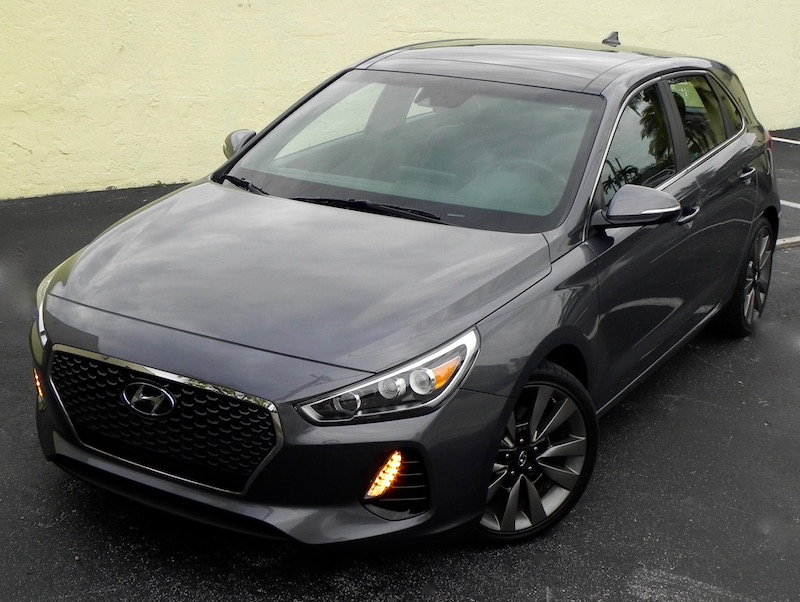
HYUNDAI HITS THE MARK WITH 2018 ELANTRA GT SPORT, A HATCHBACK WITH SOME POP
A staple in the Hyundai lineup going on three decades, the Elantra ranks as the South Korean automaker’s best seller and, in fact, is one of the top sellers in the U.S., checking in at the No. 20 spot for 2017 despite a slight dip of 4.9 percent over 2016 numbers.
It was first introduced as an economy sedan and since 2013 also has been offered in hatchback form under the label Elantra GT.
For 2018, the Elantra GT comes in two flavors, a base model and the far more attractive Elantra GT Sport. With a 201 horsepower, 1.6-liter turbo-4 under the hood, the Elantra GT Sport offers a bit of fun behind the wheel as well as providing even better fuel economy than the base model.
The base Elantra GT with its 2.0-liter normally aspirated 4-banger is rated at only 161 hp and 150 pound-feet of torque (to the Sport’s 195 lb.-ft.). With a 6-speed automatic transmission, it earns EPA figures of 24 miles-per-gallon city, 32 highway, and 27 combined.
Even with its power advantage, EPA figures for the GT Sport with its 7-speed dual clutch transmission are 26/32/28.
OK. That’s not a huge difference, and the numbers when equipped with a 6-speed manual transmission slightly favor the base over the GT Sport, but with such a power advantage you would expect the GT Sport to be a bit thirstier.
My impression of my week in the 2018 Hyundai Elantra GT Sport may have been influenced a bit by the fact that I had been driving some large pickups and SUVs in the preceding weeks, but I found the GT Sport a lively performer even with the double-clutch tranny (essentially an automatic). I can only imagine that manual models are even more fun.
Paddle shifters are included as standard so that’s a plus, though I must confess that driving on South Florida’s mostly flat terrain I find little use for them. Driving in “sport” mode is more convenient and adds performance.
The cabin is nicely appointed for its class and roomy as well. In fact, cabin capacity is a generous 96.5 cubic feet, resulting in legroom of over 42 inches in the front and just under 35 in the back and a cargo area of nearly 25 cubic feet behind the back seats.
Fold those back seats and the Elantra GT Sport enjoys a big advantage over its competitors with a maximum 55.1 cubic feet of storage space. According to Hyundai, the only competitor that comes close to that is the Volkswagen Golf with a max 52.7 cubic feet. Others offer from 16 to 25 percent less max cargo availability.
So you’re getting both performance and functionality — and technology and features to enhance the overall driving experience.
Standard features in the Elantra GT Sport include an 8-inch display for the 8-speaker audio system, Android Auto and Apple CarPlay, dual automatic temperature control, push-button start, electronic parking brake with auto hold (it’s a mystery to me why more manufacturers don’t offer this feature), leather seating surfaces with heated front seats, Bluetooth hands-free phone, 18-inch wheels, full LED headlights and taillights, blinds-spot detection and rear cross-traffic alert, and a rear window wiper and spoiler.
All that is included in a starting price of $24,350 with the double-clutch tranny, which is $4,000 more than the base Elantra GT’s MSRP of $20,350.
Adding options like a Sport Tech package that includes a navigation system and Hyundai’s Blue-Link services plus the $885 destination and delivery charge and the total of my test Elantra GT Sport came to $28,210.
That’s a good jump up from the base Elantra GT starting MSRP of under $20,000 with a manual tranny and just over $20,000 for the base equipped with the 6-speed automatic, but it’s competitive in its class when you take into consideration all the features the GT Sport has to offer.
 What I liked about the 2018 Hyundai Elantra GT Sport: The GT Sport has quite a bit of technological features for its class, and they are easy to operate. Hyundai has a knack for making life simple.
What I didn’t like about the 2018 Hyundai Elantra GT Sport: Not a lot to complain about here. Designers might want to sacrifice a bit of the spacious cargo area to add an inch or so of legroom in for occupants in the second-row seats.
Would I buy the 2018 Hyundai Elantra GT Sport? Yes. The extra features of the GT Sport make it worth your consideration in the compact segment.


 Many of the features that once were available as option packages are now standard on the Limited, including the 10.25-inch screen navigation system, adaptive cruise control with Stop-and-Go, Harmon-Kardon Premium sound system, front parking sensors, lane follow assist, and forward collision avoidance with Pedestrian Detection.