VOLKSWAGEN BOOSTS HORSEPOWER
TO 228 FOR ITS ‘HOT HATCH’ GOLF GTI
Based on the seventh generation of Volkswagen’s popular Golf hatchback, the 2019 VW Golf GTI 2.0T is the Germans’ answer for those buyers asking for a little more punch from the iconic Golf hatchback.
Using Teutonic terms, the GTI is a “hot hatch” offering a bit more in the way of horsepower over the 2018 GTI and a lot more than the 147 horsepower the standard Golf delivers.
The 2.0-liter turbocharged 4-cylinder engine in the 2019 is rated at 228 horsepower, 8 more than the 2018 GTI though torque numbers remain the same at 258 pound-feet starting at 1500 rpm. Those power numbers are achieved using premium fuel, but you can use regular unleaded if you aren’t seeking that peak performance.
A 6-speed manual transmission is standard with a 6-speed automatic as optional for an extra $1,100. Fuel economy is pretty much the same with either transmission with the manual rated at 24 miles-per-gallon city, 32 highway and the automatic 25/31. Combined mpg is the same for either at 27.
The 2019 GTI comes in four trim levels including a limited edition Rabbit Edition that slots in between the S and SE. Sitting at the top of the line is the Autobahn trim on which this review is based.
It is easily the most expensive of the bunch with a starting MSRP of $37,990 including the $895 destination and delivery charge with the automatic transmission. The base S model with the automatic starts at $29,590, which puts it at the high end of the segment (remember, subtract $1,100 for the manual tranny).
Additional features you get as standard in the Autobahn over the other trims include a 12-way power sport driver’s seat with lumbar support, dual-zone automatic climate control, an auto-dimming rear-view mirror, Fender premium audio, 8-inch touchscreen with navigation, VW’s Car-Net system for enhanced connectivity, active blind spot monitor, adaptive cruise control, lane-keeping assist, park distance control, and park steering assistant.
Leather seating surfaces and Sirius/XM satellite radio are standard on both the Autobahn and SE trims. S and Rabbit models get cloth seats with “Clark” plaid inserts (Google it).
Special safety features like forward collision warning with autonomous emergency braking and rear traffic alert come on the upper three trims and are optional on the base S trim.
The interior is nicely done with techno features easy enough to operate. Both the radio and climate control systems are operated with knobs doing the volume and tuning on the former and temperature and blower on the latter. Of course, there are duplicate controls for the radio on the steering wheel.
The GTI is pretty roomy for a compact with 41.2 inches of legroom up front, 35.6 in the back, and cargo capacity of 22.8 cubic feet. The ride is solid but not overly stiff under normal conditions, and, like most smaller cars, it gives the illusion of higher speed when whipping through the streets and roads.
Little wonder that, according to research by J.D. Power, more than half of GTI buyers identify themselves as “performance” buyers. And they are not kids either. J.D. Power describes the average GTI buy as a male, with a median age of 46 years and median yearly household income of nearly $114,000.
What I liked about the 2019 Golf GTI 2.0T Autobahn: Technology is user friendly, though the navigation system map was not updated so I didn’t get a chance to test it, but audio and climate control were fine. You can turn off the automatic stop/start function with the push of a button. Performance was pretty lively. Red accents on the exterior are a nice touch. The interior is roomy for its class.
What I didn't like about the 2019 Golf GTI 2.0T Autobahn: The price tag is pretty steep for a compact hatchback.
Would I buy the 2019 Golf GTI 2.0T Autobahn? I no longer fit in this demographic, but if I did a lot of driving on crowded urban with scant parking, I would consider it for sure. It’s a good vehicle for daily commutes.
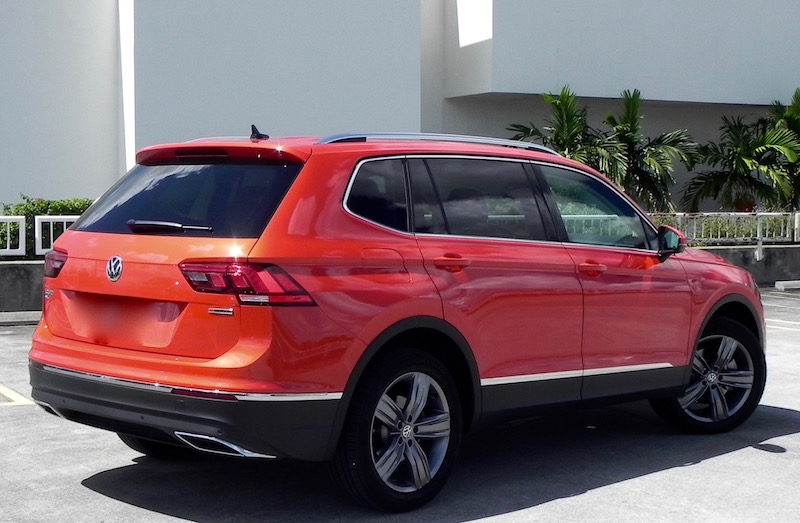
2019 VW TIGUAN: ABOUT EVERYTHING YOU WOULD WANT IN A COMPACT CROSSOVER SUV
Volkswagen gave its Tiguan compact SUV a much-needed makeover for 2018, and apparently designers/engineers got things the way they wanted because about the only updates for 2019 involve some shuffling of equipment.
The 2019 Tiguan crossover is offered in six trims (S, SE, SEL, SEL R-Line, SEL Premium, and SEL Premium R-Line with the latter two topping the portfolio and getting VW's 4-Motion all-wheel drive as standard. The other four trims come with front-wheel drive as standard and 4Motion as an option.
VW's Digital Cockpit and Park Distance Control are now standard on SEL models after debuting on SEL Premium in 2018.
All Tiguans come with a 2.0-liter, turbocharged 4-cylinder engine matched with an 8-speed automatic transmission. It runs on regular unleaded fuel and is rated at 184 horsepower and 221 pound-feet of torque. Mileage figures are 22 miles-per-gallon city, 29 highway and 25 for with FWD and 21/29/24 with the 4-Motion system.
Those aren't particularly great numbers for the class, and it could use a little more punch when it comes to performance, though Sport mode does deliver more in the way of response.
This review is based on the 2.0T SEL Premium model, which comes packed with just about every and any feature you might desire included in the MSRP of $38,190 (that includes the $995 destination and delivery charge, but not the $295 for the Habanero Orange Metallic exterior that ran my test vehicle's total to $38,485).
In addition to the usual collection of seat belts and air bags, safety features include Anti Slip Regulation and Engine Brake Assist, Intelligent Crash Response System, Forward Collision Warning and Autonomous Emergency Braking, blind spot monitor, lane-keeping assist, and a rear view camera, all standard.
Technology systems include an overhead camera system, VW's Virtual Cockpit, remote start and remote power liftgate, 8-inch touchscreen navigation, Fender Premium Audio, Bluetooth connectivity, and adaptive cruise control, all standard.
Other features include automatic LED headlights, rain-sensing windshield wipers, power tilt and sliding panoramic sunroof, heated and leather-wrapped steering wheel, dual-zone climate control, leather seating surfaces, and 19-inch alloy wheels, all standard.
Third-row seating is available in FWD models and available as an option for 4-Motion models, though it cuts back considerably the available cargo space (a generous 37.6 cubic feet behind the second row).
If you can live without some of those features, the SE trim is well-equipped and has a starting MSRP of $27,690 (including the destination and delivery charge) with front-wheel drive and $28,990 for the 4-Motion system.
Even the SEL trim with FWD will save you $5,400 over the SEL Premium. It's definitely worth considering if you can live with Halogen headlights in place of LED, leatherette seats instead of leather, and without rain-sensing wipers. The SEL comes navigation and a power liftgate as well.
What I liked about the 2019 Volkswagen Tiguan SEL Premium: After dealing with smaller screens in a couple of more expensive vehicles, the image for the rearview camera was a joy to see -- very clear in high def and good size as well. There's a good bit of technological features, and they are user-friendly to operate.
What I didn't like about the 2019 Volkswagen Tiguan SEL Premium: Driving in Sport mode remedies what could have been a complaint about the lack of energy and performance in Normal mode.
Would I buy the 2019 Volkswagen Tiguan SEL Premium? Yes. This meets a lot of what you are looking for in a compact SUV/crossover with good passenger and cargo space and easy handling. I would go with another color though!
AND ANOTHER BITES THE DUST; VW ENDING PRODUCTION FOR ITS STATION WAGONS
Station wagons long ago ceded the role of the favorite family transportation mode to minivans and SUVs, and now two more are being relegated to the scrap heap.
Volkswagen recently announced that it was ending production of its popular Golf Sportwagen and Alltrack wagons with the 2019 model year.
It will continue to make the Alltrack at its Pueblo, Mexico, plant through December, but that will be it for the German manufacturer’s last wagons, ending for the segment that dates back to pre-moon landing days.
In a news release, the company said that the rising popularity of SUVs, which accounted for 47 percent of all vehicle sales in the U.S. in the first six months of 2019, and the strong performances for its Atlas and Tiguan SUVs were behind the move. Those two models accounted for more than half of VW’s sales for the first half of the year.
“SUVs have definitely assumed the mantle of family haulers from the station wagons and minivans we remember from our childhoods,” Scott Keogh President and CEO, Volkswagen of America, said in the release.
VW plans to release three new SUV models in the next two years, including one electric model, the CROZZ.
Certainly the declining sales of the Golf models (down 36 percent for the first six months this year) can’t be blamed on anything the company did wrong with them. They’re both good vehicles offering good hauling capability in a fuel-efficient package.
The Golf SportWagen 1.4T SE I recently had the pleasure of driving for a week offered better fuel mileage (combined 31 miles-per-gallon) with its 1.4-liter turbo 4-cylinder engine than my older Passat wagon (2.0T) usually gets on the highway. And it runs on regular 87 octane as opposed to the premium recommended for my 2007.
Front-wheel drive is standard, but a 4-wheel drive version is available with the SportWagen 4Motion model. Also standard is a 6-speed manual transmission, but an 8-speed automatic on my test vehicle came with no extra charge (as did the beige Leatherette interior and night blue exterior).
The 1.4T engine standard in the S and SE trims is rated at modest 147 horsepower at 5000 rpm but a more robust 184 pound-feet of torque at 1400, which helps when it comes to throttle response.
The 1.8-liter turbo-4 in 4Motion and Alltrack models are a bit on the peppier side with their 168 hp and 199 lb.-ft. of torque.
Standard equipment in the SportsWagen SE includes a stop-start system, safety equipment like Intelligent Crash Response System and rear-view camera, 17-inch alloy wheels, automatic LED headlamps and LED daytime running lights, Halogen fog lights, black roof rails, rain-sensing wipers, leather-wrapped steering wheels with paddles for manual gear selection, carpeted floor mats front and rear, a carpeted floor in the cargo hold with an adjustable floor and removable cover, a panoramic sunroof, and technology that includes blind-spot monitor, lane-keeping assist, adaptive cruise control, keyless access with push-button start, and Bluetooth connectivity.
All that and more is included in the MSRP of $30,890 (including destination and delivery). S models start at $22,790 (manual) and $23,880 (automatic).
With the Golf SportWagen and Alltrack ending production, VW dealers won’t have a new wagon to offer next year for the first time since its 1966 1600 Squareback Sedan, which had cargo space under the hood and above the engine in the rear. It was around for seven years.
Other wagon models from the company over the years have been the Type 412 Wagon (1971-74), VW Dasher 1974-81), VW Quantum (1981-1988), VW Fox (1989-91), Passat Wagon (1990-2010) and Jetta. The Jetta enjoyed two stints, 2001-2005 and 2008-2014.
The SportWagen’s run started in 2015, and the Alltrack debuted as a 2017 model.
What I liked about the 2019 VW Golf SportWagen 1.4T SE: It’s an attractive wagon, both inside and out, and its compact size is more agile than you might expect. At 178.9 inches long, it still provides cargo volume of 30.4 cubic feet behind the second-row seats and 66.5 cubic feet when those seats are folded. Infotainment features are user friendly — a rarity among German models.
What I didn’t like about the 2019 VW Golf SportWagen 1.4T SE: The space devoted to cargo comes comes at a cost for second-row passengers, who get only 35.6 inches of legroom, which isn’t cramped but not exactly generous either.
Would I buy the 2019 VW Golf SportWagen 1.4T SE? Yes. On a personal note, we have enjoyed our VW Passat wagon, which went out of production several years ago, and this or the VW Alltrack looked to be the best successors.
VW UPGRADES ATLAS BY MAKING SEVERAL SAFETY FEATURES STANDARD EQUIPMENT
Introduced just a couple of years ago, the Atlas SUV is the largest vehicle in Volkswagen’s lineup and has become the German automaker’s third-best seller behind only the smaller Tiguan crossover and Jetta compact sedan.
VW sold nearly 60,000 Atlas SUVs in 2018, the first full year of production, and is well on pace to top that this year with just over 22,000 sold the first four months, an increase of 7.3 percent over the same period last year.
It’s no surprise. The Atlas offers lots of space for cargo and passengers with three rows of seating and a maximum of just over 96 cubic feet of storage space in an attractive package that drives more like a compact than a mid-size SUV. Even my passenger for the week commented that it seemed smaller than it actually is.
There’s even good rear cargo space with the third-row seats in place, which is not always the case in seven-passenger SUVs. The third row in many SUVs often is suitable only for children and not very big ones at that, but such is not the case with the Atlas.
Not sure how they would fare on a day-long trip, but the third-row riders have nearly 34 inches of legroom, and with the way the second-row seats tilt and slide forward, they don’t have to be contortionists to get back there.
VW said at the time of its launching that the Atlas was going at the sweet spot of the core of the market. It was “designed for the American family” and is built at the company’s assembly plant in Chattanooga, Tennessee.
Seems right to me.
Though it is too soon for major changes in only its second year, the 2019 Atlas now gets as standard across the line such safety features as Front Assist (which alerts the driver to a potential collision), Blind Spot Monitor, and Rear Traffic Alert.
Even the base S trim gets automatic headlights, rain-sensing wipers, and heated side mirrors as standard. Other trims are the SE, the SE w/Technology, SE w/Technology R-Line, SEL, SEL R-Line, and SEL Premium with additional niceties as standard.
The SE w/Technology that served as my ride for the week included 18-inch alloy wheels, automatic LED headlights with LED daytime running lights, fog lights, rain-sensing windshield wipers, three-zone climate control, leather-wrapped tilt-and-telescoping steering wheel, 10-way power driver’s seat with lumbar support (4-way manually adjustable front passenger seat), leatherette seating surfaces, roll-up manual second-row sunshades, and a front console with USB data and charging port and 12V and USB charging ports in the first and second rows.
Technology in the SE w/Technology includes adaptive cruise control, forward collision warning with pedestrian detection, blind-spot monitoring, lane-keeping assist, push-button start, remote power liftgate, Bluetooth connectivity, and an 8-inch touchscreen for audio.
SEL and SEL Premium models also get upgraded features like VW’s Digital Cockpit with a fully-digital instrument cluster offering a customizable presentation of important vehicle information on a 10-inch display.
The Atlas comes with the choice of two engines, both mated to an 8-speed automatic transmission. A 2.0 turbocharged 4-cylinder is rated at 235 horsepower and 258 pound-feet of torque kicking in a 1600 rpm. It is available with front-wheel drive only.
A 3.6-liter V6 is rated at a maximum 276 hp and 266 lb.-ft. of torque and is available with VW’s 4Motion all-wheel drive configuration as well as front-wheel drive.
Both engines feature stop/start technology, but that annoying feature can be turned off with the push of a button at the bottom of the center stack. Fuel consumption for the 4-banger is at the rate of 20 miles-per-gallon city, 26 highway and 22 combined and for the V6 17/24/19 with FWD and 17/23/19 with AWD.
That’s not the most fuel-efficient in its class, but is not the thirstiest either. You won’t be winning many drag races with the Atlas (of course, you don’t do things like that), but you won’t be left idling at the light either.
With an optional trailer package ($550), towing capacity is generous 5,000 pounds.
MSRP for the Atlas starts at $32,890 for the S FWD with the 4-cylinder engine and runs up to $49,390 for the top-of-the-line, AWD V6 SEL Premium trim
The SE w/Technology carries a price of $38,840 with FWD and the trailer package.
For more about the Atlas, you can check out my coverage of the 2017 media preview at https://tinyurl.com/y4z34jl4.
What I liked about the 2019 Volkswagen Atlas SE w/Technology: The ride is comfortable and quiet, and the cabin is especially spacious, though it drives like a much smaller vehicle. Too many three-row SUVs don’t have the space at the back to handle the staff that often comes along with seven passengers, but the Atlas gives you a nice area (20.6 cubic feet) behind the last row. You get 55.5 cubic feet behind the second row and 96.8 cubic feet with the second and third rows folded. Technology is plentiful and user-friendly.
What I didn’t like about the 2019 Volkswagen Atlas SE w/Technology: Though there’s something to be said for simplicity, the interior styling could use a bit of upgrading and a bit less plastic.
Would I buy the 2019 Volkswagen Atlas SE w/Technology? As I have mentioned before (several times, actually) I personally have no need for a three-row SUV, but this one could make me change my mind. It’s particularly good if you’re looking for German engineering but don’t want to pay luxury prices to get it.
VOLKSWAGEN BOOSTS HORSEPOWER TO 278 FOR 2019 GOLF GTI HATCHBACK
Fuel economy may be the No. 1 reason many people shop in the compact class, but it’s not the only one.
In what could be considered a “sub-grouping” in the segment, so-called “pocket rockets” — compacts and sub-compacts tuned for performance — throw a bit of spirit into the mix while still offering decent fuel economy.
Volkswagen’s Golf GTI has been a prominent player in this field since it was brought to the U.S. in 1983, the second generation of the snappy little hatchback that had been serving European audiences for the previous eight years.
It especially appealed to those buyers with champagne tastes when it comes to performance but were living on beer budgets.
J.D. Power and Associates put it this way: The GTI was based on the first-generation Golf and was “a performance buffed version of the small, fun, but painfully slow economy car, and offered up a measure of athleticism and German handling for those who were interested in Teutonic vigor but couldn’t cough up the cash for a BMW or Mercedes.”
A marketing firm that keeps track of such things, J.D. Power says that men account for 86 percent of GTI sales. They have a median age of 46 and median annual household income of $113,816, and more than half identify themselves as “performance buyers.”
Not surprisingly, the 2019 Golf, which is offered in S, SE, and Autobahn trim with a limited-edition special GTI Rabbit Edition slotting in between the S and SE, gets a boost of 8 horsepower over its predecessor for a total of 278 hp available when run on premium fuel. (It also can run on unleaded fuel.)
Peak torque from the 2.0-liter, turbocharged 4-cylinder engine is 258 pound-feet from 1500 rpm through 4500. Mated to a 6-speed manual transmission, the GTI still offers fuel mileage numbers of 24 miles-per-gallon city, 32 highway and 27 combined while those equipped with the optional 7-speed DSG automatic boasts numbers of 25/31/27.
Those aren’t spectacular numbers for the segment, but you’ve got to sacrifice something to get that performance.
That power train is common to all trims as is the MIB II touchscreen infotainment system. You can flip through different driving modes (Normal, Comfort, Eco, and Sport) by pushing a button on the console. It’s right next to a button to turn off the Stop-Start feature on models equipped with the automatic transmission.
The GTI’s interior is nice, very nice actually. A special GTI interior with red ambient lighting, leather seats with red stitching, and illuminated door sills, and a black headliner add a touch of class to the nicely appointed cabin.
There’s also lots of space for passengers (just over 41 inches of legroom up front and 35.6 for the second row) and your stuff. Cargo room behind the second row is 22.8 cubic feet. Fold those seats and it’s a spacious 52.7.
The top-of-the-food chain Autobahn trim, which served as my test vehicle for the week, comes with long list of standard equipment that includes such features as a crash response system, rear-view camera, 18-inch alloy wheels, automatic LED headlights and LED daytime running lights and fog lights, rain-sensing wipers, panoramic moonroof, GTI grille, bumpers, side skirts, and rear spoiler, dual-zone climate control, paddle shifters, and technological features like navigation, a Fender premium audio system, Bluetooth connectivity, and adaptive cruise control.
 Those features make options pretty much unnecessary, but they do drive up the price. Base MSRP for the GTI Autobahn is $37,095. Add in the $895 destination charge and the total is $37,990.
That number may be out of range for those shopping on a “beer budget,” but you don’t have to go for the Autobahn trim. The SE model starts at just over $28,000 counting the destination charge.
Call that a “craft beer budget.”
What I liked about the 2019 Volkswagen Golf GTI 2.0T Autobahn: It’s a fun car to drive, especially when Sport mode is engaged. It’s comfortable enough and offers pretty decent storage in the back even without the second-row seats folded (easily accomplished). The Autobahn trim comes with a lengthy list of standard equipment.
What I didn’t like about the 2019 Volkswagen Golf GTI 2.0T Autobahn: Road noise kind of drowns out the audio. Some techno features require extra steps to perform basic functions like changing the clock, and the touchscreen can be overly sensitive. It’s easy to hit the screen surface and change a station when you’re turning up the audio volume if you’re not careful.
Would I buy the 2019 Volkswagen Golf GTI 2.0T Autobahn? I wouldn’t personally because I am not a fan of compact hatchbacks in general, but if that is the kind of vehicle you are looking for, this should be on your list. Cost no doubt plays a huge part. The GTI is among the most expensive offerings in its class.
VOLKSWAGEN ADDS NEW R-LINE MODEL
IN REDESIGNED JETTA LINEUP FOR 2019
Introduced nearly a year ago at the North American International Auto Show in Detroit, the 2019 Volkswagen Jetta kicks off the new year as a fully redesigned sedan that should ensure its role as one of the German automaker’s top sellers and make it more of a contender it its class as well.
Built on the company’s new MQB platform, it also gets a new trim level with R-Line features added to the lineup along with S, SE, SEL, and SEL Premium treatments. At $23,890 including the $895 destination and delivery charge, the R-Line falls right in the middle of Jetta’s pricing chart that ranges from $19,440 for an S with a 6-speed manual transmission to $27,390 for the SEL Premium and its standard 8-speed automatic tranny.
Like all Jettas, the R-Line gets a turbocharged, 1.4-liter 4-cylinder engine that rates among the leaders in fuel economy among non-hybrid compact sedans. Government figures are 30 miles-per-gallon city, 40 highway, and 34 combined whether equipped with the manual or the automatic, which is standard on all but the S model.
Yes, you sacrifice a bit in straight-ahead power (figures are 147 horsepower and 5000 rpm and 184 at 1400) for those numbers, but you can kick up performance a bit by switching to Sport mode. (Other choices are Eco, Normal, and Custom.)
Though with some brands you may get extra performance from “R” designated models, the “R” in this case pertains to sportier styling features like special 17-inch wheels, a more aggressive rear bumper with dual exhaust, a gloss-black grille, black side mirror caps, R-Line badging, and a unique leather-wrapped steering wheel with R-Line insignia.
Still, it felt pretty lively in my around-town experience.
The R-Line also gets VW’s XDS Cross Differential System that helps improve stability, handling, and cornering. Other than that and the other special features, the R-Line gets standard equipment similar to that on SE models.
That includes VW’s MIB II touchscreen infotainment system with a 6.5-inch screen, Android and Apple CarPlay connectivity, Bluetooth communications, LED headlamps and taillights, sunroof, simulated leather upholstery, heated front seats, dual-zone A/C, and keyless entry with push-button start.
Among safety features, the R-Line is in line with other Jetta trims with a rear-view camera, Forward Collision Warning with Autonomous Emergency Braking, Blind Spot Monitor, and the usual collection of airbags.
Optional features for the Jetta R-Line include a heated steering wheel and heated rear seats, remote start, heated front washer nozzles, and heated windshield wiper park that can be all gotten together in a Cold Weather Package.
As noted, the Jetta is one of VW’s best sellers. The company reports that more than 17.5 million have been sold since it was introduced in 1979 with 3.2 million of those sold in the U.S.
Sales have fallen off a bit for the first 11 months of 2018, though they picked up for last November. December numbers are not in as of this writing.
What I liked about the Volkswagen Jetta R-Line: It has a quiet ride, the and the R-Line touches give it a nice sporty look. The infotainment features, such as they were on my test model, were user-friendly, and the trunk is a nice-size (14.1 cubic feet) for the class.
What I didn’t like about the Volkswagen Jetta R-Line: I’d like to give whoever came up with the idea of a two-stage trunk lid a knock on the head, which is what you will get from the lid itself if you aren’t careful. If not opened fully, the lid starts to lower to closing position, giving you an unexpected knock on the noggin as you start to load it if you are not careful.
Would I buy the 2019 Volkswagen Jetta R-Line: I’d definitely consider it, though the interior could use a little less plastic surfaces.