2020 HYUNDAI SONATA HYBRID ADDS
FUN TO FUEL-SIPPING PERFORMANCE
If you still cling to the notion that a gas-electric powertrain has to be a boring vehicle that is no fun to drive, you need to check out the 2020 Hyundai Sonata Hybrid. You will likely change your mind.
The Sonata offers a different kind of hybrid performance. Though it wouldn’t be your first choice for a drag race, it is a peppy performer around town and a steady cruiser on the highway.
Part of the eighth generation Sonata the South Korean automaker introduced for 2020, the Sonata Hybrid comes in three trims, starting with the base Blue and continuing with the upgraded SEL and Limited models. A plug-in Hybrid was dropped from the lineup.
The Limited that served as my test vehicle for the week comes with a long list of standard equipment.
All models are front-wheel drive with a 2.0-liter inline 4-cylinder gas engine (150 horsepower, 139 pound-feet of torque) paired with an electric motor (51 hp, 151 lb.-ft) for a net 192 horsepower at 6000 rpm.
Rather than a continuously variable transmission (CVT) often found in hybrid drivetrains, the Sonata gets a 6-speed automatic with manual shift mode. It also includes a Sport mode, which adds to the driving experience.
The Blue earns the top EPA mileage figures of 50 miles-per-gallon city, 54 highway, and 52 combined. The slightly heavier SEL and Limited’s numbers are 45/51/47, all an increase over the previous model’s 41/42 figures.
Included in the Limited’s base MSRP of $35,300 are such niceties as LED headlights and taillights, proximity key entry and push-button start, adaptable cruise control, hands-free trunk release, leather seating surfaces, heated and ventilated front seats, power front seat with memory settings for the driver, Bose premium sound system, dual automatic climate control, a 10.25-inch touchscreen with navigation, Apple CarPlay and Android Auto, Hyundai’s Blue Link system, and a solar panel roof that feeds the lithium-ion battery.
Safety features include a blind-spot warning system, rear cross-traffic alert, forward collision-avoidance assist with pedestrian detection, parking assist, and around-view monitor. A lane-keeping assist system can be a bit on the sensitive side with its annoying beeps, but it can be turned off.
Also included is Hyundai’s Blind Spot View Monitor that shows any traffic that may be in your blindspot via an image projected in the tach or speedometer gauges’ spot in the instrument cluster when the corresponding turn signal is activated. It’s a nice touch that seemingly has limited appeal, but I find a nice addition.
The only extra on my test Sonata was $135 for carpeted floor mats, making the final total $36,430.
The Limited’s interior has a nice, comfortable feel about it with good legroom both front (46.1 inches) and back (34.8). Truck space is a very generous 16 cubic feet, which matches that of the gas-only Sonata.
The Limited’s overall cabin ambiance has a premium feel about it, and the exterior appearance rivals that of luxury models costing thousands of dollars more. It’s an eye-catcher, for sure.
A friend of mine and fellow reviewer, someone who gets a new vehicle in his driveway every week, summed up the whole package.
“This,” he said, “is what I would buy if I needed a personal car for my family.”
What I liked about the 2020 Hyundai Sonata Hybrid Limited: In addition to the performance, the ride is quiet and comfortable, and the cabin is roomy and nicely appointed. Fuel economy is excellent, and I love that you don’t have to plug it in to recharge. It has lots of technology that is intuitive to operate, and the annoying whine that is typical to hybrids when they are coming to a stop is absent.
What I didn’t like about the 2020 Hyundai Sonata Hybrid Limited: Although the infotainment system is very user friendly, I missed having a knob to surf the radio dial. There is one to control volume. Why get rid of the one to change stations? I just hope it is not an indication that designers are going to follow competitors with unnecessary “updates” to infotainment features.
Would I buy the 2020 Hyundai Sonata Hybrid Limited: Without a doubt, yes. If you haven’t been completely taken in by the trend to crossover SUVs and are open to a sedan, this one should be on your list. The only drawback would be that the Hybrid Limited is at the top of the Sonata’s price range. But the base Blue trim starts at under $28,000, and the SEL under $30,000 (not including destination and delivery). The 2020 Sonata Hybrid carries over to 2021.
HYUNDAI IONIQ OFFERS BUYERS CHOICE
OF THREE FUEL-EFFICIENT POWER TRAINS
About at the midpoint of its first generation that was introduced for the 2017 model year, Hyundai’s 2020 Ioniq hatchback gets a refreshing that keeps it at the forefront of its class.
It is offered with one of three, fuel-sipping powertrains — traditional gas-electric hybrid, plug-in hybrid, and all-electric — and at prices that, at least by today’s standards, won’t break your bank account.
The Ioniq (Hyundai prefers IONIQ but I’m running low on capital letters) Hybrid starts at $24,155 (including delivery charges) for the base Blue trim. Upgraded SE models start at $26,105, SEL at $29,355, and the top-of-the-line Limited at $31,155.
The Hybrid comes with with a 1.6-liter 4-cylinder gas engine combined with a 32-kW electric motor mated to a 6-speed, dual-clutch transmission that shifts so smoothly you might think it is a CVT.
Horsepower and torque numbers for the combined gas-electric system are 139 horsepower and 195 pound-feet, respectively, with fuel economy checking in a 55 miles-per-gallon city and 54 highway, saving you an estimated $3,750 in fuel costs over a 5-year period (if you trust the government’s numbers).
The Hybrid Blue gets a slightly higher fuel number (58 mpg), and the Plug-In offers a bit more horsepower (156) but the same torque number (195). The Plug-In has a top all-electric range of 29 miles, but the Electric Ioniq claims a range of 170 miles.
MSRPs for the Ioniq Plug-In are $27,230 (SE), $30,230 (SEL), and $36,380 (Limited). MSRPs for the Ioniq Electric are $34,000 (SE) and $39,560 (Limited).
This review is based on the Hybrid HEV Limited.
Hyundai gave all trims upgrades such as a new grille, new front and rear bumper fascias, LED head, tail, and daytime running lights, new wheel designs, and new side sill moldings for 2020.
Interior enhacements include a new console upper cover, new center LCD information screen, dark chrome instrument panel trim, touchdown heating and cooling controls, and new ambient lighting.
Some of the touchscreen controls can be a bit fussy, and I resorted to using the voice command system to change radio stations and that worked fine.
 Many of the features that once were available as option packages are now standard on the Limited, including the 10.25-inch screen navigation system, adaptive cruise control with Stop-and-Go, Harmon-Kardon Premium sound system, front parking sensors, lane follow assist, and forward collision avoidance with Pedestrian Detection.
In addition, no charge features on the Limited include 17-inch alloy wheels, blind-spot alert, power tilt-and-slide sunroof, an electric parking brake, auto hold, power driver’s seat with lumbar support, leather seating surfaces, heated front seats, ambient LED lighting, cargo cover, Android Auto and Apple CarPlan, and Hundai’s Blue Link connectivity system (think OnStar).
 The Ioniq has a nicely appointed, spacious interior with up to 42.2 inches of legroom up front and 35.7 for the second row.
Cargo space is a generous 23.5 cubic feet, a big plus over hybrid sedans.
All in all, the Ioniq has to be on your list if you are searching for a hybrid that looks mainstream.
What I liked about the 2020 Hyundai Ioniq HEV Limited: Superb exterior styling and a roomy interior featuring high-quality materials rate high. The plentiful technological features are all user-friendly. The ride is smooth and comfortable, and fuel mileage is excellent.
What I didn’t like about the 2020 Hyundai Ioniq HEV Limited: Road noise seemed to be on the high side, but it’s not a big issue. A bit more healthier throttle response would be nice, but performance is livened up when in Sport mode.
Would I buy the 2020 Hyundai Ioniq HEV Limted? Yes. Few hybrid-only vehicles have the all-around sex appeal that the Ioniq does. Most simply look dorky perhaps in a futile attempt to project a futuristic image.
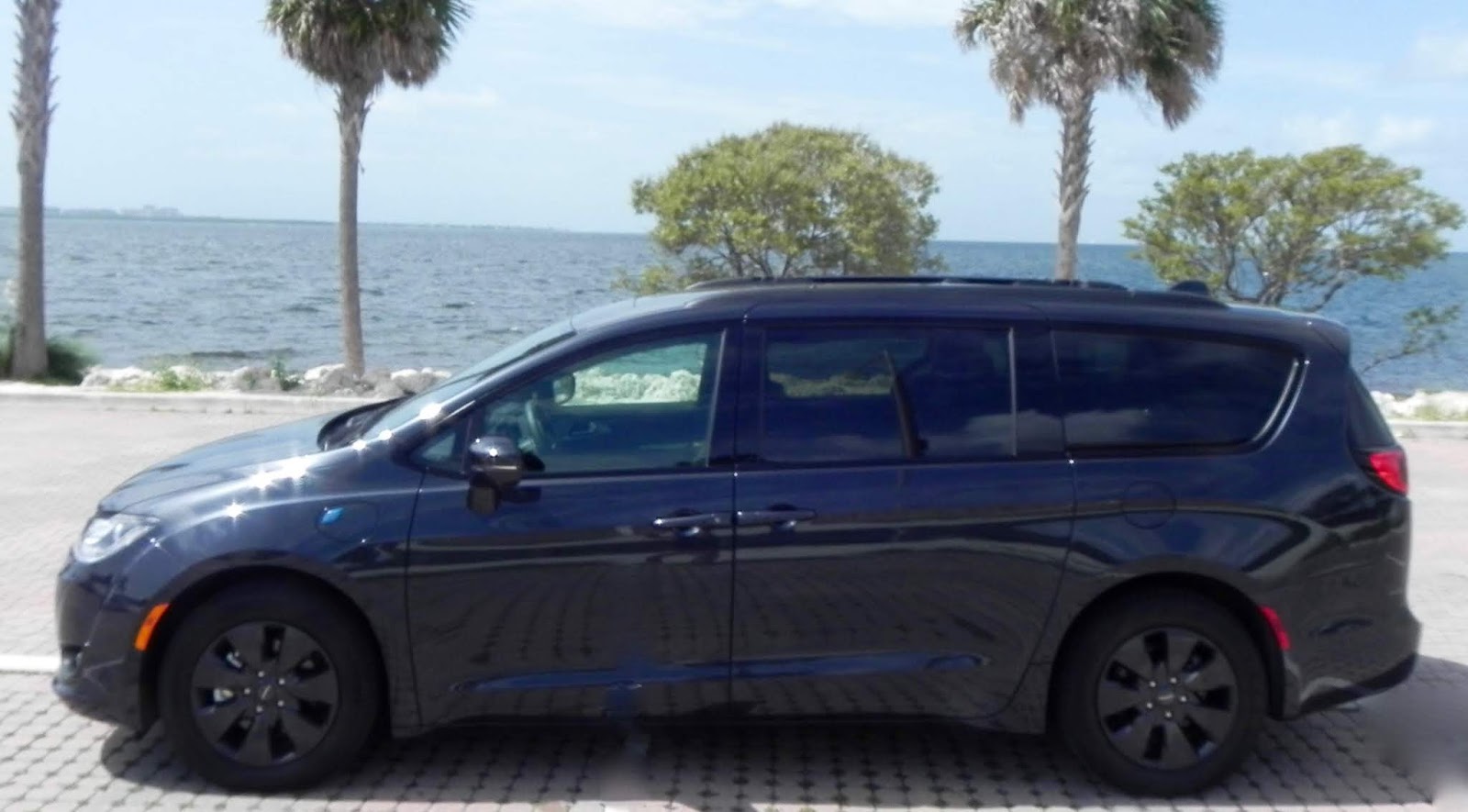
CHRYSLER PACIFICA REMAINS ONLY MINIVAN WITH HYBRID DRIVETRAIN FOR 2019
Though there were other stabs at it in the past, including one as far back as 1935, Chrysler generally is credited with creating the family minivan that we know today when it introduced the Dodge Caravan and Plymouth Voyager in 1984.
Thus it is fitting that Chrysler is the first — and so far only — manufacturer to offer a gas-electric hybrid minivan on the market with the Pacifica Hybrid.
The 2019 model actually marks the third year for the plug-in model that can go up to 30 miles on a full electric charge and offer a combined range of 530 miles under V6 power.
Frankly, the surprising thing about this is that nobody has come out with such a vehicle before. A minivan that offers mileage figures of 82 MPGe and 30 mpg combined electric-gasoline while still delivering decent acceleration with its 287 horsepower and 262 pound-feet of torque would seem to be a win-win situation with growing families.
No doubt, others will soon catch up.
With the exception of the powertrain and the lack of Stow N’ Go seating, the Pacifica Hybrid and the Pacific share mostly the same characteristics. The Pacifica Hybrid sacrifices the storage space under the second row seats to house the battery pack, and that is about it.
Getting in an out of the Pacifica Hybrid is a snap (no need for a running board), it rides comfortably, and it offers good storage space. Cargo volume behind the third row (which, by the way, with its 36.5 inches of legroom is not as cramped as some critics have said), is a generous 32.3 cubic feet. It’s 87.5 cubic feet behind the second-row after folding the third-row seats with the push of a button.
It comes in three trims.
The Touring Plus carries a base MSRP of $41,490, the Touring L is listed at $43,690, and the top-of-the-line Limited carries a tab of $47,040, which is a big step up from the gasoline-powered Pacific that starts at under $30,000.
This review is based on the 2019 Pacifica Hybrid Limited. Adding in optional equipment ran the total price tag to $50,800.
Say this: Even before adding in extras, the Pacific Hybrid is well-equipped.
Standard features on the Limited include Chrysler’s UConnect 4C infotainment system with navigation and an 8.4-inch screen, Bluetooth hands-free communication, 1-year of SiriusXM radio with Traffic Plus, Android Auto and Apple CarPlay, 4G LTE Wi-Fi hot spot, heated steering wheel, heated and ventilated front seats, remote start, blind-spot and cross-traffic alert, rear-park assist, and remote start.
A new S Assistance Package ($595) that adds among other things Nappa leather bucket seats and special black trim and an Advanced Safety Tec Group ($995) that includes Full-Speed Collision Warning-Plus, a 360-surround view camera system, lane-departure warning and other advanced safety features are well-worth the extra cost.
A tri-panel, panoramic sunroof, which I personally can do without, is an extra $1,795.
All told the total MSRP for my test vehicle was $50,800. (If you do the math, you’ll see eliminating the sunroof will keep you under $50,000.
That doesn’t take into account any of the tax credits you may get from the federal or state government, which can make the Pacific Hybrid a bit more competitive price-wise. As it is, it is pretty much at the top of the segment.
What I liked about the 2019 Chrysler Pacifica Hybrid Limited: Throttle response is quite robust for a minivan, and fuel efficiency is at the top of its class. Rear doors open on both sides, which may not be new to the segment but are still appreciated. They also power open with either a punch on the appropriate spot on the key fob or a gentle tug on the door handle. They close the same way. Tech features are very user-friendly.
What I didn’t like about the 2019 Chrysler Pacifica Hybrid Limited: I don’t get the allure of plugin hybrids. Yes, you can get some miles on electric power only, but unless you have a special charging outlet, getting the battery up to full charge is a drawn-out process. That said, the hybrid operation still makes sense here.
Would I buy the 2019 Chrysler Pacifica Hybrid Limited? Yes. It’s an ideal vehicle for family transportation, especially families with three or more children. Unfortunately, it’s about 35 years too late for me!
HYUNDAI HAS COME UP WITH A HYBRID YOU CAN LIVE WITH IN ITS 2019 IONIQ LIMITED
While hybrid drivetrains are offered in many so-called mainstream vehicles these days, Hyundai created the Ioniq hatchback as a conventional gas-electric hybrid, a plug-in hybrid, and electric powertrain, but with no gasoline-only engine option and without some of the quirks that often come with the hybrid segment.
In fact, driving the Ioniq Hybrid can make you forget you’re being the wheel of a traditional hybrid.
Not that you’d confuse it with a high-performance sports car or anything, but shifting on the go from Eco to Sport mode gives you a hybrid that actually is fun to drive.
As noted, the Ioniq comes with the choice of three drivetrains, with the Hybrid and Plug-in mated to a 6-speed dual-clutch automatic transmission and the Electric to a single-speed reduction gear set.
This review is limited to the standard Hybrid in Limited trim with a base MSRP of $29,435 including the destination and delivery charge ($885). The base model for the hybrid is the Blue model with a starting price of $23,285. The SEL is a step up at $25,835.
Both the standard Hybrid and the Plug-in get a 1.6-liter, 4-cylinder engine that is rated at 104 horsepower and 109 pound-feet of torque and matched with an electric motor that gets its power from a lithium-ion battery (located under the rear seat) to produce 125 pound-feet of torque. Combined horsepower is 139 hp.
The motor in the all-electric version is rated at only 118 hp but puts out a significant 218 lb.-ft. of torque.
The Blue trim Hybrid is rated at a segment-leading 57 miles-per-gallon city, 59 highway while the Limited and SEL come in at 55/54 (assuming you haven’t spent all your time driving in Sport mode).
As the top dog in the lineup, the 2019 Ioniq Limited gets as standard such features as HID headlights, LED daytime running lights, LED taillights, power tilt-and-slide moonroof, proximity key entry and push-button start, leather seating surfaces with heated front seats and a power-adjustable driver’s seat, dual automatic temperature control, 7-inch color touchscreen audio display, Android Auto and Apple CarPlay, Bluetooth hands-free phone system, and Hyundai’s Blue Link system with a complimentary 3-year trial.
New as standard this year is safety equipment that includes Automatic Emergency Braking with Pedestrian Detection, Lane-keeping assist, Smart Cruise Control, High-Beam Assist, and Driver Attention Warning.
Other safety features include blind-spot detection with rear cross-traffic alert, vehicle stability management with traction control, a rearview camera, and the usual collection of airbags (front, front-side impact, side curtain, and driver’s knees).
At 176 inches long, the Limited Hybrid offers more stowage capacity (26.3 cubic feet) than its Plug-in and Electric brethren (23 cubic feet) with front legroom of 42.2 inches. Rear legroom in all Ioniqs is 35.7 inches, which isn’t cramped but not particularly generous either.
The ambiance of the interior isn’t luxury, but nice enough for the its class. There is some road noise, but it isn’t excessive.
Options like an Ultimate Package and carpeted floor mats runs the total tab to $31,760, which may produce sticker shock for those who haven’t been car-shopping in the last decade, but is in line with other current hybrid and electric models.
The Ultimate Package includes navigation that operates off the touchscreen, Infinity premium sound, and rear parking sensors for an extra $2,200.
 All in all, the Ioniq is a hybrid you should find very comfortable to live with.
What I liked about the 2019 Hyundai Ioniq Limited: With the Ioniq, Hyundai has eliminated the annoying whine that often is heard when a hybrid slows to a stop by going with a traditional transmission instead of a CVT. Operation of infotainment features is very user-friendly, as is usually the case with vehicles out of the South Korean’s stable. Fuel efficiency is excellent, though if you want a better driving experience you have to go into Sport mode and sacrifice some of that advantage.
What I didn’t like about the 2019 Hyundai Ioniq Limited: The backseat is on the small side, but what is more distressing at the rear is the annoying crossbar that splits the large rear window. It is a feature that first popped up with Toyota’s Prius and impacts the rear view.
Would I buy the 2019 Hyundai Ioniq Limited? Of all the compact hybrids on the market, this is one I would seriously consider. A well-equipped Limited model would be my choice, but SEL trim also can be fitted with key options as well.
MERCEDES-BENZ OFFERS A NEW KIND OF HYBRID EXPERIENCE WITH C350e PLUG-IN
While most manufacturers try to squeeze as many miles they can out of the batteries of their electric vehicles, Mercedes-Benz has taken a different approach with the C350e.
This plug-in hybrid offers little in the way of electric-only drive, but packs a punch that rivals even AMG-tuned versions of the company’s fleet.
Consider, the 2.0-liter turbo 4-cylinder engine and electric motor propels the C350e from zero-to-60 mph in just 5.8 seconds, according to Mercedes-Benz clockers.
That’s the same as the C300 that traditionally has serveed as the entry point to the company’s luxury fleet and only 1.2 behind that for the AMG C43.
In fact, at 443 pound-feet (combined gas and electric) the C350e’s torque number is actually better than the 384 lb.-ft. offered by the AMG C43 and not all that short of the 479 the the 4.0-liter, biturbo V8 delivers to the AMG C63.
Plug-in hybrid indeed!
But about that electric-only driving. Though Mercedes-Benz touted a range of up to 20 miles of all-electric driving with the debut of the 2016 C350e, that figure has been tempered in bit. Cut in half, actually.
The spec sheet reports a range of 0-8 miles for the 2018 C350e, which isn’t going to take you far in run silent mode. But mileage ratings for electric-gas combined driving are 51 MPGe and gas-only 30 mpg, and you get a modicum of recharging while driving on gas as well. So it’s not all bad.
For the most part, you get the same classy cabin and features in the C350e that you do in other C-Class models with one notable exception.
The C350e sticks with a 7-speed automatic transmission with paddle shifters while the C300 and C300 4MATIC get a new 9-speed tranny.
Among standard equipment included in the 47,900 base MSRP for the C350e or are no-charge items are LED headlights (new for 2018), LED tail lamps, 18-inch wheels, dual-zone climate control, Bluetooth connectivity, power tilt-and-sliding sunroof, rain-sensing windshield wipers, rear-view camera, Collision Prevention Assist Plus that uses radar to monitor vehicles around you, natural grain wood trim, and black fabric headliner.
The outlet to plug in the cord is at the rear bumper, a change from the customary spot up front on most other plug-in vehicles.
Dynamic Select lets you change driving modes to Sport or Sport-plus with Comfort as the default setting by flipping a switch on the console.
Adding such optional items and packages, like leather seating and thigh support for the drive’s seat, navigation with an 8.4-inch high-definition monitor, blind-spot and lane-keeping assist, and cross-traffic assist can run the total price up to $61,785 with the $995 destination and delivery cost included.
Yes, that’s a pretty big jump over the starting price of $40,250 for the C300, a bit more than the base price for the C43, and near the starting price for the C63. But you may be eligible for tax credits that will bring the cost down.
What I liked about the 2018 Mercedes-Benz C350e: This may be the liveliest hybrid on the market today. Throttle response makes you forget you’re driving a hybrid. The cabin is impeccable with high quality materials throughout.
What I didn’t like about the 2018 Mercedes-Benz C350e: The COMAND System for infotainment features, though simplified from the original version, still demands too much of the driver’s attention to perform functions. And the display monitor sticks up in the middle of the dash like a misplaced iPad. Watch your head when getting in, especially on the passenger side.
Would I buy the 2018 Mercedes-Benz C350e? Probably not, because I’m not a fan of plug-in hybrids. The extra $7,000-plus it costs over the base C300 could cause you some hesitation as well, though tax credits for buying a hybrid will cut down on that difference. Other than the drivetrain, the C350e is every bit high in quality as you would expect from the company.
BMW 740e GIVES BUYERS THE OPPORTUNITY FOR PLUGIN POWER IN A LUXURY SEDAN
If your concept of a plugin hybrid vehicle is a little econobox with the styling flair of a Model T, then we have a surprise for you.
BMW now offers a plugin hybrid version of its top-of-the-line 7 Series sedan.
Yes, even BMW, a manufacturer of vehicles that have become somewhat of the ultimate symbol of decadent opulence, has felt the need to cater to the public’s infatuation with plug-ins. Of course, government regulation has something to do with it, too. Got to meet those CAFE marks, you know.
Unlike a fully electric vehicle like the German automaker’s BMW i3, the BMW 740e xDrive is a conventional gas-electric hybrid equipped with a 2.0-liter, turbocharged 4-cylinder gas engine and an electric motor that combined produces 332 horsepower and 360 pound-feet of torque, the latter kicking in at only l250 rpm.
“Combined” is the key word here. It probably is going to account for the bigger part of your driving experience since “electric only” range is extremely limited.
How limited? I charged it overnight up to 100 percent capacity at home (it’s a considerably shorter time with the 240-volt outlet) and took off on electric power the next day. It seemed like I blinked and it was out of juice.
Of course, I exaggerate, but only a little. Officially, range on electric-only driving is an estimated 14 miles. You get it by pushing the proper button on the console, and then it switches to gas automatically when the battery is drained.
It’s not like you have to call for emergency road service, but still, if you live in an urban environment of almost any size bigger than Andy Griffith’s Mayberry you’re not going to be able to rely on electric driving for any extended time. If you want, you can set a target range for saving battery power to save all-electric driving for later.
Not that that is a bad thing.
Even with a 4-cylinder engine, a first for the 7-Series in cars BMW exports to the U.S. from the final assembly point in Dingolfing, Germany, the 740e is a pretty spritely performer. You can set it in various modes like Sport or Sport+ to enhance performance as well.
That is going to affect fuel mileage, of course. EPA figures are 27 miles-per-gallon running on gas only and 64 MPGe combined electric-gas operation.
The “xDrive” in the name, by the way, denotes it is all-wheel drive, the only configuration offered in plug-in models.
Other than the powertrain, the 740e offers anything and everything you can get in other 7-Series models, which means top-end cabin treatments with lots of leather and high-quality, soft materials and premium features like a Harman Kardon sound system and iDrive 6.0 system with touchscreen and a navigation system with a 10.2-inch, high-definition screen.
Keyless entry, a panoramic moon roof, backup camera, wireless charging and WiFi hotspot, adaptive LED headlights and fog lights, 14-way power adjustable front seat with lumbar support, an 8-speed STEPTRONIC transmission with paddle shifters, run-flat tires, leather-wrapped steering wheel, 4-zone climate control, and Concierge Services are included in the base MSRP of $90,700.
Throw in extras like a Driver’s Assistance Package (head-up display, blind spot detection, and lane departure warning), a Parking Assistance Package, Integral Active Steering, 19-inch wheels, Apple CarPlay (but not Android Auto) capability, along with other options and the total can come close to $100,000 with the $995 destination and delivery charge.
What I liked about the 2018 BMW 740e xDrive: The overall ambiance makes for an pleasant experience in the vehicle, even when stuck in rush-hour traffic. Despite its size (206.6 inches long, 74.9 inches wide with a wheelbase of 126.4 inches), the 740e is a capable performer.
What I didn’t like about the 2018 BMW 740e xDrive: Operating the infotainment systems doesn’t seem as imposing as it once did — maybe I’m getting used to them or BMW has dumbed them down — but I still find having to rely on spinning a dial on the console to get through various menu options, some of them as simple as changing audio mode or a radio station, to be distracting. Fortunately, I often have a driving partner with me to alert me when traffic has stopped a quarter-mile ahead. Having to plug it in to get a full charge (which takes time) can be a nuisance, depending on what the situation with electric outlets is in your driveway/garage. It is for mine.
Would I buy the 2018 BMW 740e xDrive? Probably not, because I just don’t get it when it comes to plugins. You can get a base 740i for a lot less, and even a 740i xDrive is going to save you several thousand dollars up front. You get all that’s good about the 7-Series plus the opportunity to step up to a more powerful powertrain, and fuel mileage in the base isn’t all that bad (21 mpg city, 29 highway with the turbo-6).
MINI COOPER S E COUNTRYMAN GETS PLUG-IN POWER AS NEW HYBRID MODEL FOR 2018
The MINI Cooper is not yet at the stage where it needs to be upgraded to the “MAXI” Cooper, but it seems to be moving in that direction.
Launched in 1959 as a trend-setting, two-door sub-compact that was 120.25 inches long —not much more than the wheelbase for many large vehicles — and weighed in at just over 1,300 pounds, the MINI now is available as a four-door wagon that is four feet longer and weighs in at twice the original hardtop’s heft.
Yet it still evokes the same carefree, fun attitude of its smaller predecessor.
And now it’s electric.
Well, sort of.
I’m not sure how many points a range of 25 miles or so on a fully charged battery is going to get from the greenies, but that’s what the pairing of the turbo-charged 3-cylinder engine and electric motor in the 2018 MINI Cooper S E Countryman ALL4 will get you at speeds up to 78 mph to earn it an MPGe rating of 65 miles-per-gallon.
 A plug-in hybrid, the power train is new for this year as MINI’s first serious dip into the electric world since the limited-production MINI E of 2008. With that kind of limited range, though, it’s kind of like sticking your toes into the pool to test the water temperature before jumping in.
If you are already mentally doing the math to see just how far it’s going to take you on electric juice alone, fear not. After the 7.6 kilowatt, lithium-ion battery poops out, the Countryman S E runs on gas only, drinking fuel at a rate of 27 mpg, and you still have 134 horsepower and 162 pound-feet of torque to work with.
When running in tandem, the electric motor and gas engine have a combined 221 hp and 264 lb.-ft. of torque, more than enough oomph for a competitive driving experience.
The SE Countryman ALL 4, as the “4” designation might clue you, is an all-wheel drive vehicle with front wheels getting power from the gas engine and the electric motor delivering its 87 hp and 122 lb.-ft. of power to the rear. A 6-speed automatic transmission is standard.
One of the more surprising things to first-time occupants in the MINI is the amount of interior space it provides. As the largest in the MINI portfolio, the Countryman delivers there.
Even the rear-seat passengers get up to 37.6 inches of legroom. It’s the cargo area that gets the short stick with less than 16 cubic feet of space available, though up to 48.5 cubic feet is available with the second-row folded.
The cabin has a premium feel about it as might be expected of a product out of parent company BMW’s luxury stable. Not that you are going to confuse the MINI with a Bimmer. The large circular display at the top of the center stack keeps you very much aware that you are in a MINI.
The Countryman S E rides on standard 18-inch wheels and gets LED headlights and fog lights as standard along with features like dual-zone climate control, heated front sport seats (which some might find too snug), a rear camera, and more included in the MSRP of $36,800 (plus the $850 destination charge).
There is the usual laundry list of upgraded features available like a premium Harmon Kardon sound system and automatic climate control, but the only extras on my test vehicle that came with a charge were $500 for the melting silver metallic exterior color, $500 for the parking assist system, $750 for the head-up display, and $300 for the SiriusXM satellite radio with a one-year subscription.
That ran the total up to $39,700, which pretty makes the MINI Cooper S E Countryman ALL4 the most expensive of its class.
What I liked about the 2018 MINI Cooper S E Countryman ALL4: It has good interior space for passengers and the hybrid system provides plenty of power. I really wasn’t conscious of any lag. The torque number is impressive for a vehicle of this class.
What I didn’t like about the 2018 MINI Cooper S E Countryman ALL4: The infotainment system is not particularly complicated, but getting through various functions does take some extra steps at times — not surprising, since BMW models can be annoying in that aspect. The head-up system isn’t worth the cost and the display, with what looks like a piece of plastic sticking up from the dash, detracts from the cabin’s appearance. Oh, and I don’t really get the appeal of going through the hassle of plug-in recharging.
Would I buy the 2018 MINI Cooper S E Countryman ALL4? Probably not. It’s a good car, but a bit on the expensive side. It’s fun to drive, yes, but I’m certain you can find competitors that offer a pleasant experience behind the wheel and will look good and save you a few bucks in the process.