HYUNDAI IONIQ OFFERS BUYERS CHOICE
OF THREE FUEL-EFFICIENT POWER TRAINS
About at the midpoint of its first generation that was introduced for the 2017 model year, Hyundai’s 2020 Ioniq hatchback gets a refreshing that keeps it at the forefront of its class.
It is offered with one of three, fuel-sipping powertrains — traditional gas-electric hybrid, plug-in hybrid, and all-electric — and at prices that, at least by today’s standards, won’t break your bank account.
The Ioniq (Hyundai prefers IONIQ but I’m running low on capital letters) Hybrid starts at $24,155 (including delivery charges) for the base Blue trim. Upgraded SE models start at $26,105, SEL at $29,355, and the top-of-the-line Limited at $31,155.
The Hybrid comes with with a 1.6-liter 4-cylinder gas engine combined with a 32-kW electric motor mated to a 6-speed, dual-clutch transmission that shifts so smoothly you might think it is a CVT.
Horsepower and torque numbers for the combined gas-electric system are 139 horsepower and 195 pound-feet, respectively, with fuel economy checking in a 55 miles-per-gallon city and 54 highway, saving you an estimated $3,750 in fuel costs over a 5-year period (if you trust the government’s numbers).
The Hybrid Blue gets a slightly higher fuel number (58 mpg), and the Plug-In offers a bit more horsepower (156) but the same torque number (195). The Plug-In has a top all-electric range of 29 miles, but the Electric Ioniq claims a range of 170 miles.
MSRPs for the Ioniq Plug-In are $27,230 (SE), $30,230 (SEL), and $36,380 (Limited). MSRPs for the Ioniq Electric are $34,000 (SE) and $39,560 (Limited).
This review is based on the Hybrid HEV Limited.
Hyundai gave all trims upgrades such as a new grille, new front and rear bumper fascias, LED head, tail, and daytime running lights, new wheel designs, and new side sill moldings for 2020.
Interior enhacements include a new console upper cover, new center LCD information screen, dark chrome instrument panel trim, touchdown heating and cooling controls, and new ambient lighting.
Some of the touchscreen controls can be a bit fussy, and I resorted to using the voice command system to change radio stations and that worked fine.
 Many of the features that once were available as option packages are now standard on the Limited, including the 10.25-inch screen navigation system, adaptive cruise control with Stop-and-Go, Harmon-Kardon Premium sound system, front parking sensors, lane follow assist, and forward collision avoidance with Pedestrian Detection.
In addition, no charge features on the Limited include 17-inch alloy wheels, blind-spot alert, power tilt-and-slide sunroof, an electric parking brake, auto hold, power driver’s seat with lumbar support, leather seating surfaces, heated front seats, ambient LED lighting, cargo cover, Android Auto and Apple CarPlan, and Hundai’s Blue Link connectivity system (think OnStar).
 The Ioniq has a nicely appointed, spacious interior with up to 42.2 inches of legroom up front and 35.7 for the second row.
Cargo space is a generous 23.5 cubic feet, a big plus over hybrid sedans.
All in all, the Ioniq has to be on your list if you are searching for a hybrid that looks mainstream.
What I liked about the 2020 Hyundai Ioniq HEV Limited: Superb exterior styling and a roomy interior featuring high-quality materials rate high. The plentiful technological features are all user-friendly. The ride is smooth and comfortable, and fuel mileage is excellent.
What I didn’t like about the 2020 Hyundai Ioniq HEV Limited: Road noise seemed to be on the high side, but it’s not a big issue. A bit more healthier throttle response would be nice, but performance is livened up when in Sport mode.
Would I buy the 2020 Hyundai Ioniq HEV Limted? Yes. Few hybrid-only vehicles have the all-around sex appeal that the Ioniq does. Most simply look dorky perhaps in a futile attempt to project a futuristic image.
HYUNDAI HAS COME UP WITH A HYBRID YOU CAN LIVE WITH IN ITS 2019 IONIQ LIMITED
While hybrid drivetrains are offered in many so-called mainstream vehicles these days, Hyundai created the Ioniq hatchback as a conventional gas-electric hybrid, a plug-in hybrid, and electric powertrain, but with no gasoline-only engine option and without some of the quirks that often come with the hybrid segment.
In fact, driving the Ioniq Hybrid can make you forget you’re being the wheel of a traditional hybrid.
Not that you’d confuse it with a high-performance sports car or anything, but shifting on the go from Eco to Sport mode gives you a hybrid that actually is fun to drive.
As noted, the Ioniq comes with the choice of three drivetrains, with the Hybrid and Plug-in mated to a 6-speed dual-clutch automatic transmission and the Electric to a single-speed reduction gear set.
This review is limited to the standard Hybrid in Limited trim with a base MSRP of $29,435 including the destination and delivery charge ($885). The base model for the hybrid is the Blue model with a starting price of $23,285. The SEL is a step up at $25,835.
Both the standard Hybrid and the Plug-in get a 1.6-liter, 4-cylinder engine that is rated at 104 horsepower and 109 pound-feet of torque and matched with an electric motor that gets its power from a lithium-ion battery (located under the rear seat) to produce 125 pound-feet of torque. Combined horsepower is 139 hp.
The motor in the all-electric version is rated at only 118 hp but puts out a significant 218 lb.-ft. of torque.
The Blue trim Hybrid is rated at a segment-leading 57 miles-per-gallon city, 59 highway while the Limited and SEL come in at 55/54 (assuming you haven’t spent all your time driving in Sport mode).
As the top dog in the lineup, the 2019 Ioniq Limited gets as standard such features as HID headlights, LED daytime running lights, LED taillights, power tilt-and-slide moonroof, proximity key entry and push-button start, leather seating surfaces with heated front seats and a power-adjustable driver’s seat, dual automatic temperature control, 7-inch color touchscreen audio display, Android Auto and Apple CarPlay, Bluetooth hands-free phone system, and Hyundai’s Blue Link system with a complimentary 3-year trial.
New as standard this year is safety equipment that includes Automatic Emergency Braking with Pedestrian Detection, Lane-keeping assist, Smart Cruise Control, High-Beam Assist, and Driver Attention Warning.
Other safety features include blind-spot detection with rear cross-traffic alert, vehicle stability management with traction control, a rearview camera, and the usual collection of airbags (front, front-side impact, side curtain, and driver’s knees).
At 176 inches long, the Limited Hybrid offers more stowage capacity (26.3 cubic feet) than its Plug-in and Electric brethren (23 cubic feet) with front legroom of 42.2 inches. Rear legroom in all Ioniqs is 35.7 inches, which isn’t cramped but not particularly generous either.
The ambiance of the interior isn’t luxury, but nice enough for the its class. There is some road noise, but it isn’t excessive.
Options like an Ultimate Package and carpeted floor mats runs the total tab to $31,760, which may produce sticker shock for those who haven’t been car-shopping in the last decade, but is in line with other current hybrid and electric models.
The Ultimate Package includes navigation that operates off the touchscreen, Infinity premium sound, and rear parking sensors for an extra $2,200.
 All in all, the Ioniq is a hybrid you should find very comfortable to live with.
What I liked about the 2019 Hyundai Ioniq Limited: With the Ioniq, Hyundai has eliminated the annoying whine that often is heard when a hybrid slows to a stop by going with a traditional transmission instead of a CVT. Operation of infotainment features is very user-friendly, as is usually the case with vehicles out of the South Korean’s stable. Fuel efficiency is excellent, though if you want a better driving experience you have to go into Sport mode and sacrifice some of that advantage.
What I didn’t like about the 2019 Hyundai Ioniq Limited: The backseat is on the small side, but what is more distressing at the rear is the annoying crossbar that splits the large rear window. It is a feature that first popped up with Toyota’s Prius and impacts the rear view.
Would I buy the 2019 Hyundai Ioniq Limited? Of all the compact hybrids on the market, this is one I would seriously consider. A well-equipped Limited model would be my choice, but SEL trim also can be fitted with key options as well.
2017 HYUNDAI IONIQ: A TRADITIONAL
HYBRID THAT DOESN’T ACT LIKE ONE
I have never been a big fan of the Toyota Prius, no matter what version (Prius Hatchback, Prius C, Prius Prime, or Prius v Wagon) you are talking about.
When they first came to the U.S. 17 years or so ago, I ran a few numbers and immediately thought, “Wow. You're going to have to drive a lot of miles to make up in savings on gas what you are paying in up front costs.”
Plus, I thought the interior was full of a lot of cheap materials, likely a necessity to make up for the cost of the hybrid technology. (Even then they initially were sold for a loss here.) Having what instrument panel there was over in the middle of the dash made for an uncomfortable feeling, and I didn’t like the way the gear selector stuck up out of the dash.
Frankly, I thought the introduction of hybrid powertrains into models like the Camry, Accord, or Malibu would eventually bring about the demise of the Prius, but I was definitely wrong about that. The Prius seems to be as popular as ever.
But if the Fusion Hybrid can't knock the Prius from its perch, perhaps Hyundai has a vehicle that will.
That shouldn’t be a surprise. The South Korean automaker seems to have a knack for taking technology and features that other companies have created and refining them to the point where they are actually better than the original and not some cheap knockoff.
Like the Hyundai Ioniq.
Hyundai added this hatchback to its portfolio in 2017, offering three different drivetrains. There is the conventional gas-electric hybrid system, a plug-in version, and a fully electric model, all of which went on sale earlier this year in the U.S.
Hyundai claims a range of 124 miles for the Ioniq Electric and says that using a DC fast charger can get the battery up to 80 percent capacity in just 23 minutes.
The plug-in also offers a battery-only range of up to 25 miles.
And the traditional hybrid setup in the Base Blue trim offers up to 58 miles per gallon in fuel efficiency, which is better than the EPA rating of the basic Prius Hatchback's 52 mpg.
The Ioniq Hybrid Limited that I had for a week carries fuel ratings of 55 mpg city, 54 highway and 55 overall, which puts it at the top of its segment, and with a base MSRP of $28,355 (including $835 destination and delivery) it's very competitive in price as well. The Base Ioniq Blue checks in at around $23,000, which is less than the least expensive Prius.
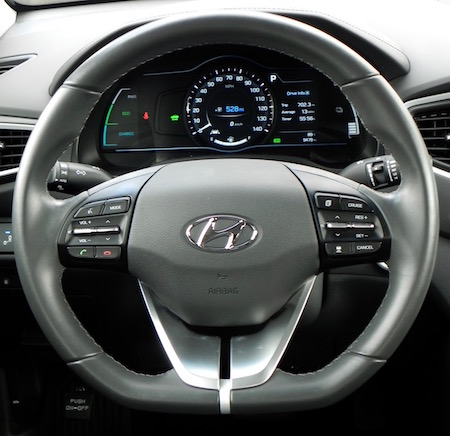
But there is more to the Ioniq than mere powertrain and price. Yes, it’s nice to punch the start button and see the instrument panel light up showing that you have a range of over 550 miles for your use, but I like to have something that looks good sitting in the driveway as well.
No, the Ioniq doesn’t get the juices flowing like having a 911 Porsche sitting outside my house would, but it looks sharp, and it isn’t funkiness that draws the attention.
With its sleek profile and eye-catching exterior, the Ioniq has the appeal of a sports coupe with its flowing lines, bold grille, LED daytime running lights and cat eye-like headlamps featuring HID lights (standard on the Limited trim). The profile may be somewhat reminiscent of the Prius, but the details are a huge step up in sex appeal. It’s a real car, not something a science fiction writer would conjure up.
Inside, the Ioniq has an attractive cabin with high quality materials and operation of technological functions arranged in an intuitive, user-friendly manner. One of Hyundai’s strengths seems to be that its designers take the approach that technology is supposed to simplify and amplify life, not overly complicate it. It works for me for sure.
Standard equipment in the Ioniq Limited includes safety features like blind-spot detection with rear cross-traffic alert and lane-change assist, a rearview camera, 17-inch alloy wheels, a tilt-and-slide sunroof, push-button start, dual climate control, leather seating surfaces, satellite radio capability, Android Auto and Apple CarPlay systems, and Hyundai’s Blue Link system.
Our test vehicle also featured options like an easy-to-operate navigation system, adaptive cruise control, lane departure warning, rear parking sensors, premium audio, and wireless device charging for compatible Smart phones that ran the total MSRP to $31,460.
Driving the Ioniq Hybrid doesn’t fall into the category of “thrilling” but neither is it “boring.” Pleasant might be the the best way to describe it. The 1.6-liter 4-cylinder engine produces 104 horsepower and 109 pound-feet of torque that is augmented by the horsepower electric motor.
Combined net horsepower is rated at 139, which gets to the front wheels via a 6-speed dual-clutch transmission that essentially operates as an automatic. But no paddle shifters. Sigh.
To kick up the fun, you can switch to sport mode and get much quicker throttle responses than the standard zero-to-60 mph time of 8.9 seconds, which is over a second quicker than the 2017 Prius Prime and a half-second faster than the standard 2016 Prius, according to the website zeroto60times.com, though some other sources report slightly slower times for the Ioniq.
 Sport mode also gives a boost to the handling characteristics to add to the driving experience.
The bottom line here really is that with the Hyundai Ioniq Hybrid Limited you forget you are behind the wheel of a traditional gas-electric hybrid, which, to me, is a good thing.
Oh. Keep in mind that there are some differences in what is offered on the Ioniq Plug-In or Ioniq Electric.
What I liked about the 2017 Hyundai Ioniq Hybrid Limited: The technology is really very easy to operate, and the driving experience when put in sport mode is a fun one. Storage room is very good (26.5 cubic feet). The annoying whine that is heard on many hybrids when slowing to a stop isn’t in evidence with the Ioniq.
What I didn’t like about the 2017 Hyundai Ioniq Hybrid Limited: Perhaps because of its hatchback configuration, Hyundai designers haven’t solved the issue of the cross bar that splits the rear liftgate that just about any Prius driver will tell you can be a visual distraction when looking in the rearview mirror.
Would I buy the 2017 Hyundai Ioniq Hybrid Limited? Yes. I’ve not gotten aboard the hybrid bandwagon in the past, but this is one that I certainly wouldn’t mind owning.


 Many of the features that once were available as option packages are now standard on the Limited, including the 10.25-inch screen navigation system, adaptive cruise control with Stop-and-Go, Harmon-Kardon Premium sound system, front parking sensors, lane follow assist, and forward collision avoidance with Pedestrian Detection.