CHEVY EXTENDS DRIVING RANGE TO 259 MILES FOR 2020 ALL-ELECTRIC BOLT WAGONS
Chevrolet was an early player in the plug-in hybrid game of post-2000 with the 2011 Chevy Volt, which at the time was considered revolutionary with an extended range of driving on electric power only for everyday commutes paired with the convenience of a gas engine for longer treks.
Early reaction was mixed.
Environmental groups pretty much loved it for obvious reasons and the panel of judges for Detroit’s North American Auto Show awarded it North American Car of the Year honors for 2011.
But while most automotive reviewers seemed to get what the Volt was all-about, some others in the news media did not. Part of that was because they thought of the Volt as an “electric” vehicle when it really was more of an updated version of the gas-electric hybrid models that had been introduced about a decade before. They pooh-poohed its all-electric range of about 40 miles while ignoring the range anxiety relief the gas engine provided all together.
One cable show host laughed about how his Volt’s battery ran out of charge when he was halfway through the Lincoln Tunnel, giving his co-host the impression that he had been left stranded in a vehicle without power.
Of course, he hadn’t been. What occurred when he used up the battery was that the Volt had seamlessly shifted over to the 4-cylinder gas engine so he could complete his trip.
Frankly, I thought the system was a good way to ease the problem of range anxiety that comes with driving an all-electric car for an extended time. But apparently, I was in the minority.
Chevy ceased production of the Volt over a year ago and is now all-in on its all-electric Bolt EV, which it introduced as a 2017 model. There is no gas engine to extend a trip, but it does have an much-increased electric range of up 259 miles when fully charged, an increase of 21 miles over previous Bolts.
That’s almost five times the 53 miles that was promised for the 2019 Volt when it went out of production.
Classed as a “small wagon,” the Bolt still comes in only two trim levels for 2020. The base LT carries a base MSRP of $37,495 while the upgraded Premier that served as my test vehicle starts at $41,020.
That does not figure in any tax credits the Bolt may earn.
Both trims get the same powertrain with the electric motor putting out 200 horsepower and 266 pound-feet of torque, which are darn good numbers of a car of this size (3,563 pounds, 69.5 wide, and 164 inches long with a wheelbase of 102.4 inches).
That power is delivered to the front wheels via what Chevy calls an electronic precision shift system that operates like a traditional continuously variable transmission and results in a zero-to-60 mph time of 6.5 seconds, according to company clockers.
The Bolt also offers one-pedal driving. When in Low mode, it lets you speed up or slow down using only the accelerator pedal. Press it and you go. Lift your foot and you slow down (and capture some of the power from the moving vehicle to store a bit of electrical energy in the lithium-ion battery pack).
Frankly, it takes a bit of getting used to, which I must confess I didn’t.
In addition to the extended range, two new colors (Oasis Blue and Cayenne Orange Metallic) are available for 2020, and the rear-vision camera and surrounded vision system has been upgrade with high-definition cameras.
Heated front and rear seats are available on the Premier with heated front seats available on the LT with the Comfort and Convenience Package. Leather seats also are standard on the Premier, which gets many of the features from optional packages offered on the LT.
My test 2020 Chevy Bolt Premier came with a $750 Fast-charging option that would seriously cut the charging time you have to contend with using a regular household outlet.
Also, an Infotainment Package includes a wireless charging device, Bose Premium Sound, rear USB charging ports, and a Driver Confidence II Package offers automatic high-beam headlights, following distance indicator, forward collision alert, lane-keeping assist with lane-departure warning, and automatic emergency braking with pedestrian braking.
Those options and the $875 destination and delivery charge ran the final tab to $43,735.
What I liked about the 2020 Chevrolet Bolt EV Premier: It’s kind of a fun car to drive. Throttle response is very quick, and unless you want to take a 260-mile trip, the range is good for everyday driving. The interior also very roomy, and the Premier gets a surround-view camera system included as standard.
What I didn’t like about the 2020 Chevrolet Bolt EV Premier: While designers avoided giving the Bolt’s interior a dorky look in what could have been a vain attempt to make it look “futuristic,” it still has a cheap feel about it. Not expecting luxury here, but an upgrade in some materials would be nice.
Would I buy the 2020 Chevrolet Bolt Bolt EV Premier? Probably not at this time, mostly because I’m not a big fan of all-electric vehicles. I don’t have an advanced charger and have to rely on my household for charging, which can take forever. The Bolt is priced competitively in its segment but still strikes me as a $20,000-plus car that is double the price because of the electric powertrain.
XT5 CROSSOVER SUV TAKES OVER
FOR SRX AS CADILLAC’S SALES LEADER
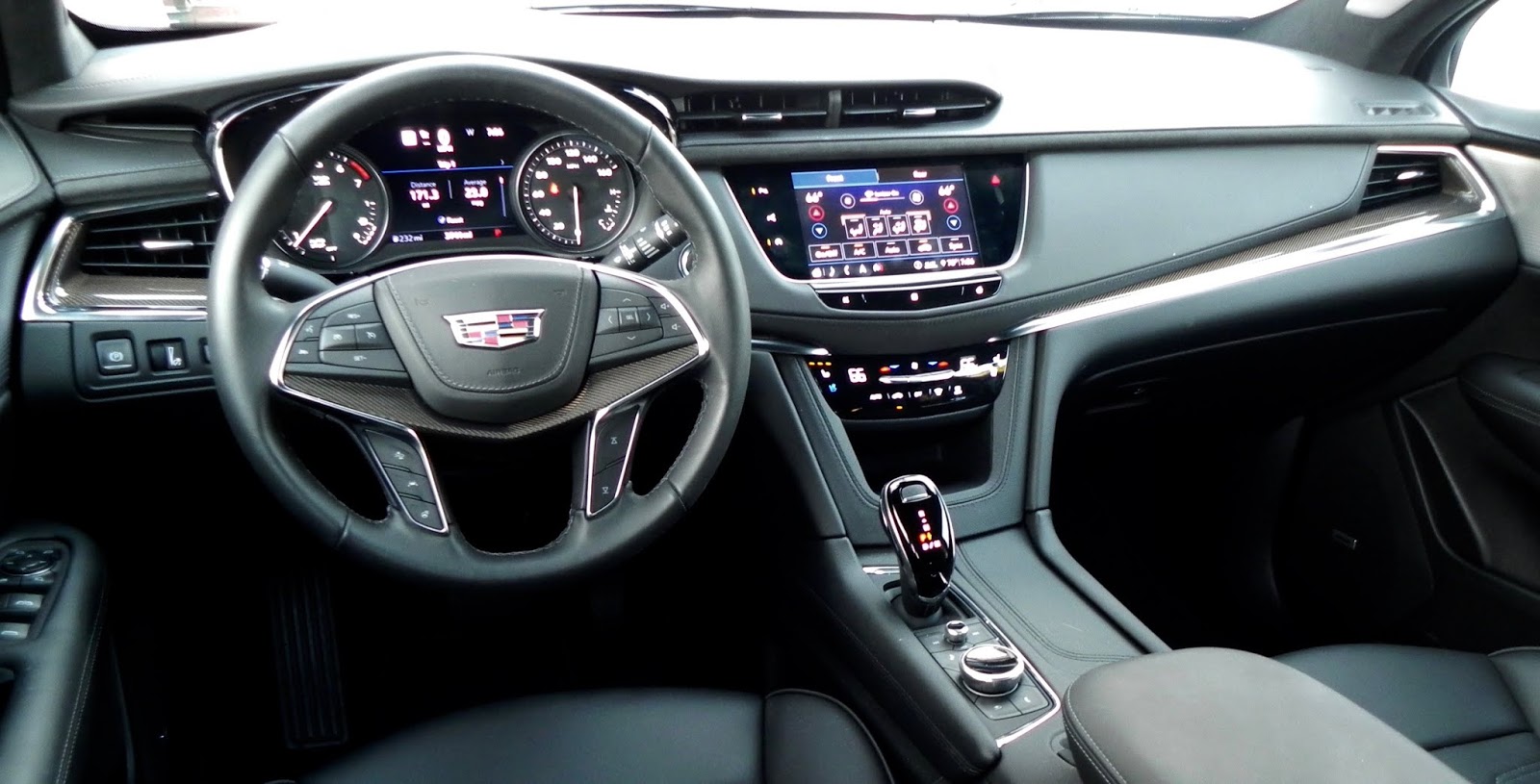
Since the SRX became Cadillac’s best-selling vehicle during its 13-year run, it isn’t surprising that its successor, the XT5 crossover SUV, would assume the same role, and it has.
Though it has yet to match the sales popularity of the SRX, which hit a model sales high of 68,850 for 2015, the next-to-last year of production, the XT5 still outpaced every other Cadillac model with a reported 49,878 sold in the U.S. in 2019. That tops the iconic Escalade (35,424) and its XT4 (31,987) and XT6 (11,560) siblings and easily outpaces the top-selling Cadillac sedans, the XTS (11,306) and CT6 (7,952).
To keep the XT5 on pace with a challenging field of competitors, Cadillac has updated the 2020 model with numerous changes that include new interior color schemes, a revised infotainment system, and a new base engine.
Available only with a V6 at its 2017 debut, the XT5 now comes standard with a turbocharged 4-cylinder engine on Luxury and Premium Luxury trims. It is rated at 237 horsepower and 258 pound-feet. of torque compared to the 310/271, respectively, in the V6 while offering respectable fuel mileage of 21 miles-per-gallon city, 28 highway, and 24 combined.
The V6 is standard on the top-of-the-line Sport trim and also is available on Luxury and Premium Luxury models. Each engine gets its own version of a 9-speed automatic transmission.
The other major change is with the infotainment system. The company’s CUE system (Cadillac User Experience) that was introduced some years back came under heavy criticism for its problems and annoyances and actually was the target of a class action lawsuit last year.
The new system still can take some getting used to, but is a step up from its predecessor, which was overly sensitive, susceptible to sun glare issues, and often slow to respond. It gets Apple CarPlay and Android Auto capability.
This review is based on the Premium Luxury trim that carries a base MSRP of $46,795.
Standard equipment on Premium Luxury models includes the 4-cylinder engine, front-wheel drive (AWD is available), 18-inch wheels, SiriusXM satellite radio capability, Bose premium audio, automatic dual-zone climate control, heated front seats, LED headlights and taillights, LED daytime running lights, leather seating surfaces, 8-way power adjustable driver’s seat and 6-way adjustable front passenger seat with lumbar support, heated steering wheel, sunroof, wireless charging and a bevy of safety features that include automatic emergency braking, forward collision alert, and front and rear parking assist.
An optional Platinum Package upgrades the leather seats for all rows and adds a suede headliner among other things for an extra $4,850.
Other options on my test XT5 were a technology package that features a surround-view camera; a driver assistance package that includes lane-keeping assist and adaptive cruise control; a comfort package that includes tri-zone climate control and ventilated front and rear seats, and navigation with the CUE infotainment system.
It also came with 20-inch wheels over the standard 18s.
The issue there, of course, is that all those options and packages added nearly $14,000 to the base MSRP before the $995 destination and delivery charge was added.
What I liked about the 2020 Cadillac XT5 Premium Luxury: The turbo-4 engine delivers adequate power in a fuel efficient manner. The overall ride is quiet and comfortable and well up to what you expect from a Cadillac. The XT5 also comes in at the right size — not too big and not too small. Cadillac added a button to deactivate the stop/start system.
What I didn’t like about the 2020 Cadillac XT5 Premium Luxury: The console storage compartment is too small, especially considering what you typically have with an SUV. The 8-inch touchscreen also is a bit on the small side by today’s standards.
Would I buy the 2020 Cadillac XT5 Premium Luxury? Not sure, but I’d definitely give it a look if I were shopping in the segment. Like many others, I really liked the SRX, much more than the Escalade. Desirable options oquickly drive the final cost up and take away from the XT5’s price advantage, however. The bottom line for my test XT5 was $63,715.
AFTER SPECTACULAR DEBUT, HYUNDAI KONA SUBCOMPACT SUV PRETTY MUCH HAS IT ALL
Introduced as a 2018 model, the Hyundai Kona subcompact SUV wasted little time making an impression when judges at the North American Auto Show in Detroit selected it as the 2019 North American Utility Vehicle of the Year, making it the first in its class to be so honored.
Previous winners of the award created in 2017 to go with Car of the Year and Truck of the Year were the Volvo XC60 and the reintroduced Chrysler Pacific and the winner for 2020 was the Kia Telluride, all larger and higher priced than the spunky little vehicle that gets its name from the west coast of the big island of Hawaii.
Slotted between the new smaller Venue and the slightly larger Tucson in the South Korean automaker’s SUV/crossover lineup, the Kona comes in five trims for 2020.
The base SE starts at $20,300, the SEL $22,100, and the SEL Plus (added after the initial launch) $23,950 in front-wheel-drive configuration with each getting a 2.0-liter, 4-cylinder engine mated with a 6-speed automatic transmission.
The Kona Limited and Kona Ultimate on which this review get a 1.6-liter turbocharged 4-cylinder engine mated with a 7-speed double-clutch transmission and carry starting MSRPs of $26,100 and $27,950, respectively, for FWD models.
AWD adds $1,400 to each of the trims.
The good thing, especially if you have trouble making decisions, is that the prices include all but the destination and delivery charge of $1,095 and small extras like carpeted floor mats ($135).
Instead of confusing option and optional features to a trim, the standard equipment list keeps expanding as you move up the line.
Thus from such standard features on 16-inch alloy wheels, lane-keeping assist, driver attention warning, rear-view monitor with parking guidance, LED daytime running lights, remote keyless entry, tilt-and-telescoping steering wheel, power windows, a 7-inch LCD touchscreen displays and a cargo area cover on SE models moving up to the top-of-the-line Ultimate gets you 18-inch alloy wheels, LED headlights and taillights, proximity key with push-button start, leather seats with leather-wrapped steering wheel and shift knob, a head-up display, 8-inch color touchscreen with navigation, and rain-sensing wipers.
Parking distance warning and forward collision avoidance with pedestrian detection also are among standard safety features on the Ultimate model. For 2020, Hyundai made adaptive cruise control standard for the Ultimate.
The 1.6L turbo engine gives the Kona a much livelier performance than the 2.0L on the SE, SEL, and SEL Plus trims. It is rated at 175 horsepower and 195 pound-feet of torque compared to the 147/132 numbers on the normally aspirated 4-bangers with a negligible difference in fuel economy numbers.
Both engines drink regular gas with the 1.6L turbo rated at 28 miles-per-gallon city, 32 highway and 30 combined on FWD models compared to 27/33/30 for the 2.0L AWD drive trims. With AWD, the numbers are 26/29/27 for the 1.6L turbo and 26/30/28 the 2.0L.
As I said, a negligible difference.
You can tailor your driving mode depending on your mood. Feeling frugal? Normal mode prioritizes fuel economy over performance. Feeling frisky? Sport mode adds to more rapid get-off-the-line responses and earlier downshifts when braking.
I didn’t drive the 2.0L engine, but splurging for the 1.6L turbo would seem to be worth the extra cost. Zeroto60times.com did not have a listing for the 2020 model but the 2019 Kona Ultimate with AWD was clocked at a respectable 6.3 seconds, making the Kona one of the zippiest in its class.
The overall ride is comfortable and quiet enough, and the simplicity of the infotainment operation makes it even more so, especially when going solo.
Cabin comforts for the 5-passenger Kona are first-rate with none of the feeling of cheapness you often get from vehicles at the low-end of the pricing chart. Ultimate and Limited editions get leather seats, which adds to the ambiance.
All models also get Android Auto and Apple CarPlay among standard tech features, and SEL Plus, Limited, and Ultimate also come with Blind Spot Warning and a three-year subscription to Hyundai’s Blue Link connectivity services.
I should also mention here that the Kona also is available with an electric drivetrain, but that is a separate model. It has an estimated range of 258 miles on a full charge.
What I liked about the 2020 Hyundai Kona Ultimate: The Kona comes with a lot of standard technology and other features that make for a very comfortable fit while keeping the MSRP well under $30,000. As usual with vehicles from the South Korean automaker, the tech functions are very user friendly and take very little getting used do. Features like lane-keeping assist and driver assist are not overbearing as on some competitors.
What I didn’t like about the 2020 Hyundai Kona Ultimate: The back seat is a bit cramped (less than 35 inches of legroom) and there isn’t a lot in the way of cargo room (19.2 cubic feet) for its class. That’s more than found on your usual sedan (even full-size models) but barely more than what the smaller Venue offers.
Would I guy the 2020 Hyundai Kona Ultimate? Yes. It’s among the best in its class and offers a ton of features at a competitive price. If you want to get away from a sedan (as many buyers are) but are shying away from a larger SUV/crossover, this may be perfect for you.
FORD F250 KEEPS WORKHORSE CAPABILITY WITHOUT SACRIFICING COMFORT OR STYLE
Heavy duty pickups are not for everyone, not even all truck enthusiasts, but if you really do need a bigger truck, the Ford’s 2020 F250 Super Duty certainly should be on your shopping list.
Available in six trims (XL, XLT, Lariat, King Ranch, Platinum, Limited), the F250 offers the choice of three powertrains, including a new gas V8, a choice of three cabs (Regular, SuperCab, or Crew) and two bed lengths (6.8 or 8.2 feet). It also is offered in 4X2 (rear-wheel) or 4X4 drive configuration.
A real workhorse, the F250 lists a conventional towing capacity of up to 20,000 pounds, depending on the engine. cab configuration and box, and a maximum payload of over 4,200 pounds, which is a little more than you’re going to need for those weekend Home Depot/Lowe’s runs.
According to Ford, maximum capacity for conventional towing with the F150 is 10,500 pounds, though that goes up to 12,500/13,200 in select configurations and wheels/tires.
The new 7.3-liter V8 engine in the F250 is mated to a 10-speed automatic transmission featuring normal, tow/haul, eco, and deep sand/modes. It is rated at 430 horsepower and 475 pound-feet of torque for extra punch.
A 6.2-liter V8 is rated at 385 horsepower and and 430 pound-feet of torque and is mated to a 6-speed automatic transmission only, not the 10-speed.
The 5.7-liter diesel V8 gets the 10-speed tranny, however, and is rated at 485 hp and a whopping 1,050 lb.-ft of torque! That’ll tow your boat!
All that power and capacity may be what separates the F250 from its popular smaller brother, the F150, but it is not the only thing the former has in its favor. While heavy duty pickups of the past were relatively short on creature comforts, the new F250 has all the trappings of a high-end family SUV.
Technological features available include Ford’s Pro Trailer Backup Assist for getting trailers into tight spaces. Trailer Reverse Guidance shows the trailer angle and direction while providing steering assists. Ford says the systems accommodate all trailer styles, including conventional, fifth-wheel, and gooseneck designs.
With its 4G LTE modem, standard FordPass Connect provides Wi-Fi access for up to 10 devices as well as wireless charging and charging through USB-C ports. Other features like lane-keeping alert, blind spot information, and pre-collision assist with automatic emergency breaking also are available as well as standard on some trims.
When it comes to standard equipment, XL models are fairly bare-bones (windows are manual) but include A/C, vinyl upholstery, telescoping tow mirrors, and a four-speaker sound system, but the list expands as you go up the line.
High-end models include as standard such niceties as power windows, power adjustable seats, the Sync3 infotainment system, power retractible side steps and power tailgate, and adaptive cruise control.
Limited trims up the comfort ante with two-tone genuine leather interior, wood and brushed aluminum trim, and decorative stitching on the leather-wrapped instrument panel top, leather-wrapped armrests and center console lid. A suede headliner adds a touch of class to the cabin
Lariat and King Ranch also add distinctive design touches.
If you’re taking your 4X4 vehicle off road, Ford has a new Tremor off-road package with enhanced features to add to its capability with suspension updates and Super Duty Tremor Control for rock crawls.
That, of courses, jacks up the bottom line considerably from about $34,800 for the XL 4X2 regular cab to well over $60,000 or even $80,000 for loaded high-end trims and specialty models.
What I liked about the 2020 Ford F250 Super Duty pickup: The F250 is a great highway/expressway cruiser, and the interior is exceptionally nice. Gone are the days when comfort took a backseat to work chores in pickups. The Sync (XL) and Sync3 (other trims) infotainment systems are very user-friendly.
What I didn’t like about the 2020 Ford F250 Super Duty pickup: I don’t like having to wrangle a vehicle of this size around mall parking lots or through narrow city streets. Fortunately, the mirrors fold in for particularly tight squeezes.
Would I buy the 2020 Ford F250 Super Duty pick? It’s not for me and probably most pickup buyers, but not because it isn’t a good vehicle. It is. But the need for a Super Duty pickup isn’t going to be there for most consumers. Ford’s F150 fills the bill for them. But if you need the extra power to tow your yacht, the F250 will do it for you in style.
FORD UPDATES MUSTANG SPORTS COUPE WITH MID-CYCLE REFRESHING FOR 2020
Every car enthusiast should have a Ford Mustang sometime in their life, and, with the possible exception of the debut 1964 1/2 model or the original Fastback that starred in the 1968 movie Bullitt (more on that later), there may be not better time for that than now.
For 2020, Ford has continued to build on the 2015 redesign that moved the Mustang into its sixth generation with up to nine variants of the famed coupe and convertible filling out this year’s Pony portfolio.
New to the lineup is a High-Performance, 2.3-liter turbocharged EcoBoost model that puts to shame the 4-cylinder versions from the 1970s and ’80s with performance numbers of 310 horsepower and 350 pound-feet of torque, which, according to the automaker, makes it the most powerful 4-cylinder sports car from an American manufacturer.
Even without the High Performance Package, which also includes aero, suspension and brake components from the Mustang GT Performance Package offered on the new, top-of-the-line Shelby GT500, the base EcoBoost model rates numbers of 310 hp and 350 lb.-ft.
Those figures may not match up to the 760/665 horsepower/torque from the supercharged Shelby GT500, but they’re enough to give the 2.3L High Performance Mustangs the kind of performance that separates it from the crowd when it comes to crowded city streets.
Mated with a 10-speed automatic transmission with paddle shifters, the 2.3L High Performance Mustang delivers EPA ratings of 20 miles-per-gallon city, 28 highway or 20/27 with the standard 6-speed manual.
While performance is likely its top attraction, the new Mustang also offers more in the way of creature comfort features than it did in the past. Ford once seemed to take the notion that having a pony logo in the front grille and on the steering wheel hub was enough in itself, but that isn’t true any more.
The interior is more refined with better fit and finish and fewer rattles and hard surfaces than in the past. Ford also has made the FordPass Connect system standard across the line, allowing owners to check the status of their vehicles or find them and even lock or unlock the cars via their Smartphone. Models with an automatic transmission also come with remote start.
Ford’s Sync3 system also is available offering enhanced voice recognition, 911 Assist, and two smart-charging USB ports. Even the standard base Sync with Applinks is one of the best infotainment systems on the market.
LED headlights with auto on/off, LED daytime running lights, and LED taillights are standard throughout the line. Also included among standard features are a leather-wrapped steering wheel with cruise and audio controls, tilt-and-telescoping steering wheel, and push-button start.
Four new exterior colors also are offered for 2020 models, including a spectacular Rapid Red (formerly Red Hot) Metallic Clearcoat.
The Mustang comes in a variety of trims that can fit just about any budget. The base EcoBoost (without the High Performance package) starts at $27,765 with the High Performance Package taking the final tab to over $32,000.
For Sheby GT500 models with the Supercharged V8 engine, you can more than double that.
There’s also a Bullitt model, and at $47,705, it’s a lot less dough than the $3.4 million the original Mustang from the movie sold for at a Mecum Auctions event in January.
What I liked about the 2020 Ford Mustang Ecobost 2.3L: The cabin has been seriously upgraded with quality materials over earlier models, and the Sync system for infotainment features is easy to operate and responds readily to voice commands. It’s nice to have knobs to adjust the A/C temp/blower and radio. It may only be a 4-cylinder, but its exhaust notes sing Mustang’s distinctive sweet tune.
What I didn’t like about the 2020 Ford Mustang Ecobost 2.3L: At 4.2 inches, the screen in the middle of the center stack is on the small side, which is OK for displaying radio station frequencies and similar functions but not so good to show images from the backup camera. The backseat is really tight. Even the claimed 29 inches of legroom seems overly generous.
Would I buy the 2020 Ford Mustang Ecobost 2.3L? In a heartbeat.
HYUNDAI IONIQ OFFERS BUYERS CHOICE
OF THREE FUEL-EFFICIENT POWER TRAINS
About at the midpoint of its first generation that was introduced for the 2017 model year, Hyundai’s 2020 Ioniq hatchback gets a refreshing that keeps it at the forefront of its class.
It is offered with one of three, fuel-sipping powertrains — traditional gas-electric hybrid, plug-in hybrid, and all-electric — and at prices that, at least by today’s standards, won’t break your bank account.
The Ioniq (Hyundai prefers IONIQ but I’m running low on capital letters) Hybrid starts at $24,155 (including delivery charges) for the base Blue trim. Upgraded SE models start at $26,105, SEL at $29,355, and the top-of-the-line Limited at $31,155.
The Hybrid comes with with a 1.6-liter 4-cylinder gas engine combined with a 32-kW electric motor mated to a 6-speed, dual-clutch transmission that shifts so smoothly you might think it is a CVT.
Horsepower and torque numbers for the combined gas-electric system are 139 horsepower and 195 pound-feet, respectively, with fuel economy checking in a 55 miles-per-gallon city and 54 highway, saving you an estimated $3,750 in fuel costs over a 5-year period (if you trust the government’s numbers).
The Hybrid Blue gets a slightly higher fuel number (58 mpg), and the Plug-In offers a bit more horsepower (156) but the same torque number (195). The Plug-In has a top all-electric range of 29 miles, but the Electric Ioniq claims a range of 170 miles.
MSRPs for the Ioniq Plug-In are $27,230 (SE), $30,230 (SEL), and $36,380 (Limited). MSRPs for the Ioniq Electric are $34,000 (SE) and $39,560 (Limited).
This review is based on the Hybrid HEV Limited.
Hyundai gave all trims upgrades such as a new grille, new front and rear bumper fascias, LED head, tail, and daytime running lights, new wheel designs, and new side sill moldings for 2020.
Interior enhacements include a new console upper cover, new center LCD information screen, dark chrome instrument panel trim, touchdown heating and cooling controls, and new ambient lighting.
Some of the touchscreen controls can be a bit fussy, and I resorted to using the voice command system to change radio stations and that worked fine.
 Many of the features that once were available as option packages are now standard on the Limited, including the 10.25-inch screen navigation system, adaptive cruise control with Stop-and-Go, Harmon-Kardon Premium sound system, front parking sensors, lane follow assist, and forward collision avoidance with Pedestrian Detection.
In addition, no charge features on the Limited include 17-inch alloy wheels, blind-spot alert, power tilt-and-slide sunroof, an electric parking brake, auto hold, power driver’s seat with lumbar support, leather seating surfaces, heated front seats, ambient LED lighting, cargo cover, Android Auto and Apple CarPlan, and Hundai’s Blue Link connectivity system (think OnStar).
 The Ioniq has a nicely appointed, spacious interior with up to 42.2 inches of legroom up front and 35.7 for the second row.
Cargo space is a generous 23.5 cubic feet, a big plus over hybrid sedans.
All in all, the Ioniq has to be on your list if you are searching for a hybrid that looks mainstream.
What I liked about the 2020 Hyundai Ioniq HEV Limited: Superb exterior styling and a roomy interior featuring high-quality materials rate high. The plentiful technological features are all user-friendly. The ride is smooth and comfortable, and fuel mileage is excellent.
What I didn’t like about the 2020 Hyundai Ioniq HEV Limited: Road noise seemed to be on the high side, but it’s not a big issue. A bit more healthier throttle response would be nice, but performance is livened up when in Sport mode.
Would I buy the 2020 Hyundai Ioniq HEV Limted? Yes. Few hybrid-only vehicles have the all-around sex appeal that the Ioniq does. Most simply look dorky perhaps in a futile attempt to project a futuristic image.