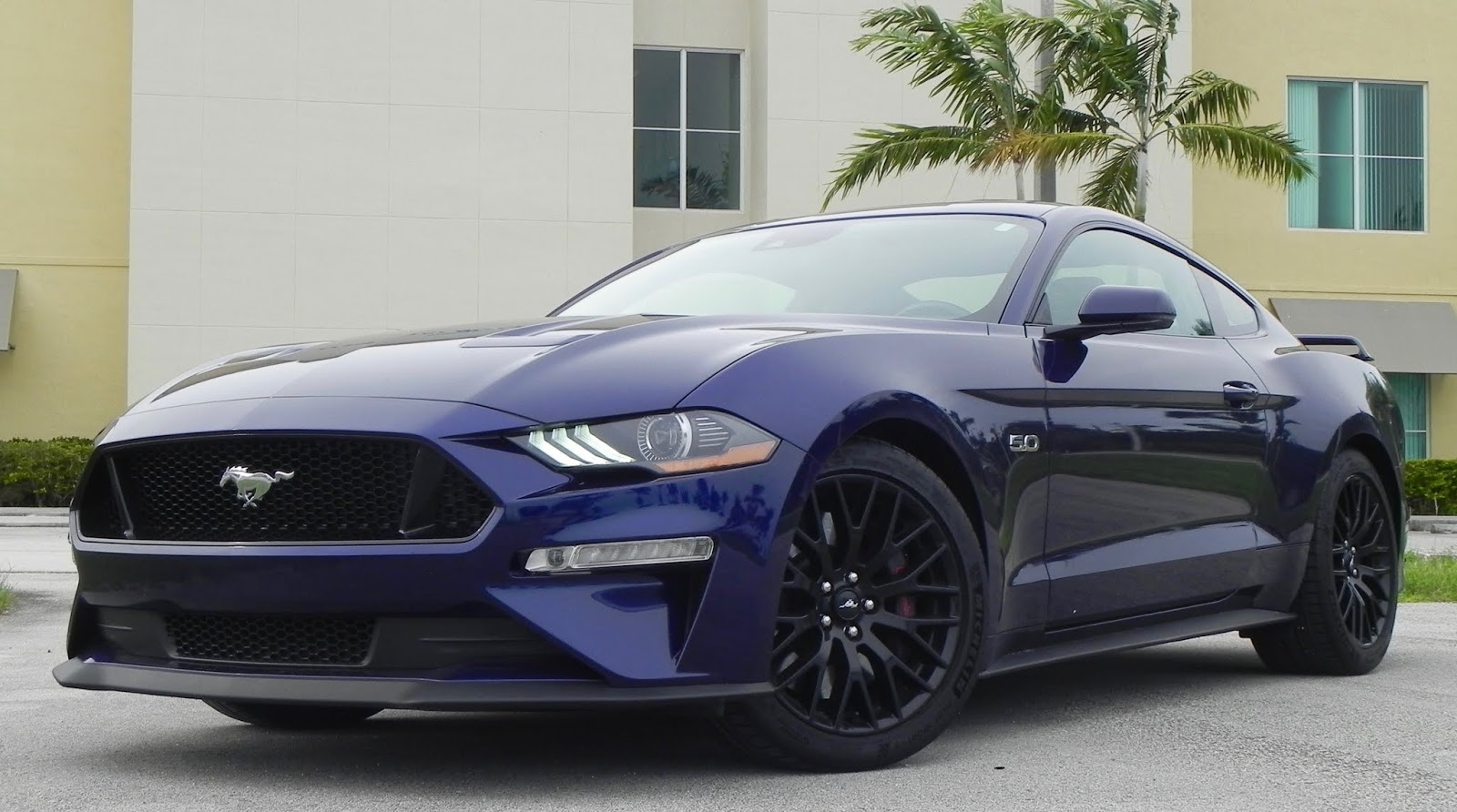
Showing posts with label Mustang. Show all posts

Thursday, June 11, 2020


2020 FORD MUSTANG CONVERTIBLE LIVES UP TO ITS GLORIOUS PONY CAR PAST


It was unveiled at the 1964 New York’s World Fair and made its movie debut the same year in the James Bond flick Goldfinger.

It appeared on the covers of Time and Newsweek and was featured in commercials that ran simultaneously on all three television networks the night before it went on sale.

Almost 22,000 were sold the first day and over 400,000 in its first year, about four times what was expected, and hit the million mark in production just two years after being launched.

We’re talking here about the Ford Mustang, of course, which at 56 years old retains all the vibrancy and energy of a 20-something halfway through a case of Red Bull.

Even with COVID-19 fears slowing auto sales, the Mustang still came through with positive numbers for the first quarter of 2020. Ford, which suffered a decrease of 13.2 percent in sales for its fleet overall and a dip of 37.6 percent for its cars, reported an increase of 6.8 percent to 18,069 vehicles for the Mustang in the first three months of this year.
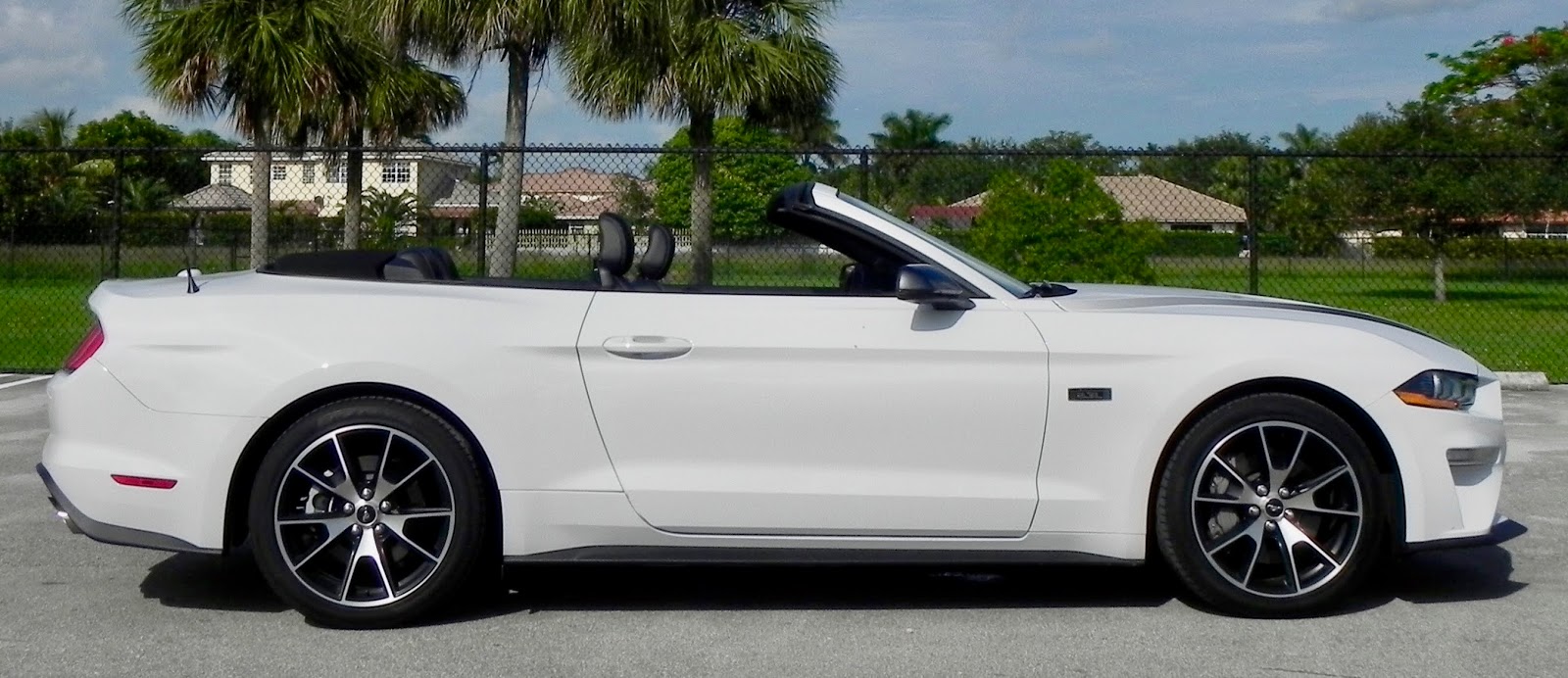

Apparently, though at one point in its over five-decade history the Mustang seemed to be slipping with blah styling overall and a lifeless 4-cylinder as a base engine, that is no longer the case. The 2020 model very much lives up to the Mustang’s glorious past in both its retro styling and upgraded performance.

Ford has added a new High Performance Package to its Ecoboost models that boosts power for the turbocharged 4-cylinder engine to 330 horsepower and 350 pound-feet of torque, which the company claims makes it the “most powerful four-cylinder sports car by an American automaker.”


The Shelby GT500 model sits at the top of the performance heap with 760 hp and 675 lb.-ft., but the 2.3L Ecoboost 2.3L model with the High Performance package delivers a very satisfying zero-to-60 mph time that Ford says is in the mid-four-second range when on premium fuel. Top speed is increased to 155 mph, a 10-mph gain over the 2019 EcoBoost Performance Package and 34 mph faster than the base EcoBoost Mustang.

Ford has given the Mustang’s interior a more refined ambiance with leather-trimmed seats and leather-wrapped steering wheel as well as dual-zone climate control.


It also has simplified the top operation for the convertible that served as my test model. You simply need to release one latch and then press a button at the top of the windshield and the top lowers or raises in just a few seconds. (But you must be completely stopped.)

My test vehicle also came with the 6-speed manual transmission which adds to the fun, but if three-pedal driving is not your thing, a 10-speed, SelectShift automatic is available.


Fuel efficiency, by the way, is listed at 20 miles-per-gallon city, 27 highway, 23 combined with the manual and 20/28/23 with the automatic.

Other standard equipment on this 2020 Mustang 2.3 High Performance convertible included LED headlights with signature lighting, LED fog lamps, LED taillights with sequential turn signals, dual exhaust, push-button start, steering wheel buttons for cruise and audio control, two Smart charging USB ports, tilt-and-telescoping steering wheel, Ford Pass/Connect wth 4G Wi-Fi, Sync3 infotainment system, and track apps.


Additional features on my test car included the 2.3L High Performance Package, hood accents and a carbon-fiber sport interior trim package.

Alas, pricing to cover all that was not listed on the spec sheet, but the MSRP for the Ecoboost 2.3L High Performance starts at $38,380 including destination and delivery charges. Figure the extras will take it over the $40,000 mark.

What I liked about the 2020 Ford Mustang Convertible 2.3L: You don’t have to go for the V8 if you want a lively performance. Though the GT packs a bigger punch, the Ecoboost 2.3L is pretty sprightly, especially with the manual transmission. The exhaust tone remains one of the sweetest in the industry, and it has a pretty good size trunk (11.4 cubic feet) for a convertible. Lowering the top involves releasing just one clamp manually and pushing a button. The standard Sync3 infotainment system with an 8-inch display is very user friendly

What I liked about the 2020 Ford Mustang Convertible 2.3L: Not a lot of room in the backseat, of course, and rear vision is somewhat restricted when the top is up. A flat-bottom steering wheel would be appreciated to ease getting into the driver’s seat. It can be kind of tricky, especially if there is a car parked or other object close to the left.

Would I buy the 2020 Ford Mustang Convertible 2.3L? In a heartbeat. I’ve owned only one Mustang in my life. Why stop there?


Tuesday, March 10, 2020

FORD UPDATES MUSTANG SPORTS COUPE WITH MID-CYCLE REFRESHING FOR 2020


Every car enthusiast should have a Ford Mustang sometime in their life, and, with the possible exception of the debut 1964 1/2 model or the original Fastback that starred in the 1968 movie Bullitt (more on that later), there may be not better time for that than now.

For 2020, Ford has continued to build on the 2015 redesign that moved the Mustang into its sixth generation with up to nine variants of the famed coupe and convertible filling out this year’s Pony portfolio.


New to the lineup is a High-Performance, 2.3-liter turbocharged EcoBoost model that puts to shame the 4-cylinder versions from the 1970s and ’80s with performance numbers of 310 horsepower and 350 pound-feet of torque, which, according to the automaker, makes it the most powerful 4-cylinder sports car from an American manufacturer.

Even without the High Performance Package, which also includes aero, suspension and brake components from the Mustang GT Performance Package offered on the new, top-of-the-line Shelby GT500, the base EcoBoost model rates numbers of 310 hp and 350 lb.-ft.


Those figures may not match up to the 760/665 horsepower/torque from the supercharged Shelby GT500, but they’re enough to give the 2.3L High Performance Mustangs the kind of performance that separates it from the crowd when it comes to crowded city streets.

Mated with a 10-speed automatic transmission with paddle shifters, the 2.3L High Performance Mustang delivers EPA ratings of 20 miles-per-gallon city, 28 highway or 20/27 with the standard 6-speed manual.

While performance is likely its top attraction, the new Mustang also offers more in the way of creature comfort features than it did in the past. Ford once seemed to take the notion that having a pony logo in the front grille and on the steering wheel hub was enough in itself, but that isn’t true any more.

The interior is more refined with better fit and finish and fewer rattles and hard surfaces than in the past. Ford also has made the FordPass Connect system standard across the line, allowing owners to check the status of their vehicles or find them and even lock or unlock the cars via their Smartphone. Models with an automatic transmission also come with remote start.


Ford’s Sync3 system also is available offering enhanced voice recognition, 911 Assist, and two smart-charging USB ports. Even the standard base Sync with Applinks is one of the best infotainment systems on the market.

LED headlights with auto on/off, LED daytime running lights, and LED taillights are standard throughout the line. Also included among standard features are a leather-wrapped steering wheel with cruise and audio controls, tilt-and-telescoping steering wheel, and push-button start.


Four new exterior colors also are offered for 2020 models, including a spectacular Rapid Red (formerly Red Hot) Metallic Clearcoat.

The Mustang comes in a variety of trims that can fit just about any budget. The base EcoBoost (without the High Performance package) starts at $27,765 with the High Performance Package taking the final tab to over $32,000.

For Sheby GT500 models with the Supercharged V8 engine, you can more than double that.

There’s also a Bullitt model, and at $47,705, it’s a lot less dough than the $3.4 million the original Mustang from the movie sold for at a Mecum Auctions event in January.  


What I liked about the 2020 Ford Mustang Ecobost 2.3L: The cabin has been seriously upgraded with quality materials over earlier models, and the Sync system for infotainment features is easy to operate and responds readily to voice commands. It’s nice to have knobs to adjust the A/C temp/blower and radio. It may only be a 4-cylinder, but its exhaust notes sing Mustang’s distinctive sweet tune.

What I didn’t like about the 2020 Ford Mustang Ecobost 2.3L: At 4.2 inches, the screen in the middle of the center stack is on the small side, which is OK for displaying radio station frequencies and similar functions but not so good to show images from the backup camera. The backseat is really tight. Even the claimed 29 inches of legroom seems overly generous.

Would I buy the 2020 Ford Mustang Ecobost 2.3L? In a heartbeat.


Saturday, February 2, 2019


FORD MUSTANG MAY BE GROWING OLDER, BUT STILL EXUDES A FUN-LOVING ATTITUDE


Ford's Mustang will soon reach “senior status” as its 55th birthday fast approaches, but it still is very much the same young-at-heart vehicle as when it was unveiled at the New York World’s Fair on April 17, 1964.

Especially in convertible form, the 2019 Ford Mustang exudes the same “life is short, have fun” image evoked by those early Mustangs, which fans dubbed 1964 1/2 models because of the timing of the launch. (For the record, Ford, which took orders for 22,000 Mustangs that first day, had advertised it as a 1965.)

That’s no doubt an important part as to the Mustang’s ability to survive for over five decades without a break in production, but not, I think, the only key.

So to is its versatility.


If you want to experience the full effect of what the Mustang offers in the way of a traditional America Muscle Car, you should go for the Mustang GT with a 5.0-liter V8 under the hood pumping out 460 horsepower and 420 pound-feet of torque to its rear wheels via a 6-speed manual transmission and the dual exhaust emitting all the proper sounds.

You can go full bore with the Bullitt coupe model that marks its return for 2019 or the Shelby GT350, each with a 5.2-liter V8 rated at 526 hp and 429 lb.-ft. of torque.


But if a price that starts at over $46,000 is out of your league (as it is mine), or you want something a little less thirsty than a V8 that drinks premium fuel at the rate of 15 miles-per-gallon city and 24 highway, the Mustang also is offered with a 2.3-liter 4-cylinder Ecoboost engine that boosts those figures to 20/28 while still delivering a lively driving experience.

This is not the sluggish 4-cylinder introduced in the Mustang II back in the 1970s and phased out in 1993. Far from it. It actually led to Ford’s phasing out of the V6 that once served as the base engine in the updating Ford gave the Mustang for 2018.


Using premium fuel, the Ecoboost-4 is rated at 310 horsepower at a peak 5500 rpm with maximum torque of 350 pound-feet at 3000, so it is no slouch. It has been clocked with a zero-to-60 mph time of less than a second off the V8’s 4.6 seconds.

Of course, the Mustang also is noted as much for the V8’s throaty sounds as it is looks and performance, and you can still get that with the Ecoboost by adjusting the exhaust to one of four settings — Quiet (for a late night arrival in the neighborhood), Normal, Sport, or Track.


My test Mustang convertible came with the a 10-speed automatic transmission that shifted so smoothly you’d have thought it was a CVT (thankfully, it wasn’t). You can also shift gears manually via the usual steering wheel-mounted shifters, 

Inside, Ford has given the Mustang several upgrades. It seats four, if not in luxury at least in comfort without the Spartan-like ambiance of past models. You still have to crank a latch at the top of the windshield for lowering or securing the soft top, but it’s an easy operation.

Standard equipment in the Premium version includes headlamps with LED signature lighting, LED taillights with sequential turn signal lighting, 12-inch LCD instrument cluster, dual zone electronic climate control, leather-trimmed seats and leather-wrapped steering wheel, two Smart charging USB ports, tilt-and-telescoping steering wheel, keyless access and push-button start, selectable drive modes (Sport adds to the experience), and Ford’s Sync3 infotainment system, which I found very user-friendly.

All that is covered in the starting MSRP of $37,355 (including $995 destination and delivery).

A couple of options, a package that included navigation, the automatic transmission, and a rear deck spoiler, ran the total of my test vehicle to $42,440.


What I liked about the 2019 Ford Mustang Convertible: Hey! It’s a convertible! What’s not to like? OK. The turbo-4 engine offers a bit of practicality to go with a fun driving experience. The capability of setting the exhaust notes to your personal taste (Normal, Quiet, Sport, Track) also is a nice feature.

What I didn’t like about the 2019 Ford Mustang Convertible: It’s a given that the back seat is going to be cramped since it’s a convertible, but it's also extra difficult to get back there, especially with the top up. Trunk volume is only 11.4 cubic feet, but you don’t need to make any special adjustments before lowering the cloth top.

Would I buy the 2019 Ford Mustang Convertible? Sure would. U.S. News & World Report ranks it right behind the Mazda Miata in sports cars. But with those two vehicles being so different, the Mustang essentially is No. 1 in its class.


Friday, June 8, 2018


FORD GIVES ICONIC MUSTANG MID-CYCLE REFRESHING FOR 2018; THEY GOT IT RIGHT


Having moved it into its sixth generation with a makeover for 2015 that carried over the retro design theme first revealed a decade earlier, Ford has given the iconic Mustang a mid-cycle refreshing for 2018.


Included among new features the company notes are a more powerful 5.0-liter V8 engine that is mated with an all-new 10-speed automatic transmission, new driver-assist technologies like Pre-Collision Assist with Pedestrian Detection and SYNC Connect, as well as refreshed front- and rear-end designs that result in a more aggressive look while improving aerodynamics for more confident handling and improved fuel economy.

With Ford announcing it is pulling out of the sedan market, it will be up to the Mustang to carry the company’s load in the traditional coupe-sedan passenger vehicle segment once the Focus morphs into the Focus Active Crossover for 2019.

To which we say, Hooray!


Not necessarily for the disappearance of the Taurus, Fiesta, Fusion, and the Focus compact sedan but for the continued existence of the king of the Pony Cars, the Mustang.

An immediate success at its launching when 22,000 were ordered on the first day of sales on April 17, 1964, and two million sold by March 1966, the Mustang continues to be a fan favorite.


Ford reports that the Mustang has been the world’s most popular sports coupe for the last three years with the 2018 model playing a key role in that momentum.

Keeping things fresh while not forgetting its roots — as the company did with the Thunderbird  — is a key.


In addition to the changes already note, Ford also dropped the V6model from the 2018 lineup, leaving Mustang aficionados with a choice of a fuel-efficient turbo-4 (21 mpg city/31 mpg highway) or a robust 5.0-liter V8 that is rated at 460 horsepower and 420 pound-feet of torque that can get you from zero-to-60 mph in less than four seconds when in enhanced, drag strip mode, according to Mustang chief engineer Carl Widmann.

Those horsepower and torque numbers are up from the 435/400, respectively, of the previous V8 Mustang.


I drove the Ecoboost 4-banger convertible last summer (see the July blogs for my thoughts on it) and generally found it to be a very capable performer.

But let’s face it. Muscle Cars are about the big bang, and that’s why I would recommend the V8.


Of course, it’s more expensive with the Ecoboost I4 carrying a base MSRP of $25,680 while the GT Fastback checks in at $35,190. The more upscale GT Premium Edition adds another $4,000 to that number, but makes for a slightly more sophisticated vehicle than your standard Muscle Car. It’s just nice, period.

Adjustments for such functions as ambient interior lighting (you can personalize the colors) and exhaust sound ranging form quiet to track can be made through the information display in the middle of the instrument panel.

You can also change what info is displayed there. If you want your trip and fuel mileage displayed or prefer gauges to keep you updated on oil pressure and water temperature, you can set the display to that.


Among standard features on the GT Premium are leather seats and leather-wrapped tilt and telescoping steering wheel with cruise and audio controls, dual zone climate control, capless fuel filler, LED headlamps and tail lamps, LED fog lights, intermittent wipers, quad tip dual exhaust, push-button start, and a rear-view camera with guidelines.


Optional equipment includes adaptive cruise control, blind-spot warning with cross traffic alert, a Shaker 12-speaker sound system, 19-inch wheels, and a GT Performance Package. The latter adds $4,000 to the cost, but will help you get the most out of your ride.

What I liked about the 2018 Ford Mustang: The Ford people definitely got it right with this incarnation of the classic Pony Car. It looks fast even standing still, and the ability to tune the Performance Exhaust system to your liking (normal, sport, track, and quiet modes) via the digital instrument display is a great feature. It has a pretty good size trunk (13.5 cubic feet) for a coupe.


What I didn’t like about the 2018 Ford Mustang: The backseat is almost useless. It is suitable for children only, and not very big ones at that. The roof slant gives the Mustang a sexy profile but intrudes greatly on rear headroom.

Would I buy the 2018 Ford Mustang? Frankly, I probably would go for the convertible over the coupe, but if convertibles aren’t your thing, then the coupe style is the next-best thing.


Friday, July 28, 2017


SUCCESS STORY CONTINUES FOR FORD

WITH 2017 MUSTANG CONVERTIBLE 


Sales of the Ford Mustang have hit a dip in the U.S. recently, but the car that inspired the Pony Car craze over a half-century ago may be more popular than it ever has been.

That’s because the demand for it globally continue to rise even as monthly U.S. sales numbers, which are still good enough to lead the segment by a wide margin, by the way, begin to fade just a bit.

According to an Associated Press report this week, the Mustang became the world’s best-selling “sports” car — more on why I put “sports” in quotes later — in 2016 with over 150,000 sold world-wide, even though U.S. sales slipped 13 percent.


Ford actually laid claim to the title last spring after scoping data from IHS Markit, an international company that collects data and information for analysis of various industries around the world. The automaker says that it will ship the iconic vehicle to over 140 countries in 2017 with Germany and China the most popular destinations.

Frankly, as long as they keep shipping them to South Florida I’ll be happy (even though it has been years since I actually owned one).

My recent time spent in a 2017 Ford Mustang convertible confirmed that.

Of course, I may be biased here. I don’t recall ever seeing a convertible I haven’t liked, so the Mustang that was delivered to my driveway one sunny morning (alas, the sun didn’t last all that long) was ahead of the game before I had even gotten behind the wheel and pushed the button down at the bottom of the center stack to start it up.


But my continued time did nothing to dim my original enthusiasm.

My colleagues in the Southern Automotive Media Association chose the Mustang as the winner in its category (full-size) in this summer’s Topless in Miami Presented by Haartz convertible competition, so I am not alone in my enthusiasm. It is also a very popular rental in the Florida Keys where on a drive on U.S. 1 it seems like one passes you every mile whether you are headed north or south.

There likely are many reasons behind its popularity, but I have to think its versatility rates high. It has been offered with a V8, V6 (for this year; it’s to be discontinued for 2018) or even a 4-cylinder engine with either an automatic or a manual transmission, which helps spread out the cost to fit more budgets. 


No matter what powertrain you select, the dual exhausts send forth that special Mustang sound that is a delight to the ears. And you don’t have to go up to the V8 for a fun drive.

The 2.4-liter Ecoboost 4-banger sends 310 horsepower and 320 pound-feet of torque to the rear wheels, which is actually more than the 300/280 you get with the V6. The 5.0-liter V8 is tuned to 435/400, respectively.

But I think another factor is that unlike with the Thunderbird, which it introduced about a decade before, Ford stuck with the basics with the Mustang. The 2017 Mustang convertible I drove for a week in July 2017 was much like the same droptop I would have driven in July 1967 as far as the fundamentals go.


Obviously, the styling has been updated, and the 2017 model has up-to-date conveniences (like anti-lock brakes and traction control) and technology that we wouldn’t have dreamed of over 50 years ago when FM radio was considered exotic and eight-track stereos were just coming into being. 

And the top opens and closes with the twist of a handle and push of a button and folds neatly into a compartment behind the rear seat without intruding on the trunk space. No awkward opening and close dual clamps.

But it’s still a fresh-air ride for four-passengers (or one, for that matter).


The Thunderbird, on the other hand, morphed into a four-seater in 1958 after just three years as a two-seater and each succeeding generation it seemed to grow and grow and even was targeted as a competitor to Lincoln luxury before it was returned to a two-seater for 2002. It disappeared after 2005 while the Mustang lives on.

The 2.3L Premium edition I had came with a cloth top, HID projector headlights and LED fog lights, dual-zone auto climate control, leather trimmed seats, two Smart charging USB ports, tilt-and-telescoping steering wheel, a rearview camera (especially handy for when the top is up), and selectable drive modes for normal, sport, and eco performance.

All that was included in the $35,695 base MSRP.


Throw in option packages that included Shaker audio to replace the standard premium sound system, a rear deck spoiler, heated and cooled seats, and the automatic transmission and the total MSRP came to $39,585 including the $900 destination and delivery fee.

Coupe Mustangs start at $25,185 and the V6 convertible at $30,685. You get into the low $40K range with the GT Premium convertible and on into the mid-$50K range with the Shelby GT350 Fastback.

Oh, yes. I put the word “sport” in quotes up there somewhere and said I would have more on that later, didn’t I? Well, here is why.


There is no doubt that the Mustang, even with the 4-banger and especially the GT, falls in the category of a performance vehicle. You can get it with a six-speed manual transmission or a six-speed automatic with paddle shifters, and the firm ride certainly is sports-car like. It won’t jar your teeth, but you will know when you go over a bump in the road.

But when I was growing up to me a sports car was a nifty two-seater like a Triumph TR4 or an MG known more for their agility than their brute power. The Mustang with its backseat just didn’t seem to fit in that genre.

Still doesn’t to me, even though the backseat in the convertible is pretty much useless padding unless you move the front seats so far forward you are bumping your nose on the windshield.

That’s my story, and I’m sticking to it.

What I liked about the 2017 Ford Mustang convertible: Pretty much everything. Well, maybe not the backseat, but hey! I was driving all the time! It’s a quiet ride with the top up as well.

What I didn’t like about the 2017 Ford Mustang convertible: Ford really ought to take a closer look at how the top is secured. It’s not a major effort to turn the handle at the top of the center windshield to open or secure, but so many other manufacturers have found a way to see that the latches click into place automatically. Those who like to see their cars “glide” may not like the firm suspension, but it is a Muscle Car after all.


Would I buy the 2017 Ford Mustang convertible? Of course!

Sunday, October 23, 2016


4-CYLINDER 2016 FORD MUSTANG 

KEEPS UP PONY CAR TRADITION


It's interesting how things coincide sometime.

One recent morning I got an email linking to a story about how the Chevy Camaro had surpassed Ford’s Mustang in sales for September for the first time since October 2014. That afternoon what should show up in my driveway but a new Mustang coupe.

Aha, I told myself, here is a chance to see if the 32 percent drop in sales for the Mustang for the month (compared to a 25 percent rise for the Camaro) was because of something wrong with the Mustang or was it something right for the Camaro.

Well, I can’t say if it was the latter because it has been a while since I have driven a Camaro. I do remember that the last time I did, however, I was impressed with how much attention Chevy had given to the Camaro’s interior. It was nice.

But I can say for sure that it isn’t because of Ford’s doing anything wrong with the Mustang. The company did right by the Mustang when it gave it a redesign for 2015. This is probably the best looking Mustang in several generations and is a much more refined vehicle than the ground-breaking Pony car that dates back to 1964.

It’s much more comfortable than in the past, and the interior exudes a more genteel aura while retaining the traditional Muscle Car attitude. The refinements reflect a combination of strength and stylishness usually found only on performance vehicles at the entry level luxury segment.


With little to be done as far as appearance and mechanics after the 2015 makeover, for 2016 Ford took aim at brushing up technological features such as the company’s new SYNC 3 infotainment system that simplifies operation of such features as audio and navigation via voice or an 8-inch touchscreen at the top of the center stack. It also added some appearance packages and added new colors and optional over-the-top racing stripes, a nod to Mustang’s racing DNA.

The result is a Muscle Car that won’t wear you out while performing routine daily driving chores.

The Mustangs is offered with three engine choices with the Ecoboost four-cylinder having joined the V6 and V8 last year.


The thought of a four-banger under the hood of a Muscle Car may go against the grain for purists, but this is no fuel-sipping, punchless wimp under the hood. The 2.3-liter turbo-4 offers up 310 horsepower at 5500 rpm and 320 pound-feet of torque between 2500 and 4500, which is 10 more horses and 40 more pound-feet of torque than what the V6 offers. And it does do on 87-octane fuel.

Mated with a six-speed manual transmission, the turbo-4 delivers plenty of kick in the performance department, and its throaty roar is pleasing to the ear as well. And, of course, it’s the most fuel-efficient of the engine choices.


With the manual, which I highly recommend, EPA figures are 22 miles-per-gallon city, 31, highway and 25 combined with the turbo-4. Numbers are 21/32/25 with the six-speed automatic.

The V6 is rated at 22 mpg combined with the automatic and 21 with the manual. The V8, with its 435 hp and 400 lb.-ft. of torque, checks in at 19 mpg combined with either transmission.

Frankly, the overall winning package seems to be the turbo-4, that is unless you want to go all out and get the Shelby GT350 or the coming Shelby GT500 Mustang versions. Of course, you’re going to be shopping in the $50,000 to $60,000-plus range for those super cars.

The turbo-4 coupe that served as my test vehicle, the 2.3L Coupe Premium, came with a base MSRP of only $29,300 with extras like adaptive cruise control, the Ecoboost performance package, voice-activated navigation system (plus the destination and delivery charge of $900), and a 12-speaker Shaker Pro Audio system running the total MSRP to $37,540.

Standard equipment included HID projector headlamps, LED fog lamps and signature lighting, LED taillights with sequential turn signals, the 8-inch touchscreen for infotainment systems (also voice activated), dual zone climate control, leather-trimmed seats, tilt-and-telescoping steering wheel (the telescoping function was missing on the previous generation), rear-view camera, and Track Apps (for measuring performance).

What I liked about the 2016 Ford Mustang Coupe Premium: Loved its overall appearance, especially with the optional 19-inch black-painted aluminum wheels. The Ecoboost turbo-4 engine offers a nice combination of throttle response, fuel economy, and engine sound. Oh, yeah. The mustang image that is projected on the ground when approaching the car at night is kind of neat as well.

What I didn’t like about the 2016 Ford Mustang 2.3L Couple Premium: Want to experience your birth again? Just cram your way into the backseat and then extricate yourself by popping headfirst through the rear door jamb and the back of the front seat. You’ll pop out just like your entry on earth. Oh, yeah. That backseat is on the crowded side as well, but I’m not making any more analogies here.


Would I buy the 2016 Ford Mustang 2.3L Coupe Premium? Yes. It’s fun to drive, and I don’t need the extra horsepower from the GT350. Plus it gets that performance using regular fuel.