ALFA ROMEO CONTINUES TO REFINE STELVIO, BUT IT’S THE PERFORMANCE THAT COUNTS
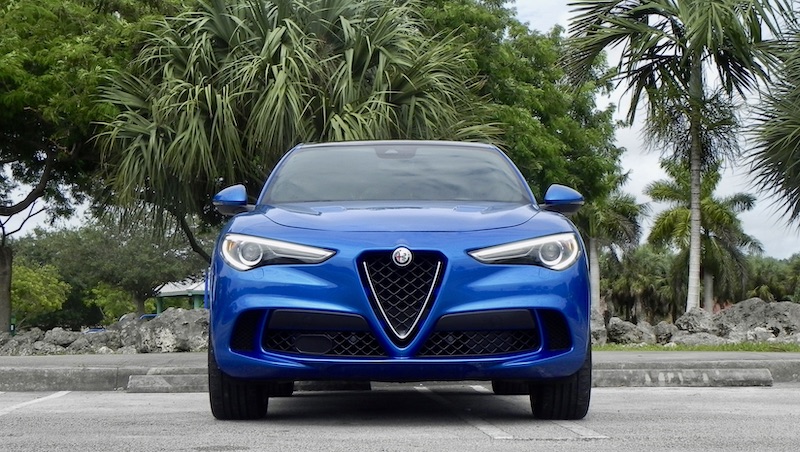
In just its third year, Alfa Romeo’s Stelvio already has established itself as a go-to vehicle for someone seeking a functional, fun-to-drive SUV in a distinctive, stylish package.
With a best-in-class 505 horsepower and 443 pound-feet of torque produced by the 2.9-liter, twin-turbocharged V6 engine, the Stelvio — it is named for a mountain pass in the easter Alps in northern Italy — is based on the Alfa Romeo’s popular Giulia sport sedan and delivers breathtaking performance numbers.
The website www.zeroto60times caught it at 3.3 seconds for zero to 60 and 11.7 for the quarter mile, and Alfa Romeo itself boasts of a record 7 minute, 51.7 second lap at the Nürburgring, making the Stelvio Quadrifoglio the fastest production SUV available in the U.S
The Stelvio is offered in several trim variations with Stelvio and Stelvio Ti models getting a 2.0-liter turbo 4-cylinder engine rated at 280 horsepower and 306 pound-feet of torque that results in a zero-to-60 clocking of 5.4 seconds and a top speed of 144 mph, according to the company.
Both engines are mated to distinctive 8-speed automatic transmissions with dynamic mode and steering column-mounted shifters for manual gear selection.
This review is based on the top-of-the-line all-wheel-drive Quadrifoglio that gets the V6 and its eye-popping performance numbers.
Of course, it also carries an eye-popping MSRP that starts at $80,445. My test model had options that ran the final bottom line to $95,690 with high-performance CCM Brembo brakes accounting for over half that bump, $8,000 to be exact.
Hey, with all that performance, you’re going to want to have the best stopping power available to go with it!
Since introducing the Stelvio for the 2018 model year, Alfa Romeo engineers have continued to upgrade its features.
For 2020, the Stelvio gets a new center console that features leather-wrapped gear shifter with bright accents, premium rotary knobs and dial materials and increased storage capacity. A wireless mobile phone charging pad also is available, and Stelvio and Stelvio Quadrifoglio models get new steering wheel designs. (For a look at the 2019 Stelvio, see my review from September 2019 via the index to the right.)
The 8.8-inch center touchscreen also is new, though I wish the operation for infotainment features was a bit more friendly. (Actually, I wish it was a lot more user-friendly.)
New available driver assistance features include lane keep assist, active blind spot assist, and traffic sign recognition. The latter is a camera-based system uses a camera mounted on the windshield that alerts you to various traffic signs in case you’re not paying attention.
Standard features on the Stelvio Quadrifoglio include Apply CarPlay and Android Auto, a one-year subscription to Sirius-XM satellite radio, a leather dash and upper doors, heated steering wheel and front seats, 8-way power adjustable front seats with 4-way power lumbar support, a 14-speaker Harmon Kardon Premium sound system, push button start, power liftgate, LED daytime running lights and taillights, dual quad exhaust system (that puts out a sweet tone when dynamic drive mode is selected, carbon fiber interior trim, and blind spot and cross-detection systems.
As noted, my vehicle for the week came in at over $95,000 with extras.
In addition to the Brembo brakes, those extras included the active driver assist programs that featured adaptive cruise control and driver attention alert, a Security and Convenience package that included a rail-mounted cargo compartment cover and premium alarm, a dual pane sunroof, heated second-row seats, the wireless charging pad, and Quadrifoglio carbon fiber steering wheel and leather-wrapped shift knob.
A 4-leaf clover logo on the side panel also is standard on the Quadrifoglio. It pays homage to Alfa Romeo’s racing heritage and designates the company’s high-performance models. “Quadrifoglio” is Italian for 4-leave clover.
Just another cool element to the Stelvio Quadrifoglio’s styling.
What I liked about the 2020 Alfa Romeo Stelvio Quadrifoglio: It’s one of the most fun-to-drive SUVs on the market as well as being comfortable and quiet. Performance is at the top of the chart. The exterior design sets it apart from many of its competitors.
What I didn’t like about the 2020 Alfa Romeo Stelvio Quadrifoglio: The good folks at Alfa Romeo need to borrow a page from their compadres at Chrysler when it comes to the operation of infotainment functions. Chrysler’s UConnect system is one of the most user-friendly on the market while the one in the Stelvio falls way short. Cargo space is only average.
Would I buy the 2020 Alfa Romeo Stelvio Quadrifoglio? I would like a friendlier infotainment system and a bit larger screen for display, but other attributes make this an intriguing buy, especially if you’re looking for a little hop in your get-along.
MERCEDES FILLS OUT SUV PORTFOLIO WITH ADDITION OF AMG GLS 63 MODEL FOR 2021
After updating the GLS with new GLS 450 and GLS 580 models for 2020, Mercedes-Benz is now out with the AMG version of its largest SUV with the 2021 Mercedes-AMG GLS 63.
The Germans say it “is more dynamic and versatile than ever before” with “plenty of space for seven people” and “improved driving dynamics” powered by a 4.8-liter biturbo V8 engine that boosts horsepower to 603 and torque to 627 pound-feet over the 577/561 numbers of its predecessor.
And that engine gets a 48 horsepower, 184 torque jump from the EQ Boost mild-hybrid system that also controls idle speed for increased fuel efficiency. (The EPA has not released numbers for the 2021 model but it does publish numbers of 16 miles-per-gallon city, 21 highway and 18 overall for the 2020 GLS 580, which has a 4.0-liter V8 with slightly lower horsepower and torque numbers than the AMG GLS 63.
Mercedes clockers caught the AMG GLS 63 at 4.1 seconds from zero-to-60 mph and an electronically limited stop speed of 174 mph. That should satisfy the power-hungry.
That engine is paired with a 9-speed automatic transmission and is configured with the company’s 4MATIC all-wheel-drive system.
You also can vary the driving dynamics by selecting one of six driving modes — Comfort, Sport, Sport+, Sand, Trail, and Individual, or you also may select gears manually via the steering wheel-mounted paddles.
But lest we not forget that the AMG GLS 63 also lives to its SUV mission as a family hauler.
It seats seven passengers. Though you probably wouldn’t want to take a long trip sitting in the third row, getting back there takes little work. There is plenty of legroom in the first two rows with 40.3 inches up front and a generous 41.9 in the second row.
Cargo room is only slightly compromised when all seats are in place with 17.4 cubic feet behind the third row and 42.7 cubic feet when those seats are lowered by pushing buttons at the rear
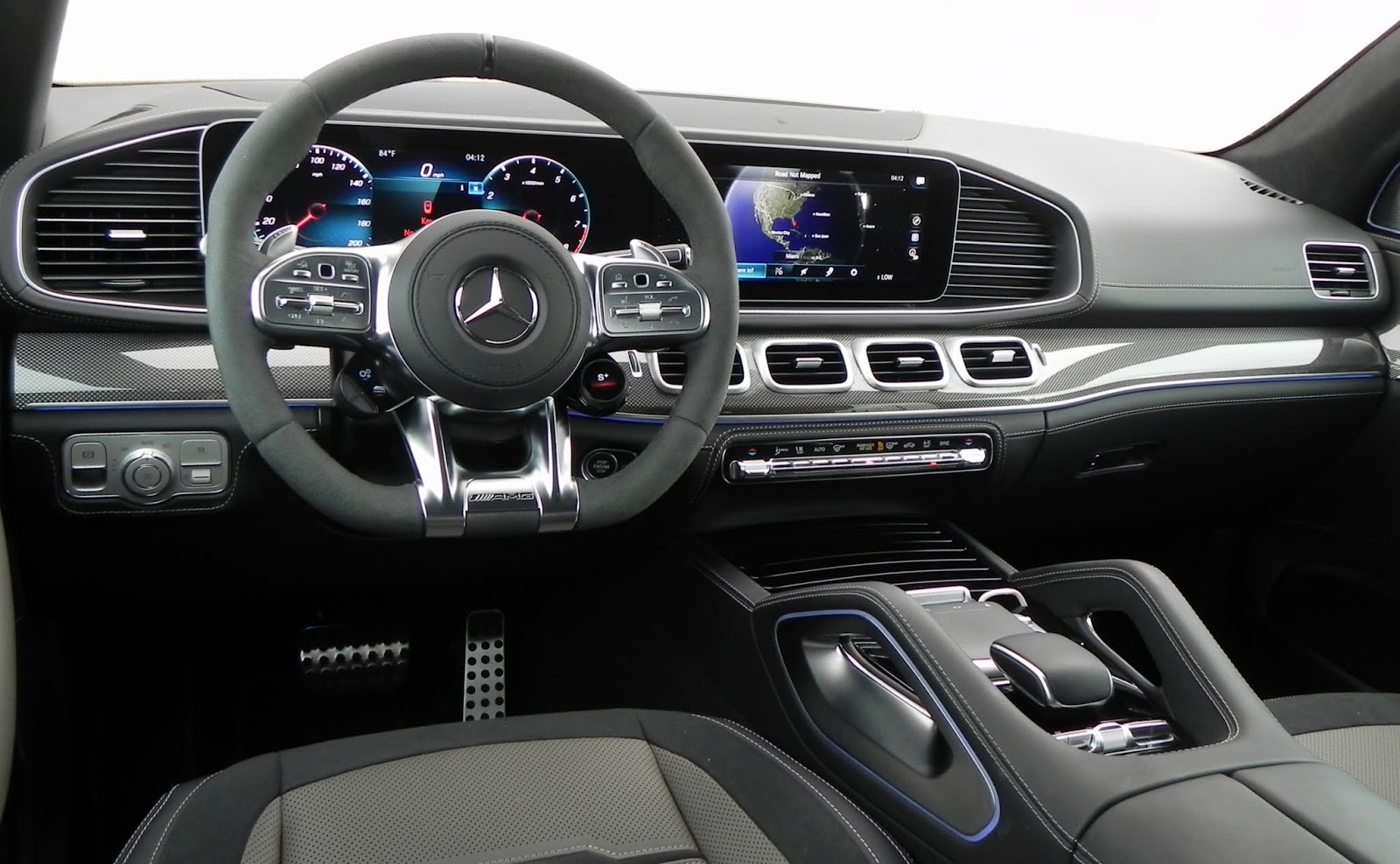
Highlighting the front are a pair of 12.3-inch display screens incorporated into one flowing piece by a single glass cover. Content in the instrument panel may be set in one of four display styles— Modern Classic, Sport, Discreet and AMG-specific Supersport.
Infotainment features of the company’s MBUX system can be run via voice command (“Hey, Mercedes”), buttons on the steering wheel, or an annoying touchpad system that is supposed to mock the gestures used for a typical laptop but mostly just get in the way. They require an inordinate time away from keeping your attention on the road. Imagine “pinching” two fingers together on the pad to adjust the navigation scale, for example.
Standard features in the super-luxurious interior include a panoramic roof, navigation, Apple CarPlay and Android Auto, Burmeister surround sound, multi-contour heated and ventilated front seats, Mercedes’ “me connect” services, wireless charging, 64-color ambient lighting, and safety systems like Attention Assist, Brake Assist, blind-spot assist, and parking assist.
That is included in the base MSRP of $133,095 (including destination and delivery).
My test model featured a couple of items you can probably live without depending on your family (like a $3,700 Rear Seat Executive Package that added rear-seat wireless charging and heated and cooled rear-seat cupholders among other things) so the bottom-line totaled $153,035.
Just another example of how the GLS lives up to the company’s billing as the “S-Class of SUVs.”
What I liked about the 2021 Mercedes-AMG GLS 63: The bold, aggressive styling exudes a “no compromise” ambiance. It is every bit as powerful as the image it projects. Highway cruising is unbelievably smooth and quiet, and you won’t have an issues with taking advantage of the smallest break in traffic to scoot across an intersection. The roomy interior is stuff with high-grade materials as might be expected with a vehicle from the Mercedes shop. The back cargo area behind behind the third row is OK, but far back seats fold with the touch of a button to provide access to a wide, yawning stowage area.

What I didn’t like about the 2021 Mercedes-AMG GLS 63: It’s a bear to maneuver in crowded mall parking lots, but my real issue with the Mercedes-AMG GLS 63 (as it was with the Mercedes-AMG GLE 63 S I reviewed on May 19) is the MBUX infotainment system, especially the touchpad pad for selecting the desired feature. The small flat pad is simply in a bad spot and you can easily find yourself listening to a different audio station if your fingers brush it when you reach for something in the cupholders. Moving it to another location on the center console farther from the cupholders might help, but would not eliminate accidental touches entirely. They just would not occur as often.
Would I buy the 2021 Mercedes-AMG GLS 63? Probably not. The touchpad system is a deal breaker with me. You have other options for changing a function, but the real killer to me is the effect of accidental brushings to change modes on the screen.
BMW X1 SHOWS THAT GOOD THINGS CAN COME IN SMALLER (NOT SMALL) PACKAGES
As you may surmise from the numerical designation, the X1 is the smallest of BMW’s fleet SUVs, but don’t sell it short.
This is a roomy vehicle that delivers both a fun driving experience while remaining true to the functional aspects of the SUV segment, or SAV for Sports Activity Vehicle in BMW parlance.
It is BMW’s best-selling X model worldwide, though according to the company the X1 ranks third behind the X3 and X5 in the U.S. market. Perhaps the upgrades from a mid-cycle refreshing will move it up.
Having moved into its second generation as a 2015 model, the new X1 gets new exterior styling cues for 2020 that make it more inline with the appearances of its larger siblings along with new colors, wheel designs and interior enhancements.
Up front, the familiar BMW kidney grille gets larger openings along with new optional LED headlights that are complemented by LED fog lights. The bumper design also is new.
At the back, the X1 gets new tinted LED taillights, and BMW says the exhaust tips opening have grown to 90mm, an increase of 20mm over previous editions.
An available M Sport package includes a redesigned aerodynamics package that features a new front bumper, side skirts, wheel arch trim, and rear diffuser in body color.
Among new colors is a “Storm Bay Metallic” that should make Navy veterans feel at home. “Battleship Gray” was my first guess as to what it would be called.
Among interior updates the 8.8-inch touchscreen is now standard across the line to operate infotainment functions.
Available in front-wheel or all-wheel drive, the X1 comes with a turbocharged 2.0-liter 4-cylinder engine that is rated at a generous 228 horsepower and 258 pound-feet of torque from1,450 to 4,500 rpm.
Mated to an 8-speed Steptronic automatic transmission with Comfort, Eco, Sport, and Sport+ diving modes, the X1 scoots from zero-to-60 mph in 6.3 seconds in AWD configuration (X1 xDrive28i) and 6.6 with FWD (X1 sDrive28i).
My AWD test model consumed the recommended premium fuel at the rate of 23 miles-per-gallon city, 21 highway, and 28 combined, which isn’t the best in the luxury subcompact class but close to it.
The X1 seats five passengers and offers storage room behind the second row that compares favorably to that in the slightly larger X3.
Standard equipment with the base MSRP of $37,300 includes a power liftgate, park distance control, active cruise control, SensaTec (simulated leather) interior upholstery, automatic climate control, matte chrome exterior trim, navigation, Apple CarPlay, rain-sensing wipers, and the Active Driving Assistant suite of features (frontal collision warning, land departure warning, speed limit info, and automatic high-beat headlights).
Options like a Premium Package that added a panoramic sunroof, a head-up display. and heated front seats among other features), fine wood trim, a mocha Dakota leather interior and a few other items ran the final total for my test vehicle to $48,645 including the 995 destination and delivery charge.
What I liked about the 2020 BMW X1 xDrive28i: It’s a fun vehicle to drive with a peppy performance that delivers decent mileage. Yet is has nice storage room at the rear (27.1 cubic feet) and 58.7 max with the second-row seats folded
What I didn’t like about the 2020 BMW X1 xDrive28i: The infotainment system requires a lot of attention when inputting commands. Do I press the console knob, turn it, or shift it to one side or the other to get what I want? Though rear space is spacious, storage of smaller items up front in the cabin is on the stingy side.
Would I buy the 2020 BMW X1 xDrive28i? Yes, though the FWD version is adequate for most city driving. You’re not going to take this out on many rough treks through the woods in any case.
MERCEDES-AMG GLE 63 S IS A POWERFUL BRUTE BUT IN A REFINED PACKAGE
So, you want a vehicle with lots of pop but need one with lots of room for hauling stuff? Well, how about getting one for both.
The 2021 Mercedes-AMG GLE 63 S performs both functions in luxurious fashion, befitting the company that introduced the concept of the performance-oriented SUV when it brought forth the 342-horsepower 1999 Mercedes-Benz GL 55 AMG.
The name has changed and the horsepower upped considerably, but the concept is the same: A top-of-the-line performer that takes a backseat to no competing vehicle when it comes to a high-performance hauler with a stunning array of ultra-luxurious features and technology that can do about anything for you short of your taxes.
We start with what’s under the hood.
A push on the starter button fires up a 4.0-liter bi-turbo V8 power plant rated at 603 horsepower and a peak torque of 627 pound-feet with a burst of an extra 21 hp and 184 lb.-ft. coming from the onboard EQ Boost starter-generator system, moving its 2.5-plus tons from zero-to-60 mph in a company reported 3.7 seconds and topping out at an electronically limited 174 mph.
That engine is mated to a 9-speed automatic transmission with manual mode via paddle shifters and Comfort, Sport, Sport+ and RACE settings for most conditions. Trail and Sand modes raise the suspension a couple of inches to increase ground clearance in poor conditions.
The GLE 63 S rides on standard 21-inch wheels with 22-inchers as an optuon and gets Mercedes’ 4MATIC all-wheel-drive system as standard.
The government does not yet list fuel milage ratings for 2021 Mercedes models, but Car & Driver put them at an estimated 15 miles-per-gallon city, 20 highway, and 17 combined, which is about what you would expect from a vehicle of this power and size.
It does have an ECO stop/start function that operates in Comfort mode (fear not; it can be be deactivated with the push of a side button next to the start button), and often when cruising four of the eight cylinders (two, three, five and eight if you’re counting) are deactivated to reduce fuel consumption. A small icon appears in the instrumental panel to alert you to this (though you’ll play hell finding that information in the mammoth owner’s manual).
 As is typical of vehicles rolling off the Mercedes assembly line, the AMG GLE 63 S glides along soothly in Comfort mode with Sport, Sport+ and RACE settings firming up the suspension for more adventurous forays.
The front bumper, the oversize Mercedes-Benz logo in the front grille, and the large black front air intakes give the GLE 63 S a brutish look, but it is a civilized brute with lots of soft surfaces and Nappa leather seating surfaces that coddle your backside.
AMG trim elements throughout the interior, including some in carbon fiber, leave no doubt of its pedigree. The special AMG exhaust system features two rectangular twin tailpipe trims.
It also is packed with the latest in technological innovations, though the touchpad system to operate them leaves more than a little to be desired. Fortunately, many of the infotainment functions also can be accessed via buttons on the steering wheel or voice (“Hey, Mercedes”) or even optional gesture control.
The HD touchscreen at the top of what would be the center stack of controls if there were an actual stack is clear and nicely incorporated into the flow of the dash instead of stuck up in the middle like some just remembered iPad.
There is no question about the quality of materials throughout the interior. They’re all top-rate.
The base MSRP for the GLE 63 S is $114,945 including the $995 destination and delivery charge.
What I liked about the 2021 Mercedes-AMG GLE 63 S: This is an impressive vehicle with an aggressive, in-your-face profile that lives up to its powerful image. There is tons of space for passengers and with just two rows of seats, there is lots of room for them to put their stuff in the back.
What I didn’t like about the 2021 Mercedes-AMG GLE 63 S: The touchpad for operating the infotainment functions on the MBUX (Mercedes-Benz User Experience) system can be very frustrating. Even if you resolve to only use the steering wheel buttons or voice commands to get to where you want, the touchpad still gets in the way. Especially when picking items out of the console cupholders, you’ll find your self suddenly listening to an different radio station if you lightly brush the touchpad with your palm.
Would I buy the Mercedes-AMG GLE 63 S: It is a bit too much over-the-top for my personal preferences, but for those seeing the ultimate in driving performance in an SUV, it is tough to beat this behemoth.
LINCOLN LEAVES ALPHABET SOUP TO OTHERS AS NAUTILUS REPLACES MKX IN SUV LINEUP
In a trend that we would very much like to see continue, Lincoln apparently is abandoning its “alphabet soup” approach to automotive nomenclature with only two such models, the MKZ and MKZ Hybrid, remaining in its present day lineup.
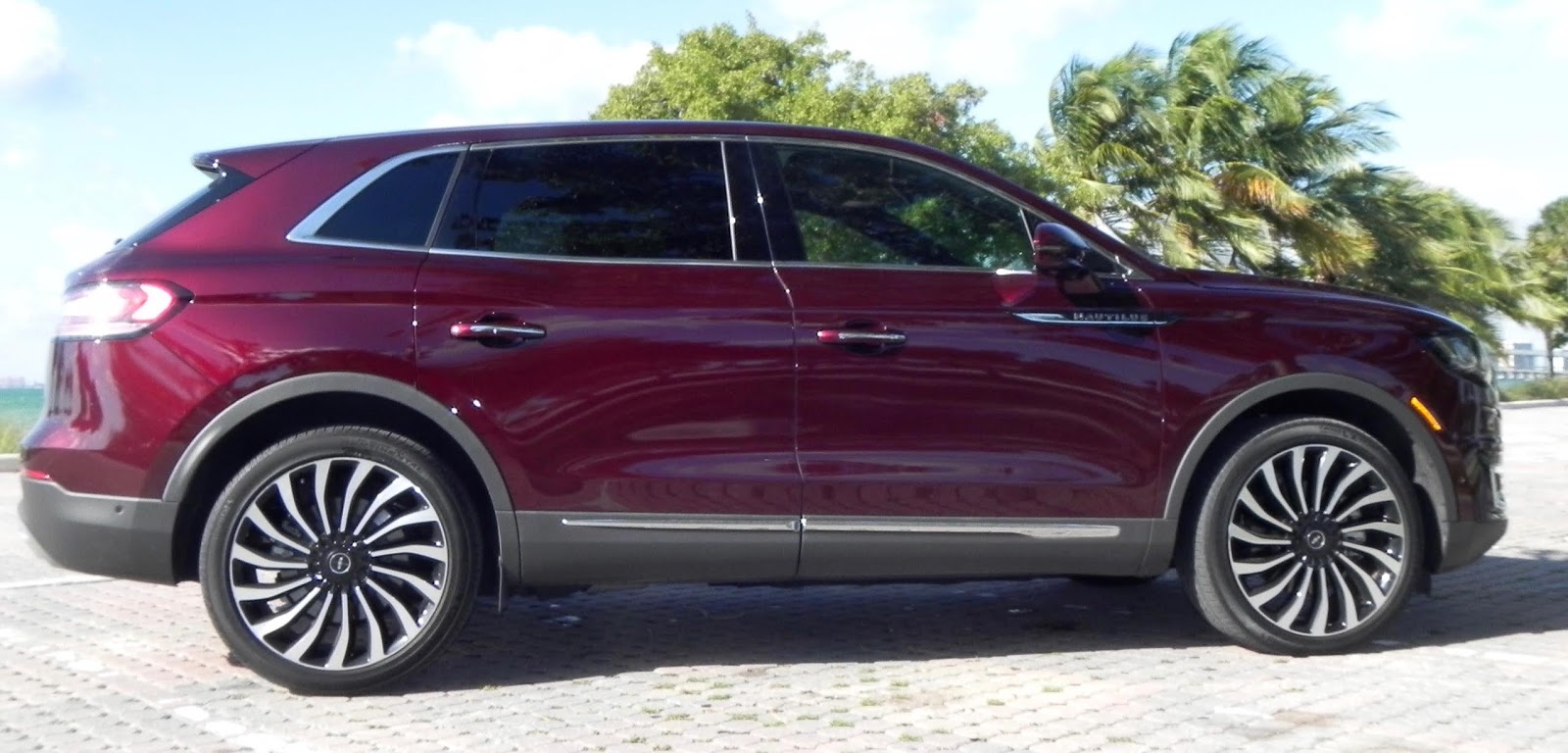
With the 2019 Nautilus taking over as the company’s entrant in the midsize segment, each of Lincoln’s crossovers/SUVs now has a full name and not a three-letter combination starting with “MK.” Its former incarnation as the MKX is no longer.
That isn’t to say that the Nautilus is “completely new,” however, at least not in the strictest sense. It is built on the same platform as its predecessor, but there is more to it than simply a new name.
Styling has been upgraded starting with a distinctive different front fascia and its “star mesh” grille. A number of driver-assist systems that were once available as stand-alone options such as blind-spot and cross-traffic alerts, pre-collision assist with automatic emergency braking, auto high beams, a lane-keeping system, and a rearview camera are now incorporated into one standard package Lincoln dubs Co-Pilot360.
A new turbocharged 4-cylinder is now the base engine with a 2.7-liter twin-turbo V6 that bumps up power and torque to 335 horsepower and 380 pound-feet of torque from the 4-banger’s 250/280, respectively, is also available.
An 8-speed automatic with paddle shifters for manual gear selection is the sole transmission offered. Both engines include an auto stop/start function that can be disabled by the push of a button at the top right of the center stack.
You may adjust the Nautilus to one of three driving modes (Normal, Comfort, Sport), and front-wheel drive is standard with all-wheel drive available. You’ll find it a capable enough cruiser on the highway and with enough punch to get you into the flow of city traffic. Front-wheel drive is standard and all-wheel drive is optional, though I wouldn’t be taking it out on the trail if I were you.
Fuel economy numbers are 21 miles-per-gallon city, 25 highway, and 23 combined for the 4-cylinder engine and 18/27,21 for the V6.
For 2019, the Nautilus comes in four trims starting with the base starting at $41,335 including the $995 destination and delivery charge. The Select trim ($45,540) has been discontinued for 2020 models.
At the top of the line are the Reserve ($49,870) and the Black Label ($59,390) trims. This review is based on the Black Label edition that included options that ran the total to $67,630.
The Black Label upgrades are really felt in interior enhancements like Venetian leather seats, a tech package that includes a 360-degree camera, and an Alcantara headliner. The Sync3 infotainment system includes a voice-activated navigation system, though the screen itself at 8 inches is somewhat on the small side.
Frankly, though, I would sacrifice screen size for simplification of operation.
The Black Label edition also offers you a choice of one of three design themes — Gala (featuring deeper colors), Chalet (with Silverwood appliques), and Thoroughbred (Chilean Maple wood, Alcantara accents, and jet black trim) — to highlight the Nautilus’ overall ambiance.
Interestingly, Black Label buyers also get a 12-month, complimentary CLEAR membership to help you speed through security a participating airports and major arenas nationwide. That’s twice the time that buyers of other trims get.
What I liked about the 2019 Lincoln Nautilus Black Label: The Nautilus has a sophisticated interior with infotainment features that are easy to operate. The ride is quiet and comfortable as well. The V6 has enough oomph to get you around in a sprightly manner.
 What I didn't like about the 2019 Lincoln Nautilus Black Label: The display screen at the top of the center stack is on the small side from what many competitors are offering in their luxury products. Looking over the hood you get the feel it is a much larger vehicle, which is not a comfortable feeling when looking for a spot in a crowded parking lot.
Would I buy the 2019 Lincoln Nautilus Black Label? It most definitely deserves a look if you are shopping in the midsize luxury SUV market.
2020 HYUNDAI SANTA FE RIVALS LUXURY SUVS WITH ITS FEATURES, TECHNOLOGY, QUALITY
Shopping for a family SUV with champagne tastes but burdened by a beer budget?
You might want to start by checking out a Hyundai showroom for the Santa Fe. You also might finish there anyway.
Fully redesigned for 2019 with the tag “Sport” removed for five-passenger models (the former three-row Santa Fe now goes by Santa Fe XL), the 2020 Santa Fe comes with about all the amenities you might want in a luxury model except the name cachet of a traditional luxury import brand from Europe or Japan.
The South Korean manufacturer has had the knack of incorporating most-wanted features in a high-quality product for quite some time now, at least since the turn of the century when it apparently decided to get serious in the United States market instead of existing by putting out cheap knockoffs.
In addition to cutting out the third row, Hyundai made the Santa Fe roomier by making it a bit longer and wider than the outgoing two-row model the Santa Fe Sport as well as improving its ride.
For 2020 it added some safety features and packages like a new blind spot monitor on Limited models and making the rear-seat occupant alert standard on SE and SEL models as well. Wireless device charging also is standard on SEL w/Convenience package and Limited models.
A 2.4-liter 4-cylinder engine is standard in all trims, and a 2.0-liter turbo 4-banger is available on SEL models with Convenience and Premium packages as well as the top-of-the-line Limited. All engines are mated with an 8-speed automatic transmission. Fuel mileage is an efficient 20 miles-per-gallon city, 26 highway, and 22 combined for the turbo.
This review is based on the 2020 Santa Fe Limited with the 2.0-turbo engine. That engine boosts power to 235 horsepower and 260 pound-feet of torque from the 2.4-liter’s 185/178 numbers, respectively, and it is well-worth the extra cost.
The all-wheel-drive Limited with the 2.4-liter engine starts at $38,445 (including destination and delivery and going with the 2.0 turbo revs that up to $40,295. Front-wheel-drive Limited models knock $1,700 off the MSRP for the AWD models.
Standard equipment on the Limited includes safety features like forward collision avoidance, blind-spot warning, high-beam assist, lane-keeping assist, rear cross-traffic alert, smart cruise control, reverse parking alert, and rear-seat occupant alert.
A panoramic sunroof, 19-inch wheels, a hands-free rear lift gate, and LED headlights, fog lights, and taillights also are standard.
Comfort and convenience features covered by the base MSRP include leather seats that are heated front and back and ventilated in the front, leather-wrapped steering wheel, 8-way power adjustable driver’s seat with lumbar support, dual automatic climate control, a proximity key with push-button start, navigation system with an 8-inch display screen, wireless device charging, Quantum surround sound audio, Bluetooth hands-free communications, and Hyundai’s Blue Link Connected Services.
In other words, all that you might want in an SUV that tops out in price where luxury SUVs begin.
The only extra to destination and delivery for my test vehicle was $135 for carpeted floor mats.
What I liked about the 2020 Hyundai Santa Fe Limited: The short answer: a lot. It looks great inside and out, the interior is classy and roomy, and the driving experience is efficient and up to standards for daily chores. Storage room behind the third row is listed at 35.9 cubic feet. Technology is plentiful and easy to operate. The enhanced blind spot warning system flashes an image of what is on your left or right when you activate the turn signal in the middle of the instrument panel, giving you a view of what may be coming up alongside you.
What I didn't like about the 2020 Hyundai Santa Fe Limited: I would like to see the display monitor more incorporated into the flow of the dash and not sticking up in the middle at the top of the center stack.
Would I buy the 2020 Hyundai Santa Fe Limited? Yes, most definitely. Fuel efficiency is among the best in its segment, and the interior has quality of a luxury SUV. The Santa Fe certainly has come a long way since the jaunty, smaller SUV it started out as.