NEW PALISADE SUV LOOKS LIKE
A WINNER FOR HYUNDAI FOR 2020
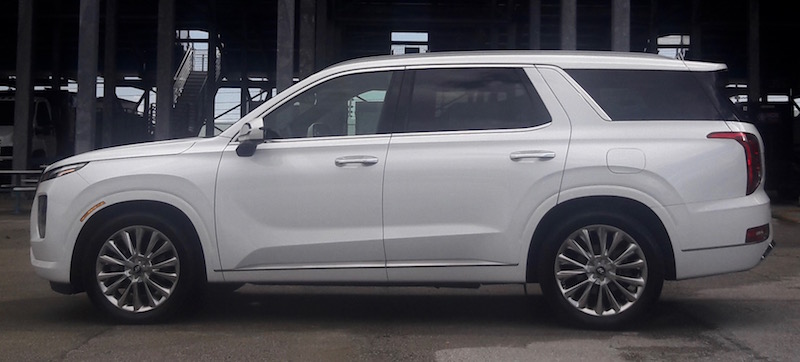
The good reception that Hyundai’s earlier ventures into the three-row SUV segment (Santa Fe XL, Veracruz) received never really translated into much of the way of overall success in the market, but that may be changing, and soon.
There's no guarantee of that, of course, but the 2020 Hyundai Palisade’s combination of good looks and functionality will even appeal to those who customarily browse luxury showrooms. It’s a high-class vehicle!
Hyundai touts its newest flagship SUV as the “ultimate family vehicle for practical, comfortable daily use” as well as the more adventurous road trips. It replaces the Santa Fe XL (2012 was the last model year for the Veracruz) as the company’s offering in three-row segment with more space for both passengers and cargo.
The Palisade’s wheelbase has greater length and a longer wheelbase than the 2019 Santa Fe XL, checking in at 196.1 inches and 114.2 inches, respectively, to the outgoing Santa Fe’s 193.1 and 110.2.
Thus passengers in the third row get more leg and shoulder room in the Palisade over the Santa Fe XL, and riders in all three rows get more head, leg and shoulder room.
The Palisade also excels when it comes to cargo space, offering a generous 18.0 cubic feet behind the third row, 45.8 behind the second, and 86.4 being the front row.
That solves the dilemma common to many three-row SUVs of having to decide what stuff you will have to leave behind to accommodate a vacation-bound seven- or eight-passenger load.
The Palisade is offered in three trim levels (SE, SEL, and Limited) with a 3.8-liter V6 engine under the hood that offers 291 horsepower and 262 pound-feet of torque.
That engine is mated to an 8-speed automatic transmission with paddle shifters for manual gear selection and four driving modes (Eco, Comfort, Sport, and Smart) with a fifth (Snow) offered in all-wheel drive models.
Fuel economy numbers are average for the class at 19 miles-per-gallon city, 24 highway, with all-wheel drive and 19/26 with front-wheel drive. Overall performance is more than up to everyday demands, and never in the week that I drove it did I find myself thinking, “I wish this had more power.”
The ride is firm, but comfortable and relatively quiet, and the Palisade handled our neighborhood’s speed bumps with ease and confidence.
The Palisade also is strong in creature comforts with a wealth of safety and technological features like forward collision assist with pedestrian detection, lane-keeping assist, rear parking distance warning, trailer sway control (towing capacity with trailer brakes is 5,000 pounds), projector headlamps with LED accents, LED daytime running lights, high beam assist, rear spoiler, privacy glass, tilt-and-telescoping steering wheel, keyless entry, lane-following assist, Bluetooth hands-free phone with wireless audio system, rear-view parking monitor with guidelines, Smart Cruise Control with Stop & Go, and Apple CarPlay and Android Auto standard on all trims.
The top-of-the-line Limited trim (the preferred model in the lineup) is especially loaded with goodies like Nappa leather seating surfaces, heated and ventilated front and second-row seats limiting capacity to 7 instead of 8), power-folding third-row seats, leather-wrapped steering wheel, a 10.25-inch touchscreen with navigation and traffic flow, a Harman Kardon premium audio system, 8-way power adjustable driver’s seat with 4-way power lumbar, blind spot monitor, surround view monitor, heads-up display, wireless charging, and Hyunda’s Blue Link system.
Captain’s chairs in the second row (standard on the Limited, optional on the SEL) reduce capacity to seven passengers instead of eight.
All that runs the Limited’s MSRP up to $47,605 including $1,045 for destination and delivery and $160 for carpeted floor mats. That’s a pretty good jump over the starting price for the SE ($32,595) and SEL ($34,545).
One interesting feature I should mention. New this year is a Blind Spot Avoidance Assist system that projects side views of adjacent lanes in the instrument panel in the spots for the speedometer and tachometer when the corresponding turn signal is activated.
Some reviewers have found the system a bit distracting, but it’s a great feature when used correctly.
What I liked about the 2020 Hyundai Palisade Limited: This could be a very long list because there is a lot to like here, starting with the user-friendly infotainment system. Hyundai long ago made that a trademark for its products. The Blind Spot Avoidance System is an interesting innovation. It gives you another look for potential vehicles riding in your blind spot.
What I didn't like about the 2020 Hyundai Palisade Limited: I had to think long and hard on this one, and probably the one thing I could come up with is that the buttons in the middle of the center stack to select radio, navigation, etc. can be hard to read depending on the lighting. I’m also not sure I like the push buttons for selecting gears for the transmission. They seem to require a bit more pressure than expected and at times it can be easy to leave your vehicle in drive when you think you have punched in reverse.
Would I buy the 2020 Hyundai Palisade Limited? In a heartbeat. The Limited version can be rather expensive, but it is worth everything you pay for. But the SEL version seems well-equipped and starts at $11,200 less than the Limited giving you some leeway with options.
INTERESTED IN A BIG TRUCK? GMC MIGHT HAVE THE ONE FOR YOU IN SIERRA 2500HD AT4
The GMC Sierra 2500HD AT4 is a big truck.
It’s also a beautiful truck and a very utilitarian vehicle, but your first impression is pretty much going to be, “Wow. This is a big truck.”
This is not the kind of truck you likely would want for runs to the local home improvement store to pick up a load of sod. This one you’d use for bringing back a load of trees for your landscaping project. Big trees.
Yes, the 2020 GMC 2500HD AT4 is for serious trucksters. GMC even touts it as “the most capable heavy-duty truck” that it has ever offered.
Standard features for AT4 models include a ProGrade Trailering system with an available 15 camera views, keyless open and start, remote start, dual zone climate control, heated front and rear outer seats, ventilated front seats, driver seat and mirror memory, folding exterior mirrors that can be extended with the push of a button, heated leather-wrapped steering wheel, LED reflector headlamps, a tailgate that flips down with the push of a button, a spray-on bedliner, a dozen cargo tie-downs, and side and corner steps for easy access to the bed.
An AT4 Premium Package ($4,215) adds such items as a rear sliding power window, a premium entertainment system with navigation, 8-inch HD touchscreen, voice recognition, Bluetooth audio streaming, Apple CarPlan and Android Auto, Bose premium sound system, wireless charging, LED roof marker lamps, front and rear park assist, lane-change alert with blind side alert, and rear cross traffic alert.
A new 6.0-liter V8 gasoline engine has increased power for 2020 (401 horsepower, 464 pound-feet of torque), but a 6.6-liter Duramax V8 turbo diesel engine is the real big boy. Mated with a new 10-speed automatic transmission, it pumps out 445 horsepower and a whopping 910 pound-feet of torque, giving this behemoth a towing capacity in excess of 30,000 pounds. It runs surprisingly quiet, too.
The AT4 model (as opposed to the upscale Denali) is designed for more off-road use with a 2-speed automatic transfer case as standard.
An off-road suspension, skid plates, a locking differential, and special shocks are included. Hill descent control, hill start assist, and a traction select system with a specific off-road (and tow) mode also are part of the package.
All this comes at a price, of course, and one that matches its size in bigness. Starting MSRP for the Sierra 2500HD AT4 is $57,700 plus a hefty $1,595 destination and delivery charge.
My well-equipped vehicle for the week had enough options to run the bottom line to $77,555 after a $750 AT4 Premium Package discount was taken off.
What I liked about the 2020 GMC Sierra 2500HD AT4 Crew Cab: This is a great looking truck that is up go about anything you might ask of a full-size pickup. The infotainment features are numerous and very user friendly. The surround-view camera is a real plus. The running board makes the climb up into the Crew Cab much less of a task. You can go a long way between fill-ups with the turbo diesel.
What I didn’t like about the 2020 GMC Sierra 2500HT HT4 Crew cab: Maneuvering in a mall parking lot is a task, a huge task. Even fitting into many marked places is difficult. The backend hangs out into the street in some lots where perpendicular parking is required. The interior could use an upgrading.
Would I buy the 2020 GMC Sierra 2500HD AT4 Crew Cab? I am not a truck guy, especially a big truck guy, so no, I would not. But it is really a great option for those who need such a big vehicle and can afford it.
BMW KICKS POWER FOR 3 SERIES SEDAN UP A NOTCH WITH 2020 M340i AND M340i xDRIVE
BMW’s 3-Series has been around for over four decades, and now the German automaker has taken its so-called “entry” level luxury sedan to a new level.
The 2020 M340i and M340i xDrive now in showrooms are the most powerful non-M 3 Series yet. With a 3.0-liter, 6-cylinder engine (382 horsepower, 369 pound-feet of torque), the M340i xDrive moves from zero-to-60 in 4.2 seconds.
That ranks right up there with the vaunted M3 with an optional Competition package!
Yet the M340i is civilized enough to earn mileage ratings of 22 miles-per-gallon city, 30 highway and 25 combined.
About the only bone to pick in the way of powertrain is that the only transmission offered is an 8-speed automatic with paddle shifters for manual shifting. No manual is available. (Sigh.)
The engine is not the only facet that gets niceties from the “M” grab bag.
Included in the base $54,000 MSRP ($54,995 including destination and delivery) are M Sport brakes, M differential, M sport steering wheel, and an M rear spoiler for a sporty appearance.
Adaptive M suspension is available for an extra $700, and included at no extra cost are LED headlights with cornering lights, 14-way power adjustable sport seats with lumbar support, navigation featuring a 10.25-inch screen, a moonroof, automatic climate control, Apple CarPlay, a wifi hotspot, and variable sport steering.
Of course, BMW also offers a lot of extras, perhaps too many in fact. You can replace the standard sound system with Harmon Kardon Surround Sound ($875) and add remote engine start ($300) and special ambient lighting ($250).
That only begins to run up the final price.
Throw in packages like the Executive Package (automatic high beams, gesture control and special lighting), Drivers Assistance Package (Active Driving Assistant Pro, blind spot and lane departure warning), Drivers Assistance Pro Package (extended traffic jam assistant), Premium Package (heated steering wheel, heated front seats, and head-up display), and Cooling & HP Tire package) and all of a sudden you’re at a bottom line of $67,070.
If you prefer all-wheel drive to rear-wheel, the xDrive system adds $2,000 to final tab.
What I liked about the 2020 BMW M340i sedan: No manual transmission is offered, but you can get enough in the way of performance by driving in Sport or Sport-plus mode. It’s a real looker from the outside, and the inside lives up to its luxury status.
What I didn’t like about the 2020 BMW M340i sedan: The iDrive 7.0 infotainment system is as fussy as ever to operate and can be distracting to the driver. Options run the M340i from the mid-$50,000 range to nearly $70,000.
Would I buy the 2020 BMW M340i sedan? There's always the issue of dealing with the operation of the iDrive infotainment system, but the M340i has so much good stuff to offer that shouldn’t be the determining factor in any decision. The real drawback would be the temptation to add too many options and run the price up.
BMW GOES BIG WITH INTRODUCTION
OF NEW X7 'ACTIVITY' VEHICLE FOR 2019
If you are a believer in bigger is always better, than BMW has the SUV (excuse me, in BMW's terminology it's a Sports Activity, not Sports Utility, Vehicle) you have been looking for.
The BMW X7 launched for 2019 is the company's largest utility, er, activity, vehicle yet with standard three-row seating for seven (or six when equipped with second-row captain's chairs) and towing capacity of up to 7,500 pounds when equipped with the factory hitch.
It comes in two versions. The X7 xDrive40i comes with a turbocharged V6 under the hood. The X7 xDrive50i on which this review is based has a turbo V8 that ups horsepower to 456 from the 335 of the turbo-6 and torque to 479 pound-feet from 330.
Both engines are mated to an 8-speed automatic transmission with paddle shifters for manual gear selection and driving modes that can be set to comfort, sport, eco, or set to individual tastes.
Presumably, driving in Eco might improve the mileage figures of 17 miles-per-gallon city, 21 highway, and 15 combined using premium fuel, but more time spent in sport mode likely would have the opposite effect.
It's your choice, of course, but sport mode does deliver a more pleasing driving experience. The V8 moves the X7 xDrive50i's 5,617 pounds from zero-to-60 mph in a brisk 5.2 seconds. BMW clockers report a 5.8 clocking for the somewhat lighter (5,370 pounds) X7 xDrive40i.
Being the biggest in the fleet of the German automaker's fleet of "Activity" vehicles, the X7 offers generous interior space, though legroom and headroom in the third row is a bit confining at 33.3 and 36.6 inches, respectively. Legroom up front is just under 40 inches with headroom of 41.9 inches.
Being a BMW, it has all the niceties that a luxury vehicle typically has complete with the latest in technology. The heated, 20-way power adjustable, multi-contour front seats include 4-way lumbar support, and the panoramic moonroof and power liftgate are standard.
Also included with no charge in the X7 xDrive50i's $92,600 MSRP (a jump of nearly $18,000 over the X7 xDrive40i) are such features as active blind spot detection and lane-keeping warning, wood interior trim, a parking assist system, Wi-Fi hotspot, and a Harmon Kardon Surround Sound audio system with a one-year subscription to SiriusXM satellite radio.
 Too many option packages quickly added $25,000 to the base MSRP for my test vehicle, however, running the total to $117,945 including the $995 destination and delivery charge.
You don't have to go full bore, of course. For example, I could do without the leather dashboard that added $1,200 to the price or the Bowers & Wilkins sound system that tacked on $3,400. The Dynamic Handling Package (suspension and steering upgrades) and M Sport Package (trim upgrades) combined add over $8,000 alone.
I also could probably do without the Premium Package (Remote Engine Start, Soft-Close automatic doors, rear electric side window shades, heated and cooled cup holders, Heads-Up Display) and Executive Package (Panoramic Sky Lounge LED Roof, Glass Controls and BMW Laserlight headlights) as well as the rear-seat entertainment system ($2,200).
 A Driving Assistant Professional package (Extended Traffic Jam Assist for limited access highways and lane-keeping assistant with active side-collision protection is standard on xDrive50i models and optional on the xDrive40i.
There's also a cold weather package that includes 5-zone climate control, heated seats for the front and rear and heated front-seat armrests and steering wheel that runs $1,200 that, being a South Florida resident, I would have no need for.
But I'd go for the captain's chairs for the second row. At $600, they seem like a bargain.
 What I liked about the 2019 BMW X7 xDrive50i: No question it is refined luxury and engineering at its best. The ride is smooth and quiet, the cabin spacious. I also like the concept of the split tailgate.
What I didn't like about the 2019 BMW X7 xDrive50i: Some nits here. As is typical of upscale German luxury cars, it is packed with technology that, alas, can be very distracting to operate. (But the 12.3-inch display screen for navigation is nice.) Adjusting the A/C blower manually (as I prefer to do) requires a fine touch. It either is too low or it blasts you out. The Active Lane Departure Warning can be overly active at times. Finally, your have to pay extra for leather seats over the standard leatherette.
Would I buy the 2019 BMW X7 xDrive50i? A bit too large for my tastes or needs, but if you are looking for or need a full-size luxury SUV, the X7 could be just what you want. No question it's a quality vehicle with outstanding engineering and a powerful engine.
2019 VW TIGUAN: ABOUT EVERYTHING YOU WOULD WANT IN A COMPACT CROSSOVER SUV
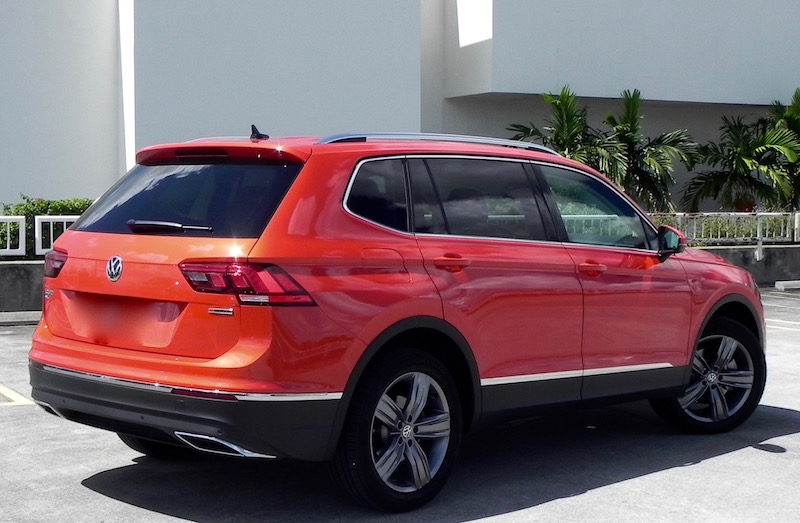
Volkswagen gave its Tiguan compact SUV a much-needed makeover for 2018, and apparently designers/engineers got things the way they wanted because about the only updates for 2019 involve some shuffling of equipment.
The 2019 Tiguan crossover is offered in six trims (S, SE, SEL, SEL R-Line, SEL Premium, and SEL Premium R-Line with the latter two topping the portfolio and getting VW's 4-Motion all-wheel drive as standard. The other four trims come with front-wheel drive as standard and 4Motion as an option.
VW's Digital Cockpit and Park Distance Control are now standard on SEL models after debuting on SEL Premium in 2018.
All Tiguans come with a 2.0-liter, turbocharged 4-cylinder engine matched with an 8-speed automatic transmission. It runs on regular unleaded fuel and is rated at 184 horsepower and 221 pound-feet of torque. Mileage figures are 22 miles-per-gallon city, 29 highway and 25 for with FWD and 21/29/24 with the 4-Motion system.
Those aren't particularly great numbers for the class, and it could use a little more punch when it comes to performance, though Sport mode does deliver more in the way of response.
This review is based on the 2.0T SEL Premium model, which comes packed with just about every and any feature you might desire included in the MSRP of $38,190 (that includes the $995 destination and delivery charge, but not the $295 for the Habanero Orange Metallic exterior that ran my test vehicle's total to $38,485).
In addition to the usual collection of seat belts and air bags, safety features include Anti Slip Regulation and Engine Brake Assist, Intelligent Crash Response System, Forward Collision Warning and Autonomous Emergency Braking, blind spot monitor, lane-keeping assist, and a rear view camera, all standard.
Technology systems include an overhead camera system, VW's Virtual Cockpit, remote start and remote power liftgate, 8-inch touchscreen navigation, Fender Premium Audio, Bluetooth connectivity, and adaptive cruise control, all standard.
Other features include automatic LED headlights, rain-sensing windshield wipers, power tilt and sliding panoramic sunroof, heated and leather-wrapped steering wheel, dual-zone climate control, leather seating surfaces, and 19-inch alloy wheels, all standard.
Third-row seating is available in FWD models and available as an option for 4-Motion models, though it cuts back considerably the available cargo space (a generous 37.6 cubic feet behind the second row).
If you can live without some of those features, the SE trim is well-equipped and has a starting MSRP of $27,690 (including the destination and delivery charge) with front-wheel drive and $28,990 for the 4-Motion system.
Even the SEL trim with FWD will save you $5,400 over the SEL Premium. It's definitely worth considering if you can live with Halogen headlights in place of LED, leatherette seats instead of leather, and without rain-sensing wipers. The SEL comes navigation and a power liftgate as well.
What I liked about the 2019 Volkswagen Tiguan SEL Premium: After dealing with smaller screens in a couple of more expensive vehicles, the image for the rearview camera was a joy to see -- very clear in high def and good size as well. There's a good bit of technological features, and they are user-friendly to operate.
What I didn't like about the 2019 Volkswagen Tiguan SEL Premium: Driving in Sport mode remedies what could have been a complaint about the lack of energy and performance in Normal mode.
Would I buy the 2019 Volkswagen Tiguan SEL Premium? Yes. This meets a lot of what you are looking for in a compact SUV/crossover with good passenger and cargo space and easy handling. I would go with another color though!
WANT THE FASTEST PRODUCTION SUV? LOOK NO FURTHER THAN 2019 ALFA ROMEO STELVIO
Considering that Alfa Romeo races in Formula and is known for producing nifty little roadsters like the 4C Spider it brought to the U.S. just a few years ago, it is not surprising that the Italian automaker’s first venture into the SUV/crossover world would come down heavy on power and performance.
Depending on what’s under the hood, the 2019 Alfa Romeo Stelvio matches the performance of many of today’s sports sedans or can take on a high-performance sports car in a straight-line drag race.
With the turbocharged 2.0-liter 4-cylinder in the base and Ti models, the Stelvio zips from zero-to-60 mph in 5.4 seconds, according to company timers. That isn’t bad for vehicle of this heft, but it would be left in the dust going against the Stelvio Quadifoglio and its twin-turbo V6.
How about numbers of 505 horsepower and 443 pound-feet of torque and a zero-to-60 clocking of 3.2 seconds? That’s nearly a second quicker than that for the company’s 4C Spider that weighs in at 2,500 pounds or nearly 2,000 pounds less than the Stelvio Quadrifoglio.
The company boasts that the Stelvio Quadfoglio turned in a record 7 minutes 51.7 seconds on the Nürburgring, the best time ever posted by a production SUV on the famed circuit, making it the fastest production SUV in the world.
Both the 4-banger and the V6 are mated to an engine-specific 8-speed automatic transmission that features Sport, Natural and Advanced Efficiency modes with the Quadrifoglio model also getting the option of “Race” for even more enhanced performance.
You set those modes via the “DNA” button on the console. The dial is marked "d, n, and a" and the image on the screen shows red for Dynamic mode, blue for Natural, and, of course, green for eco. It is yellow for Race, perhaps denoting the caution you should take when using that setting. You push the center of that DNA dial to adjust the suspension.
Quadrifoglio is the tag that Alfa Romeo assigns to its high performance models, similar to the BMW’s “M” and Mercedes’ “AMG” designations. Quadfoglio is Italian for a four-leaf clover, which explains the cloverleaf logo near the Stelvio Quadrifoglio’s front fenders. The cloverleaf’s link to Alfa Romeo dates back to Alfa Romeo’s early racing efforts in the 1920s.
The Stelvio Quadrifoglio also comes with all-wheel drive as standard, which is denoted by a Q4 on the left of the rear power liftgate.
In addition to all that power and performance, the Stelvo Quadrifoglio also features distinctive Italian styling. That can be polarizing, of course, as the risk that goes along with stepping away from the crowd can also put off some potential customers.
But it works in this case. The Selvio Quadrifoglio is not just for those who “think outside the box” but for those who don’t acknowledge that a box even exists.
Introduced for the 2018 model year, the Stelvio Quadrifoglio gets some specific styling touches with dashes of carbon fiber throughout, including a carbon-fiber drive shaft. Still, the interior could use a bit of sprucing up in comparison to some of its competitors, and the red interior borders on garish to some.
For a price tag that starts at just over $80,000, the Quadrifoglio doesn’t separate itself much in interior quality from its lower priced stablemates Stelvio, Stelvio Sport, and Stelvio Ti that run in the $40K neighborhood.
But there are plenty off features, including Apple CarPlay and Android Auto, premium Harman Kardon audio, 8-way power adjustable and heated front seats with 4-way lumbar support, navigation, leather dash and upper doors with accent stitching, bright aluminum pedals, and a leather-wrapped steering wheel that are included as standard before you have to venture into option packages offering lane-keeping assist, adaptive cruise control, and a dual-panel sunroof.
All that ran the total of my test Stelvio to $88,540.
What I liked about the 2019 Alfa Romeo Stelvio Quadrifoglio AWD: The styling, both interior and exterior, is definitely distinctive. It is a joy to drive, and comfortable for occupants as well. I don’t use them that often, but mounting the paddle shifters on the steering column rather than the steering wheel itself makes for easier shifting.
What I didn't like about the 2019 Alfa Romeo Stelvio Quadrifoglio AWD: The display for the rearview camera is on the small side, which can become critical in bright, sunny conditions. Operation of infotainment functions is somewhat fussy. You need to take care entering the vehicle, especially from the driver’s side, or you'll bump your head. Harnessing all that horsepower can be an issue if you’re not on full alert. The vehicle often takes bit of a leap at the slightest touch of the accelerator pedal when dynamic mode is set.
Would I buy the 2019 Alfa Romeo Stelvio Quadrifoglio AWD? Yes. If you’re looking for a high performance crossover/SUV, this has to be on your list.