INFINITI QX80 GETS A NEW LOOK WITH EXTERIOR REFINEMENTS FOR 2018
If you had gone by what was being said about them a decade or so ago, you would have thought that full-size SUVs, like the dinosaurs that provide them the fuel to run on, would be extinct by now.
High fuel prices gave even those consumers who had a legitimate need for such a big vehicle reason to pause and rethink their potential purchase.
But, unlike the dinosaurs, the full-size SUV has survived, thank you very much, because there are so many things they do better than other vehicles — like hauling passengers and lots of cargo and towing and going off-road.
And a full-size SUV provides a more commanding driving position, which rates high among some. If you live in a place like Miami, I think you can see all the way across the Everglades to Naples from the driver’s seat of one. (If I’ve been told once, I’ve been told 10 billion times not to exaggerate, but I can’t help myself!)
As rugged and functional as the full-size SUVs are, they also can be luxurious and refined, like the Infiniti QX80, which the luxury division of Nissan introduced as the QX56 for the 2004 model year and rebadged in 2014 to follow the company’s new naming convention. It has been around for a while so designers and engineers have had some time for tinkering over the years.
For 2018, the QX80 gets a makeover for the exterior with a more angular look and a slightly higher (20 mm, or about an inch) ride than the outgoing model. The flat hood is longer, and new LED headlights and fog lights grace the front fascia and new, thinner LED taillights the rear.
At 208.9 inches in length, it is slightly longer than some of its competitors, yet it has a smaller feel about it. Not small, mind you, but not overly bulky either.
It’s a great expressway cruiser, and the only time you may really be conscious of its size is when you’re in a tight mall parking lot or garage.
It gets plenty of power. A 5.6-liter (hence the former QX56 designation) V8 engines is mated with a 7-speed automatic transmission and produces 400 horsepower and 413 pound-feet of torque, which is plenty of power. Infiniti clockers caught the QX80 from zero-to-62 mph (yes, 62 mph; beats me) in 7.5 seconds.
In two-wheel-drive configuration mileage figures are 14 miles-per-gallon city, 20 highway and 16 combined. With 4WD, the numbers are 13/19/15.
A dial on the console switches the QX80 4-wheel drive models from automatic to high 4-wheel level to low 4-wheel for more adventurous off-roading. There also are settings for Snow and Tow mode. It can tow up to 8,500 pounds.
Inside, the cabin exudes an air of refinement, from the analog clock in the middle of the center stack that catches your eye as you climb into the cabin to the comfortable seats that provide two-way lumbar support for both the driver and the passenger.
There’s plenty of room in the cabin as well, with those in the front getting up to 39.6 inches of legroom and those in the second row up to 41. Third-row occupants are a bit more crowded with only 28.8 inches of legroom.
Handles mounted on the A-pillars are helpful in getting in and out, and the second-row captain’s chairs easily tilt forward to allow access to the far back, though that doesn’t necessarily make it easy for an adult to get back there.
A common complaint among several reviewers is that the technological features are a bit dated and not up to the competition, but frankly I’m not sure what those critics were looking for. I came to drive, not play computer games or watch a movie.
Too often, the latest technology just complicates things. In the QX80, I found audio, climate, and navigation systems easy enough to operate. Knobs can be used to adjust audio sounds and radio stations as well as blower and A/C temperature! Hooray for knobs!
Standard equipment includes Bluetooth communications, navigation with 8-inch touchscreen display and voice recognition, power tilt-and-telescoping steering wheel, two storage compartments in the console, a second-row console with storage compartment and 12V outlet, power rear liftgate, remote engine start, roof rails, and a Bose 13-speaker premium sound system.
That was included in the base MSRP of $67,850 for the 4WD model that served as my test vehicle. Adding option packages like a Deluxe Technology Package (which added two more speakers for the audio and leather-appointed seats with quilting), a Theater Package (heated second-row seats, dual 8-inch monitors and two wireless headphones), 22-inch wheels, a Driver Assistance Package (backup collision intervention, blind-spot and lane-departure warning, Forward Emergency Braking with pedestrian detection, and Intelligent Cruise Control) ran the final total to $84,660 including $995 for destination and delivery.
What I liked about the 2018 Infiniti QX80: Too often, third-row seating infringes greatly on rear storage capacity, but not-so much with the QX80. There’s 16.6 cubic feet behind the third row and 49.6 when the third-row seats are folded. Those seats are power-folded, by the way, also a nice feature.
What I didn’t like about the 2018 Infiniti QX80: I wouldn’t want to have to ride in the third row very often. Though the captain’s chairs fold easy enough, it’s still not easy to get back there.
Would I buy the 2018 Infiniti QX80? I don’t have a need for a vehicle this size, but if you do, you might want to look past the usual suspects and check it out. It has an air of quality and refinement about it that I find appealing.
HYUNDAI ACCENT NO LONGER AVAILABLE AS HATCHBACK, BUT 2018 SEDAN OFFERS A LOT
The Hyundai Accent moves into its fifth generation with the introduction of the 2018 model with the big change being the elimination of the hatchback version of this well-equipped and under-appreciated economy car.
The Accent is now available only in sedan form, but that should serve the market well.
Though Hyundai vehicles like the Sonata sedan, Veloster coupe, and Santa Fe SUV are splashier, there possibly is no better example of just how far the South Korean automaker has come over the last 30-plus years since its debut in the U.S. than the Accent.
It wasn’t the first model the company brought here. That would be the Excel, which got off to an impressive start with nearly 169,000 sold in its first year here (1986) but soon faded when its flaws and weaknesses in quality made it the butt of jokes.
The Accent made its debut nearly a decade later and soon after began a product resurgence that continues today for the company’s output. Results of J.D Power’s Initial Quality Study for 2017 motor vehicles showed Hyundai ranking in the Top 10 and well above the industry average, trailing its countryman and No. 1 Kia but finishing ahead of its Asian rivals Toyota/Lexus, Honda/Acura, and Nissan/Infiniti.
Genesis, Hyundai’s luxury offshoot, ranked second with only 77 problems per 100 vehicles to Kia’s 72 and parent Hyundai’s 88 score. The industry average for 2017 was 97 within the first 90 days of ownership covering such areas as seats, engine/transmission, features and controls, exterior and interior, heating and air conditioning, and audio/communication/entertainment/navigation.
To get back to the Accent, Hyundai made the 2018 version slightly larger, 172.6 inches long and 68.1 wide to the 2017 model’s 172.0/66.9 numbers to give it more interior volume. Its 103.9 cubic feet actually puts it into the compact rather than the subcompact class, according to the federal government standards.
But more important, designers gave the cabin a classier feel despite the generous use of hard plastic materials, and they filled it with a plethora of features not usually found as standard in the segment.
The top-of-the-line Limited trim gets touches like a leather-wrapped steering wheel and shift knob, heated front seats, 7-inch touchscreen audio display, satellite radio (with 90-day trial subscription), Android Auto and Apple CarPlay, Hyundai’s Blue Link connective services, push-button start, tilt-and-telescoping steering wheel with audio and cruise controls, automatic climate control, and more included in the base MSRP of $18,895.
That price also includes safety features like brake assist, rearview camera with dynamic guidelines, forward collision avoidance, and blind-spot as well as items like projection headlamps and LED taillights, power sunroof, 17-inch alloy wheels, and Hyundai’s well-known 10-year, 100,000-mile warranty.
Getting its 2,679 pounds moving is a 1.6-liter, 4-cylinder engine that is rated at 130 horsepower and 119 pound-feet of torque. No, that’s not a lot of punch, but that is somewhat mitigated by fuel mileage figures of 28 miles-per-gallon city, 38 highway, and 32 overall. That’s not the best in its class, but it puts the Accent among the leaders.
The standard transmission on the Limited and SEL trims is a 6-speed automatic that has manual gear selection capability. The base SE model has a 6-speed manual as standard with the automatic as an option. Fuel numbers for the manual are 28/37.
Though the Accent isn’t likely to win many drag races (if you’re into that sort of thing), it’s not a bad driver, and the ride is smooth and quiet. It’s far from being boring on city streets, and you won’t be intimated in expressway traffic.
Getting as much out of a less-than-$20,000 car as you do with the Accent is a reward in itself. And the SE starts at under $15,000 with the manual and under $16,000 with the automatic. The SEL has a starting price of $17,295.
What I liked about the 2018 Hyundai Accent Limited: It has a nice array of technological features that are easy to operate. The front seats offer up to 42.1 inches of legroom, and the trunk is 13.7 cubic feet, good for a sedan in its segment.
What I didn’t like about the 2018 Hyundai Accent Limited: The backseat is snug, as you might expect, with 33.5 inches of legroom. I’d like to see a little more out of the performance, but then, that wouldn’t be what you’re looking for in this segment.
Would I buy the 2018 Hyundai Accent Limited? Yes. It’s tough to beat what the Accent has to offer in an economical package.
200 IS GONE, BUT CHRYSLER 300 CONTINUES TO THRIVE IN FULL-SIZE SEDAN SEGMENT
Chrysler may have pulled the plug on its midsize 200 sedan after the 2017 production run because of lagging sales, but the company’s full-size 300 sedan remains a viable competitor in its class.
Though sales of the 300 were off just under 14 percent for the first quarter of 2018 compared to a year earlier, March numbers showed a significant jump of 25 percent over the same month in 2017, making it only one of 10 in its segment to show an increase for the month.
With 6,223 sold, the 300 trailed only the Dodge Charger (8,504) and Chevrolet Impala (7,581) for the month.
Maybe it’s that history is on its side.
Use of “300” in Chrysler automotive nomenclature dates back to the 1950s and the company’s “letter series,” but the current rendition dates back just over a decade when automotive media bestowed North American Car of the Year honors on the 2005 Chrysler 300 that Ralph Gilles designed.
Now Head of Design for the company making him — according to the company releases — responsible for “shaping and directing design across the Company's entire brand portfolio,” Gilles was dubbed the “King of Bling” for the aggressive approach he took with the 300’s design.
Some corners considered its styling polarizing. You either loved it or hated it, but one thing was certain: You couldn’t ignore it.
“The 300 was one of Ralph’s great designs because it has almost an Africa-American, urban presence to it,” comedian and automotive enthusiast/collector Jay Leno says in a Netflix series, Abstract: The Art of Design, that delves into the art and science of design. “It’s got street cred. It looks cool.”
It also may have been a life saver for Chrysler or at least instrumental in helping navigate the company through some dark financial times.
In 2011, Chrysler modified the 300 but just a bit, cutting back on what a New York Times reviewer called the gangsta-chic styling elements with a more refined look with rounder lines and slightly bigger windows.
But come to this year, the 13th since its introduction, there is no mistaking the 2018 Chrysler 300 for any of its competitors. If the styling is a bit less polarizing, it still remains very much distinctive.
The 300 lineup for 2018 gets a new Touring model as the base, but I spent my week in the 300S, the sportier of the group that falls at the midpoint of the trim line between the Touring and Touring L models and the Limited and 300C.
It had the optional 5.8-liter HEMI V8 under the hood in place of the standard V6, which upped horsepower and torque to 363 hp and 395 pound-feet from the smaller engine’s 260/264, respectively. I’d have to say if you want to get the full benefits of the sportier performance the 300S offers over its stablemates, the V8 is the way to go, but it does cost $3,000 more.
The engine is mated with an 8-speed automatic transmission that features paddle shifters and sport mode to further enliven responses. With rear-wheel drive, fuel economy for the V8 is rated at 16 miles-per-gallon city, 25 highway using recommended mid-grade (89 octane) fuel. Figures are 19/30 for the V6 with RWD, 18/27 with AWD with regular 87 octane recommended.
Apparently, nobody at the company put a stop watch on the 300S to get a zero-to-60 time, but previous models had it in the six-second range and the website zeroto6-times.com caught the 300C SRT8 at 4.3 seconds a few years ago. Sad to say, the SRT8 model is no longer offered.
Considering you’re going to be spending most of your time inside, it’s worth noting that the interior of the 300S has kept up with the times. The seats are comfortable, the ride is quiet and fairly smooth, and the entire cabin has been opened up with the slightly larger windows from those of the first generation improving vision overall. It’s still slightly restricted out the back, though.
Features such as Keyless Go, remote start, ParkView rear backup camera, UConnect 4C with 8.4-inch display, Apple CarPlay and Android Auto, a leather-wrapped steering wheel, and integrate voice command with Bluetooth are included in the $35,795 base MSRP.
Adding optional features such as the 300S Premium Group (navigation, dual panel, panoramic sunroof, etc.), 300S Premium Group 2 (HID headlights, power tilt-and-telescoping steering wheel, memory for driver’s seat, radio, and mirrors, parking assist system, blind-spot warning, heated steering wheel and heated second-row seats, and ventilated front seats, among other features), Beats Premium sound system, the HEMI V8, and safety features like lane departure warning and adaptive cruise control can run the total to over $48,000 including the $1,095 destination and delivery charge.
Price range for the 300 lineup runs from under $30,000 to just under $41,000 before extras are added in.
What I liked about the 2018 Chrysler 300S: Like the car itself, the color grew on me. Chrysler called it “ceramic grey clear coat” but it looked a lot like “battleship gray” to me. It took me back to my Navy days and I felt like an admiral when I got in, though if I were an admiral, I probably would be in the back seat being chauffeured and not behind the wheel. I also find the UConnect system being one of the most user-friendly around, if not the most friendly, and the 8.4-inch screen is easy on the eyes. I also liked the V8’s power and throttle response.
What I didn’t like about the 2018 Chrysler 300S: The trunk is big enough at 16.3 cubic feet (typical for the class), but the rear wheel wells may impact how you can use that space.
Would I buy the 2018 Chrysler 300S? Yes, and I would go for the S over the other models if you want more in the way of driving fun.
SUPER LUXURY AT ITS FINEST ABOUNDS
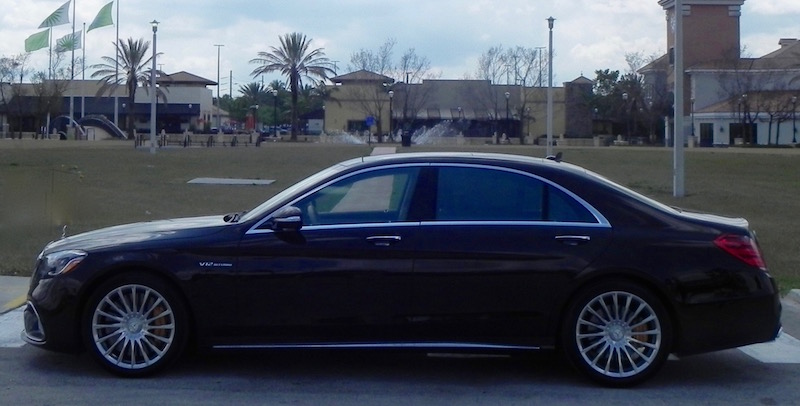
IN 2018 MERCEDES-AMG S65 SEDAN
Mercedes-Benz has added a new, V6-powered base model to its S-Class portfolio with the S450 making its debut for 2018, and I’m sure it’s a great car as is typical of just about anything and everything that comes off the German automaker’s assembly line.
But if you really want to get a feel for what the S-Class is all about, you need to check it out after the engineers in the AMG department get their hands on it.
The S-Class nomenclature has been used since 1972 and is short for Sonderklasse, which is German for “special class,” or cut to “S-Klasse.”
When it comes to the 2018 Mercedes-AMG S65 sedan, I have another word for the S-Class:
Superb.
Stunning also fits.
The opulent interior enmeshes you with unrestrained luxury with Nappa leather seats that caress your tush while their side bolsters gently hug you as you go around a corner. They’re heated and ventilated, of course, and offer massage capability and lumbar support to ease those long drives.
The 12.3-inch display screen is nicely integrated into the flow of the dash, which is accented by a soft, quilted leather panel on the passenger side for an eye-pleasing effect.
The flat-bottom steering wheel has a solid yet soft feel to the fingertips, and it comes with extra-size paddle shifters for selecting gears manually in the seven-speed automatic transmission, though if it’s performance you’re seeking, you will find the Sport+ setting delivers pleasing results.
 Backseat passengers get 41 inches of legroom and just over 39 inches of headroom and also get their own fold-down console when only two are riding in the rear.
Convenience features like keyless ignition with push-button start, dual-zone climate control, a 26-speaker Burmeister High-End surround sound system, COMAND system with navigation, electronic trunk closer and self-close doors, Bluetooth connectivity, voice control, and a bevy of safety features are standard.
The latter includes adaptive cruise control, head-up display, lane keeping/change assist, Pre-Safe Plus system with rear collision protection, a surround view system, active park assist, and the usual collection of air bags, include side-impact protection. It’s also going to monitor you as the driver to make sure you aren’t getting drowsy on a long trip.
Oh, heck. Let’s cut to the chase here. If a feature can be found in today’s automotive world, you can find it in the AMG S65.
About the only thing it’s not is self-drive and, frankly, with a bi-turbo V12 power plant at your disposal, why would you want that?
That engine sends 612 horsepower and 738 pound-feet of torque to the rear wheels that moves its nearly 5,000 pounds from zero-to-60 mph in 4.2 seconds, according to the company.
That result is a surprisingly nimble performance for a car of this class and size, and one that is equally smooth and quiet over the roughest of road surfaces.
(Sierra Club members might want to skip the next next sentence.) The AMG S65 drinks premium fuel at the rate of about 16 miles-per-gallon (13 city, 22 highway) or 6.3 gallons per 100 miles, according to the federal government. You were expecting more?
So now the kicker.
 As a super luxury sedan, it the AMG S65 carries a super luxury price tag. Starting MSRP is $229,500 with destination and delivery charge ($995) and options like a carbon braking system ($8,950) running the final total to over $240,000. That’s Super Luxury, all right.
Depending on where you live, you probably could get a nice, comfortable condo for that price, but remember this: You can sleep in your car (and there is plenty of room in the S65 for that), but you can’t drive your house.
What I liked about the 2018 Mercedes-AMG S65: Let’s make it quick. Darn near everything. Unlike a competitor, it also offers both Apple CarPlay and Android Auto capability.
What I didn’t like about the 2018 Mercedes-AMG S65: I’m getting more and more used to it, but the COMAND system for infotainment systems still can be distracting to operate.
Would I buy the 2018 Mercedes-AMG S65? Of course, I would, right after I win a multi-million dollar lottery. If you haven’t had any luck with Power Ball, note that opting for the V8-powered AMG S63 instead will save you around $82,000. It’s also slightly quicker with a 3.6-second zero-to-60 mph time, which may be one factor that eventually will lead to the end of the V12 in Mercedes models.
BMW’S 5-SERIES GETS PLUGIN HYBRID
FOR 2018 WITH 530e iPERFORMANCE SEDAN
The BMW 530e is pretty much a smaller version of the BMW 740e that I reviewed a couple of weeks ago, and I have the same issue with the 530e, a new plugin hybrid for 2018, that I did with the 740e.
I just don’t “get” the infatuation with plugin hybrids that deliver minimal mileage on electric power only.
I was able to go a bit farther on electric power with the midsize 530e than I did with the full-size 740e, which seemed to be about a blink, but still not so much that it would be classed as a “fully electric” vehicle. I still couldn’t get a full round trip of just over 20 miles in electric mode with the 530e, though it did seem to have more range than the full-size 740e.
That may not be much of a fair test, but it doesn’t make all the hassle with plugging the car in overnight to get a full charge worth it, at least not to me.
Of course, if you can pony up $51,400 for it, a figure that can quickly rise to over $65,000 when options are added in, you probably can afford to install a 240 volt charging system at your home and reduce
That is especially when you also take into consideration just how the 2018 530e iPerformance sedan performs when the 2.0-liter TwinPower Turbo 4-cylinder gas engine kicks in.
Running in conjunction with the electric motor like a typical hybrid setup, it sends 248 horsepower and 310 pound-feet of torque to the real wheels, enough to move its 4,226 pounds from zero-to-60 mph in 6.1 seconds, according to company clockers.
Mated with a 6-speed automatic Steptronic transmission with paddle shifters, mileage figures are more than decent, too — 29 miles-per-gallon combined city/highway.
Plus, and this is the big thing, you get all the finer things typical of the 5-Series portfolio (the turbo 4-cylinder 530i, V6 540i, diesel 540d, and V8 M550i), which means lots of leather and wood and soft-touch materials and lots of technological features such as navigation with a 10.2-inch high-definition screen and Apple CarPlay (but not Android Auto; sorry).
The front seats are adjustable 16 ways and include 4-way lumbar support, and you can get upgrades for heating and cooling functions as well as massaging front seats.
Dual-zone climate control, a rearview camera, and a 2-way power moonroof also are among standard features, and the soft-close automatic doors are a nice touch.
The overall cabin is spacious with front legroom of 41.4 inches and rear of 36.5. Trunk space is significantly less on the 530e from what is offered on other 5-Series models. Max is 14.5 cubic feet compared to 18.7 on the 530i, the latter figure being among class leaders. But the backseat folds with a 40/20/40 split to open up more space.
The exterior features BMW’s distinctive kidney grille and LED headlights and fog lamps along with eDrive badging on the C pillars. The door sills also get eDrive lettering, and there’s an eDrive button on the console in case you need another reminder that this is a gas-electric hybrid.
What I liked about the 2018 BMW 530e iPerformance: The overall driving experience is what you expect from BMW. It more than lives up to the company’s billing as an “ultimate driving machine” even with the “politically correct” drivetrain. (That is what a friend of mine called the 740e, and I considered it too good of a description not to borrow it from him!)
 What I didn’t like about the 2018 BMW 530e iPerformance: All the technology is nice, but can be overwhelming. At least the Germans seem to have dumbed it down a bit, but performing the simplest of tasks still take extra steps, which can be distracting.
Would I buy the 2018 BMW 530e iPerformance? Yes, and no. Or no, and yes. I love the overall vehicle and like that it is a midsize sedan over the full-size 740e, but I’m just not a fan of the plugin technology. One appealing thing is that the MSRP is low enough that when you take into considerations the tax credits you get for the electric technology, you likely will wind up paying less for it than for the base 530i.
HYUNDAI GIVES REFRESHED SONATA SEDAN UPSCALE TREATMENT FOR 2018
When it comes to midsize affordable, family friendly sedans, Toyota’s Camry and Honda’s Accord have been the traditional sales leaders in the U.S. for years, but they aren’t the only good choices in this shrinking segment.
In fact, they’re not even the only good one from an Asian automaker.
The Hyundai Sonata, made in the South Korean company’s assembly plant in Montgomery, Alabama, combines comfort and convenience in a vehicle with sharp, eye-catching styling.
Working in Hyundai’s California Design Studio, which was opened in Fountain Valley in 1990 and moved to its present site in Irvine in 2003, designers gave the Sonata a more refined look and larger cabin to move it into its seventh generation in 2015, and they have continued their tinkering with several updates for 2018.
They gave the exterior a new grille and more aggressive look overall, restyled the inside, updated the suspension, and made blind-spot warning and cross-traffic alert standard on all the trims, a nice touch when the usual practice is to make the bare bones model in the lineup just that.
Three different 4-cylinder engines are offered in the seven trim levels with the 2.4-liter serving as the standard power source. It is rated at 185 horsepower and 178 pound-feet of torque, enough for a confident performance for everyday chores.
It is mated with a 6-speed automatic transmission.
Also available are 2.0T models with a turbocharged 2.0-liter that ups the ante to 245 hp and 260 lb.-ft. and gets a new 8-speed transmission. Eco trim gets a turbo 1.6-liter paired with a 7-speed dual clutch transmission that acts like an automatic for the best fuel economy of the group (28 miles-per-gallon city, 37 mpg highway), though the 2.4L Limited isn’t much thirstier with numbers of 25/35.
My time was spent in the Limited trim with the 2.4L engine. It carries a starting MSRP of $27,400 over the base model’s $22,050, but your reward is a long laundry list of standard equipment and other features available for no charge.
These include safety technology like the blind-spot warning and cross traffic alert system cited earlier as well as headlights with what Hyundai calls Dynamic Bending Light to illuminate the path in the direction you are turning. Government crash ratings are 5-star across the board with rollover risk rated at 4 stars.
Among other items on the list the Limited’s standard or no-charge equipment are 17-inch alloy wheels, power sunroof, push-button start, heated side mirrors with turn-signal indicators, hands-free trunk with auto open, LED headlights and taillights, leather-wrapped steering wheel and shift knob, dual automatic climate control, 7-inch color touchscreen, Apple CarPlay and Android Auto connectivity, three years of Blue Link services, and heated and ventilated front seats.
Going for an optional Ultimate Package adds navigation with a 8-inch screen, automatic emergency braking and pedestrian detection (an Uber self-driving test model could have used that recently), lane-keep assist, automatic high beam assist, an Infinity premium audio system, rear parking sensors, and more for an extra $2,900.
With $885 for destination and delivery, that runs the total for the 2018 Hyundai Sonata Limited to $31,310, which is near the bottom of the top offerings in its class.
What I liked about the 2018 Hyundai Sonata Limited: A lot, really. Legroom is generous (45.5 inches in the front, 35.6 in the back), and trunk space (16.3 cubic feet) rivals some full-size sedans. The Sonata is big enough that the government (EPA) actually includes it in its list of “large cars” when comparing fuel economy.
The technology is very user-friendly (I love the small knobs for adjusting audio and larger ones for climate control temperature), and the optional 8-inch screen for navigation included in the Ultimate Package makes it easy on the eyes. The interior has a premium feel about it, and the touchscreen is nicely integrated into the flow of the dash. Plus I just like the way it looks.
What I didn’t like about the 2018 Hyundai Sonata Limited: I would like to drive it with the 2.0L turbo just to see the difference in performance. The standard engine is far from sluggish, though, and I never really felt I was lacking power. I would just like to see what more power would give it.
Would I buy the 2018 Hyundai Sonata Limited? Unequivocally, yes. It’s ironic that as the overall quality of affordable sedans continues to improve, the number of people buying them continues to decrease. Sales of midsize cars in 2017 were down just over 16 percent compared to 2016.
Only the Camry showed a gain while the Sonata was with all the others with a decline of 33.9 percent, ranking behind sales numbers for the Santa Fe SUV for the first time in the Hyundai stable. Frankly, it deserves a better fate, but buyers have an undeniable infatuation with SUVs/crossovers. Maybe the Sonata will help buck the trend.
BMW 740e GIVES BUYERS THE OPPORTUNITY FOR PLUGIN POWER IN A LUXURY SEDAN
If your concept of a plugin hybrid vehicle is a little econobox with the styling flair of a Model T, then we have a surprise for you.
BMW now offers a plugin hybrid version of its top-of-the-line 7 Series sedan.
Yes, even BMW, a manufacturer of vehicles that have become somewhat of the ultimate symbol of decadent opulence, has felt the need to cater to the public’s infatuation with plug-ins. Of course, government regulation has something to do with it, too. Got to meet those CAFE marks, you know.
Unlike a fully electric vehicle like the German automaker’s BMW i3, the BMW 740e xDrive is a conventional gas-electric hybrid equipped with a 2.0-liter, turbocharged 4-cylinder gas engine and an electric motor that combined produces 332 horsepower and 360 pound-feet of torque, the latter kicking in at only l250 rpm.
“Combined” is the key word here. It probably is going to account for the bigger part of your driving experience since “electric only” range is extremely limited.
How limited? I charged it overnight up to 100 percent capacity at home (it’s a considerably shorter time with the 240-volt outlet) and took off on electric power the next day. It seemed like I blinked and it was out of juice.
Of course, I exaggerate, but only a little. Officially, range on electric-only driving is an estimated 14 miles. You get it by pushing the proper button on the console, and then it switches to gas automatically when the battery is drained.
It’s not like you have to call for emergency road service, but still, if you live in an urban environment of almost any size bigger than Andy Griffith’s Mayberry you’re not going to be able to rely on electric driving for any extended time. If you want, you can set a target range for saving battery power to save all-electric driving for later.
Not that that is a bad thing.
Even with a 4-cylinder engine, a first for the 7-Series in cars BMW exports to the U.S. from the final assembly point in Dingolfing, Germany, the 740e is a pretty spritely performer. You can set it in various modes like Sport or Sport+ to enhance performance as well.
That is going to affect fuel mileage, of course. EPA figures are 27 miles-per-gallon running on gas only and 64 MPGe combined electric-gas operation.
The “xDrive” in the name, by the way, denotes it is all-wheel drive, the only configuration offered in plug-in models.
Other than the powertrain, the 740e offers anything and everything you can get in other 7-Series models, which means top-end cabin treatments with lots of leather and high-quality, soft materials and premium features like a Harman Kardon sound system and iDrive 6.0 system with touchscreen and a navigation system with a 10.2-inch, high-definition screen.
Keyless entry, a panoramic moon roof, backup camera, wireless charging and WiFi hotspot, adaptive LED headlights and fog lights, 14-way power adjustable front seat with lumbar support, an 8-speed STEPTRONIC transmission with paddle shifters, run-flat tires, leather-wrapped steering wheel, 4-zone climate control, and Concierge Services are included in the base MSRP of $90,700.
Throw in extras like a Driver’s Assistance Package (head-up display, blind spot detection, and lane departure warning), a Parking Assistance Package, Integral Active Steering, 19-inch wheels, Apple CarPlay (but not Android Auto) capability, along with other options and the total can come close to $100,000 with the $995 destination and delivery charge.
What I liked about the 2018 BMW 740e xDrive: The overall ambiance makes for an pleasant experience in the vehicle, even when stuck in rush-hour traffic. Despite its size (206.6 inches long, 74.9 inches wide with a wheelbase of 126.4 inches), the 740e is a capable performer.
What I didn’t like about the 2018 BMW 740e xDrive: Operating the infotainment systems doesn’t seem as imposing as it once did — maybe I’m getting used to them or BMW has dumbed them down — but I still find having to rely on spinning a dial on the console to get through various menu options, some of them as simple as changing audio mode or a radio station, to be distracting. Fortunately, I often have a driving partner with me to alert me when traffic has stopped a quarter-mile ahead. Having to plug it in to get a full charge (which takes time) can be a nuisance, depending on what the situation with electric outlets is in your driveway/garage. It is for mine.
Would I buy the 2018 BMW 740e xDrive? Probably not, because I just don’t get it when it comes to plugins. You can get a base 740i for a lot less, and even a 740i xDrive is going to save you several thousand dollars up front. You get all that’s good about the 7-Series plus the opportunity to step up to a more powerful powertrain, and fuel mileage in the base isn’t all that bad (21 mpg city, 29 highway with the turbo-6).