Thursday, May 4, 2017

2017 BMW X4 M40i OFFERS LOTS IN THE WAY OF PERFORMANCE, LITTLE IN FUNCTIONALITY


Chances are if you look for info on BMW’s X4 you’re going to find it listed with SUVs or maybe crossovers. For example, U.S. News & World Report in its compilation of reviews includes it in luxury compact SUVs along with its sibling the X3.

But that’s really not quite right.

The 2017 BMW X4 is what you might call a “tweener.” When it comes to hauling your stuff, the X4 comes up short of its competitors. It can handle a grocery run but a trip to Home Depot or Lowe’s could be another matter depending on how big your home improvement project is. Luggage for a family vacation also could be an issue.


At the same time, it is a bit too big to be considered a mere hatchback or luxury sedan/coupe.

So how does one classify the X4?

BMW solves the issue by calling it a SAC, or Sports Activity Coupe. (Which brings up the entirely different issue of having four doors while being called as a coupe, a debate we’ll save for another day).

The X4 followed the somewhat controversial X6 when it was shown at the 2014 New York Auto Show and marketed as a 2015 model. The X6 had been unveiled at the same show five years earlier and its radical styling, particularly when viewed from the back, made it a rather polarizing vehicle. You either liked the look, which had vestiges of Pontiac Aztec when viewed from the rear, or you hated it.


Because it is a bit smaller, however, the X4 gets away with that same general profile.

The first X4 came in two trims, the xDrive28i and the xDrive35i. The former featured a 4-cylinder power plant, the latter a 6-cylinder. Both were turbocharged, and the xDrive designated both trims as all-wheel drive.

The xDrive28i version is still offered for 2017, but the top-of-the-line model has since grown into X4 M40i with a Twin-Power Turbo, 3.0-liter inline 6-cylinder engine that produces 355 horsepower between 5800 and 6000 rpm with a maximum 343 pound-feet of torque between 1350 and 5250. It is mated to an 8-speed Sportronic transmission with sport and manual modes (steering wheel-mounted addle shifters). That combination results in fuel mileage numbers of 19 miles-per-gallon city, 26 highway, and 21 combined drinking using recommended premium fuel.


BMW says it will zip from zero-to-60 mph in 4.7 seconds, which puts it near the top of its segment.

Slip the transmission into sport mode and the damping control from comfort to sport or sport-plus gives you the kind of responses and handling you might expect from a top-of-the-line sports car.

And therein lies its strength. This so-called Sports Activity Vehicle is more about performance than it is anything else when it comes to SUV functionality — with the possible exception of its good looks and wealth of niceties.


The latter include Nevada leather upholstery (look it up), power glass moonroof, M design touches such as the leather-wrapped M-Sport steering wheel, Harmon Kardon premium sound system, power sport seats, and automatic dual zone climate control as standard or no-charge options included in the base MSRP of $58,100.

Add in some extras like a Technology Package that includes navigation, a head-up display for your speed (which is useless if you are wearing sunglasses with polarized lenses), and BMW Online and BMW Apps, and other options like 20-inch wheels instead of the standard 19s, a surround view camera, adaptive LED headlights, heated front and rear seats, and rear-view camera and the MSRP goes up to $67,495 (including the $995 destination and delivery charge.

That makes for a pretty well-equipped vehicle, but when it comes to things you expect in an SUV like hauling capacity, forget it. The 17.7 cubic feet of storage space behind the backseat is barely more than what you get in a full-size sedan, and it is further compromised by the slanting roofline that limits the height of your cargo. Fold the backseats and capacity is increased to 49.4 cubic feet, still short of several of its competitors, which include its sibling BMW X3.

But the “M” design tweeks are nice.

What I liked about the BMW X4 M40i: Besides the impressive driving performance, a little feature caught my fancy. It’s not new, in fact it’s been around for at least a decade on even non-luxury vehicles, but the auto hold function is a very nice addition. I don’t know why more manufacturers don’t pick it up. You press a button on the console and then every time you come to a complete stop, the parking brake is automatically set. This keeps the car from creeping forward and tapping the rear of a vehicle in front of you and also keeps you from rolling backward if you are on an incline. Yes, you can keep your foot on the brake and accomplish the same thing, but auto hold allows you to scramble to pick up anything that may have fallen on the floor. Please note: This is not the annoying start-stop system that shuts off the engine (though the X4 M40i has that feature as well) but simply a braking system. Responses to voice commands also are quick and sure.

What I didn’t like about the BMW X4 M40i: I tested the navigation system just once, and it took me on a rather round-about route to my destination, routing me to parallel streets for seemingly no particular reason. Turn directions kept referring to streets as State Route X instead of their more common name or street number. I don’t know what it may be like in Spartanburg, South Carolina, the final assembly point for the X4, but in South Florida, not many drivers are going to recognize many roads by their State Route number. 

Would I buy the BMW X4 M40i: No. The biggest thing in its favor is its driving dynamics, and it does have the advantage of giving you a high seating position over the usual sports sedan or coupe. But that’s not what I’m looking for in a Sports Utility, er Sports Activity, Vehicle.


Tuesday, April 25, 2017


JEEP COMPASS LOOKS TO BE FINDING

 ITS WAY WITH THE ‘NEW’ 2017 MODEL


Back a few years ago, I knew a guy who owned a Jeep Grand Cherokee, and whenever I would show up driving one of the Jeeps at the other end of the food chain, like say the Patriot or Liberty, he would kind of scoff and say, “That’s not even a Jeep!”

There was a tad of snobbishness in the way he said it, as if anything less than a Grand Cherokee wasn’t really up to Jeep’s traditional standards. (I’m assuming he didn’t include the Wrangler in his castigation of the smaller models.)


But in a way, he did have kind of a point. If still very much a part of the Jeep family, these models were kind of mired in the awkward adolescent stage. A couple of them were around for five years or less before the company gave up and took another crack at the compact/midsize SUV/Crossover segment with another product.

The Liberty, introduced as a 2002 model, almost made it to its teen years before giving way to the revived Cherokee about three years ago.

At one time, the Jeep Compass, introduced along with the Jeep Patriot at the 2006 New York Auto Show, seemed headed for a similar fate as the Liberty. Reviews knocked it for its sluggish performance, its fuel appetite, its poor handling, its small cargo area, and its general lack of features and overall quality. The best thing it had going for it was its relatively cheap price.


Even that couldn’t prevent a serious sales dip recently for the Compass, however. The numbers for March 2017 were off a whopping 66 percent from the same month the year before with a drop of 63 percent for year-to-date sales over the same period for 2016.

But the new Compass has taken the model in a new direction. (Couldn’t resist!)

Its engine packs more punch, it’s a bit more economical, and passenger and cargo room as been increased so as to make it at least competitive in a class that includes such notables as the Nissan Rogue, Honda CR-V, Toyota RAV4, Ford Escape, and Chevy Equinox, the sales leaders in the segment. The Compass also has the advantage of more off-road capability than others in the class.


The 2.4-cylinder Tigershark engine in the new Compass boosts horsepower and torque figures to 180/175, respectively, over the 158/141 of the 2016 base models as well as the 172/165 of the top-of-the-line offerings of last year. Fuel mileage increased slightly over 2016’s numbers, and both front legroom and rear cargo stowage area have been increased.

Jeep says cargo capacity behind the second row is up to 27.2 cubic feet from 22.7 and with the second row folded is up to 59.8 cubic feet from 53.6. Considering that hauling capability is one of the features you’re usually looking at when it comes to an SUV/Crossover, that’s a significant improvement.

My test vehicle for the week was the Compass Limited trim with four-wheel drive. The Compass also is offered in base Sport, Laramie, and Trailhawk trims, the latter for more serious off-roading enthusiasts, and with both 2WD and 4WD. The Compass Limited comes with a 9-speed automatic transmission as standard over the six-speed automatic or six-speed manual offered on other trims.

That combination results in fuel economy numbers of 22 miles-per-gallon city, 30 highway, and 25 combined, which I found fairly accurate after about 10 days of mostly highway driving. The computer showed me hovering around 25 mpg after approaching 30 earlier in my 240-mile stint.

FWD and manual transmission models vary by about a mile or two per gallon with the most efficient being 2WD models with manuals (23/32/26). Many of its competitors offer better numbers, but to be fair, some are worse as well.


The Limited 4WD has a base MSRP of $28,995, but adding such optional equipment as the UConnect 8.4 NAV system, Sirius satellite radio, a power liftgate, 19-inch black pocket aluminum wheels, Beats premium audio, and safety features such as blind spot warning, rear park assist, HID headlights, lane departure warning ran the total cost to $34,955, including the $1,095 destination charge.

We should offer up an alert here. Jeep is selling the 2016 Compass as a 2017 model under what FC Authority (an enthusiasts’ website) labels a “budget alternative” to the “all-new” 2017 Compass. It seems a little confusing, but Jeep attributes the reason to plans to market the new Compass later as a 2018 model while the old one (the 2016) will continue to be sold globally as a 2017. FC Authority notes some “wicked” deals are being made on the “old” 2017 models in the interim. Just make sure you know what you are getting.

What I liked about the 2017 Jeep Compass: All the technological functions in the Limited are extremely user-friendly. The 8.4-inch screen in the optional UConnect system is well worth the $895 cost. We also made good use of the extra cargo space!


What I didn’t like about the 2017 Jeep Compass: Though there is decent legroom in the front, the seats could offer more in the way of comfort. I’d like a bit more in the way of throttle response as well.

Would I buy the 2017 Jeep Compass: Unless I really wanted that off-road capability, which I don’t get to test much in South Florida environs, I probably would go for one of its many competitors first. But the Compass is worthy of a look.


Wednesday, April 12, 2017


JAGUAR F-TYPE SVR ROADSTER FOLLOWS IN THE FOOTSTEPS OF AN AUTOMOTIVE LEGEND


Three years ago or so Jaguar paid homage to its illustrious past when it brought the F-Type to the market.

It was the first roadster from the company in 40 years and stirred memories of the legendary Jaguar E-Type, which was based on the British marque’s D-Type racing car and manufactured from 1961-75.

Such was the admiration for the E-Type that Enzo Ferrari, who had some great looking machines coming out of his own shop, flatly declared it “the most beautiful car ever made.” High praise indeed.

So the F-Type had a lot to live up to when it came out as a soft-top convertible for 2014 and coupe the following year.

I’d say it has done a pretty good job of meeting that standard. If not the “most beautiful car in the world” — a subjective observation if there ever was one — it certainly ranks among the top five or so in today’s vehicles, though frankly I’m not sure why I picked five because I can’t think of four others I would rank ahead of it.

It’s that eye-pleasing and draws admiring glances whether it is sitting in the driveway or cruising the streets.


But to attain potential legendary status as a sports car a vehicle has to deliver in performance, and there the F-Type lives up to its promise as well.

Originally offered with both supercharged V6s and V8s that ranged from 340 horsepower and 332 pound-feet of torque to 495/460, respectively, Jaguar upped the ante for the F-Type in succeeding years with S and R trims that boosted those numbers up to 550/502.

For 2017, the Jaguar F-Type SVR — my drive for the week — even blows away those numbers with 575 hp and 516 lb.-ft. of torque. It leaps from zero-to-60 mph in 3.5 seconds and from 50 to 75 in 2.3, which helps not only when passing a slower vehicle but finding an open spot when changing lanes in traffic. 

With five trim levels overall, F-Types with the V6 engine are available with rear-wheel drive and manual transmissions, but V8 models like the SVR come only with all-wheel drive and an eight-speed automatic transmission. It has a sport mode and steering wheel-mounted paddle shifters for manual gear selection if desired.


That combination results in fuel mileage figures of 15 miles-per-gallon city, 23 highway and 18 combined with premium fuel recommended. Numbers for the V6 are 20/28/23 with an automatic and 16/24/19 with the six-speed manual. In the works for 2018 is a turbocharged 2.0-turbo 4-cylinder engine with 295 lb.-ft. of torque that claims a zero-to-60 time of 5.4 seconds.

In addition to appearance and performance, the F-Type also rates highly when it comes to the comfort and conveniences associated with the luxury class. The company didn’t skip when it came to quality materials. The power adjustable seats don’t recline all that far, this being a two-seater, but are power adjustable 14 ways and have adjustable side bolsters for support when pushing it around corners. The seats essentially envelop you when you get in.

Standard equipment on the F-Type SVR convertible includes a fully electric power top, premium Meridian sound system, touch-screen operation for the navigation system and other functions, automatic climate control, rearview camera, keyless entry and push-button start, blind-spot monitor (much appreciated with the restricted view you get with the top up), quilted leather seats, and suede dash trim.

Standard exterior features included HID headlights, a switchable active exhaust system, adaptive dynamic suspension, and a carbon fiber aerodynamic spoiler.

All that is included in the MSRP of $128,800 for the F-Type SVR — which approaches double the MSRP for the base F-Type convertible. Throw in the $995 destination and delivery fee and options like an extended leather package, carbon-fiber center console, illuminated treadplates, wheel locks, and a car care kit and the total for my test ride came to $132,283. 

One of the few shortcomings I found is in the technology. Jaguar always seems to be behind the curve when it comes to the operation of the gadgets and gizmos that fill modern luxury cars today, whether it be in the graphics or the steps needed to operate the functions. There was not a voice command system for audio or nav functions in the SVR, which doesn’t bother me but might some in the younger generation.


Here’s one of the mysteries in auto life. Why is it that the more expensive a car is, the more complicated operating the technological features becomes? At least the phone connects easily enough.

The shortfalls in technology, however, are trivialities compared to what the F-Type SVR offers in the way of performance, appearance, and luxury. Get behind the wheel and you’ll likely agree.


What I liked about the 2017 Jaguar F-Type SVR: The performance is exhilarating. Flipping the switch on the console to “Dynamic” even adds to the auditory experience with a staccato cadence coming from the dual-quad exhausts.

What I didn’t like about the 2017 Jaguar F-Type SVR: In addition to the techno quirks, the convertible trunk is small (only 7.3 cubic feet) and oddly shaped to accommodate the rear wheel wells. Not that you’re going to do a lot of hauling in it, but I’m not sure you could fit two average-size suitcases in there, especially if they were hard cases.

Would I buy the 2017 Jaguar F-Type SVR? Yes. Yes. Yes. it’s a great choice in the segment.


Sunday, April 9, 2017


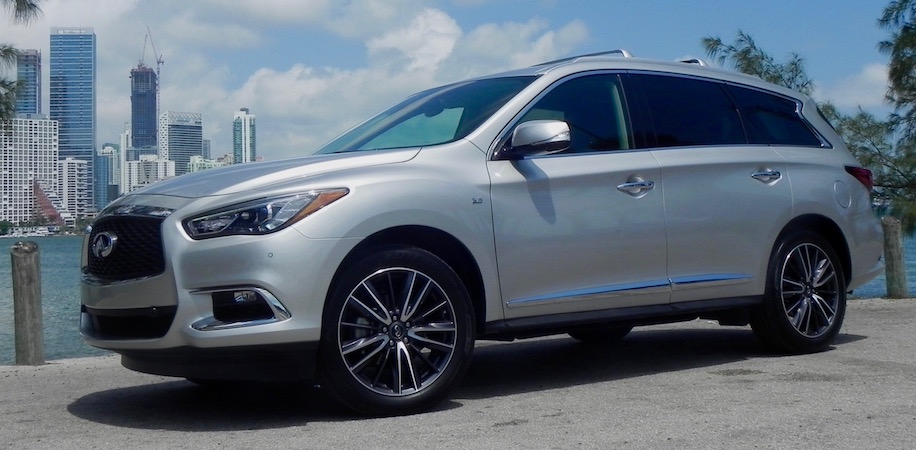
INFINITI QX60 OFFERS A LOT FOR A LITTLE (COMPARATIVELY) AMONG LUXURY SUVS


If you do a Google search for the word “inexpensive,”  the first synonym that comes up is “cheap.”

I’m here to say they don’t mean the same thing.

For instance, the 2017 QX60, a luxury midsize SUV from Infiniti, is inexpensive when compared to some of its competitors. But it’s not cheap by any means. Far from it.

Cheap would indicate the luxury arm of Japanese automaker Nissan had cut corners, used lower grade materials, and did just enough to get by when it introduced the vehicle under the JX35 nameplate as a 2013 model. It did not.


Rebadged the QX60 for 2014 under the company’s new naming policy, it offers all the amenities shoppers expect — no, demand — from the segment, with all the comfort and eye-pleasing design touches like maple interior trim and a console that has two levers to allow access to a shallow compartment for keys and door openers and another deeper one for larger objects like a camera.

And it comes with a base MSRP of $43,100 plus the destination and delivery charge of $995, leaving well under the $45,000 threshold. It’s slso a chunk of change well under that of all but a handful of its competitors in the class.


Standard equipment included in that price are a 3.5-liter, V6 engine that has been juiced up to 295 horsepower and 270 pound-feet of torque from the 265/248 of the 2016 model, a continuously variable transmission (CVT), leather appointed seats, 8-way power driver’s seat with manual lumbar adjustment, leather-wrapped shift nob and steering wheel, tri-zone (left, right, rear) climate control, HID headlights and LED fog lights, 8-inch color information display, rearview monitor, voice recognition for audio and Bluetooth, push-button start, a power moonroof, and a raft of safety features that results in an overall five-star safety rating from the National Highway Traffic Safety Administration.

To get more of the good stuff, yes, you’re going to have to delve into options and packages that are going to run the price up. In fact, a Premium Package (two-way power lumbar, heated steering wheel, remote engine start, etc.), Premium Plus Package (Infiniti InTouch with navigation, etc.), Theater Package (dual 8-inch rear-monitors for video playback, etc.), and Deluxe Technology Package (20-inch aluminum alloy wheels, Bose cabin-surround sound system, Intelligent cruise control, motion-activated rear liftgate, etc.) ran the total MSRP for my test QX60 to $58,245, which still is below base price for others in its class.

Remember, inexpensive, but not cheap!

Among other attributes, the QX60 seats seven with remarkable space for those relegated to the third row. With 30.8 inches of legroom, a couple of adults can easily fit back there, and second-row occupants have enough room (a maximum 41.7 inches of legroom) to move their seats forward to make life easier for those in the third row. Access to the far back also is quite good. You simply pull a knob on the back of the second row seats and they slide forward and you step in. The seats flip back into position easily as well.

The downside is that cargo space behind that third row is a somewhat meager. With all seats in place, stowage is listed at 15.8 cubic feet, hardly the size of a good-sized sedan trunk. Flip those third-row seats forward and the space increases to 40.8 cubic feet.

The infotainment systems is remarkably user friendly. Don’t like to use a touchscreen or the rotary knob for various selections? No worry. Duplicate buttons, including knobs to adjust audio sound levels and surf the dial, are there as well. There are plenty of USB ports, one in the console and three in the back, for charging your devices.


Though I’m not a big fan of CVTs, I found the QX60s performance adequate for the class. No, it’s not a Porsche Cayenne, but it’s not a slug either. You can adjust the transmission for Standard, Sport, Eco, or Snow mode, and I found leaving it in Sport resulted in somewhat livelier responses.

The website zeroto60.com clocked an all-wheel-drive version of the QX60 from zero to 60 mph in 7.1 seconds. That won’t give you whiplash, but it’s not going to have you banging the steering wheel for more speed.

The upside comes with fuel mileage ratings of 20 miles-per-gallon city, 27 highway, and 22 combined, among the best of the non-hybrids in the segment. Premium fuel is recommended for top performance, so why go chintzy?


The ride itself is quiet and smooth. I found the QX60 to handle normal road bumps quite well, and it was particularly at home for highway cruising. At the same time, it’s not overly big to cause you any concerns when it comes to navigation shopping mall parking lots.

What I liked about the 2017 Infiniti QX60: Technological functions are plentiful and very user friendly. You can use a rotary knob to adjust the cursor, use the hard-wired buttons on the center stack, or the touchscreen. (Touchscreen is not the best choice.) Response to voice commands also was good.

What I didn’t like about the 2017 Infiniti QX60: Storage is limited when all seats are in place. That’s the curse of three-row SUVs.

Would I buy the 2017 Infiniti QX60? I don’t have a need for a three-row SUV, but if I did, I would have this one on my shopping list. I’d had to overcome my antipathy toward CVTs, but this one has more the feel of an automatic than any I have encountered. The test model didn’t come with paddle shifters, but you can select corresponding gear ratios via the console shifter.


Thursday, April 6, 2017

VOLKSWAGEN HOPES TO GAIN SALES MUSCLE WITH INTRODUCTION OF NEW ATLAS SUV


A new SUV is coming to Volkswagen showrooms in May.

And yes, the VW folks say, its an SUV, not one of the growing numbers of “crossovers” that basically put an SUV body over a sedan chassis. (Though Mark Gillies, Senior Manager for Product Communications, sees them as “interchangeable terms.”)

The 2018 VW Atlas will be a second model to come out of the German automaker’s assembly plant in Chattanooga and will be distributed throughout the U.S., Canada, and Mexico on this side of the Atlantic and Russia and Middle Eastern countries on the other. It also will be manufactured and sold in China under the name Teramont.


VW chose the San Antonio suburb of Boerne (pronounced “Bernie”) in the heart of Texas Hill Country as the site to preview the new model to automotive media members from around the country and the world, really, with representatives from the Mideast, Russia, Canada, and Mexico included in one of the sessions as well.

Why Texas?

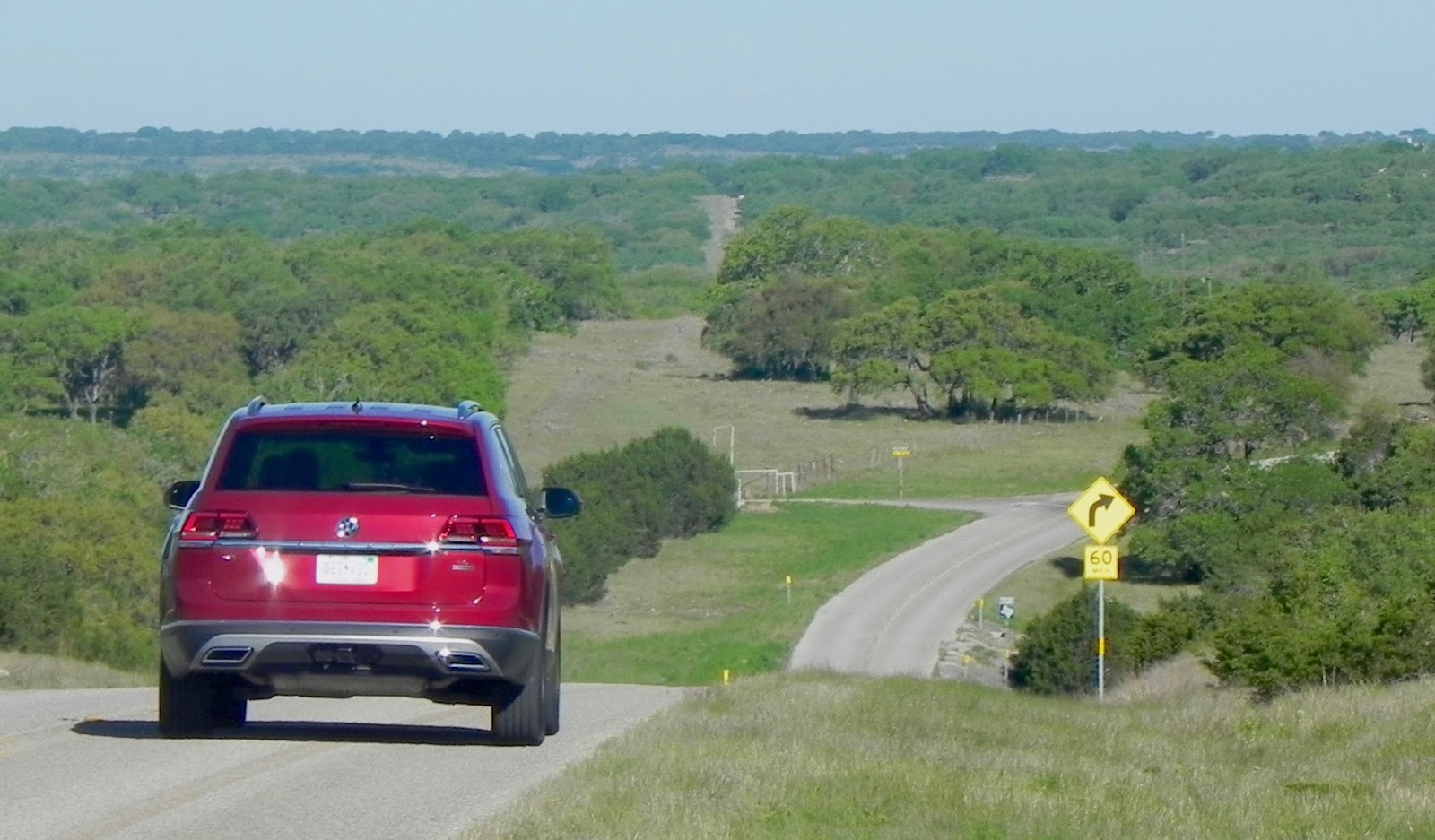
“If you look at it,” Gillies said, “the Atlas is a really big midsize SUV and it looks right at home here on the roads in Texas alongside all the trucks and SUVs here.”

A second reason, he added, is that the company tagline is “Life is as big as you make it,” and there’s no place bigger in the Lower 48 states than Texas. At 198.3 inches long, 78.3 inches wide and 70 inches high, the Atlas is larger than any other VW model on sale in the U.S.


Texas Hill Country also offered the opportunity for journalists to stretch the legs of the new vehicle over a series of curvy Texas roads, including one stretch of two-lane highway that featured a 70 mph speed limit! Yes, a road with driveways coming in at the edges and lots of yellow paint lines down the middle actually legally lets you hit what are usually interstate limits only with no fear of being introduced personally to a Texas lawman.

And the Atlas was easily up to the challenge.

My drive was spent in a top-of-the-line SEL Premium trim which features a 3.5-liter V6 engine (VR6 in VW vernacular) hooked up to an eight-speed automatic transmission and rated at 276 horsepower and 266 pound-feet of torque.

With all-wheel drive, this setup allows for up to 5,000 pounds of towing capacity when equipped with a factory-installed trailer hitch (only 2,000 with an aftermarket hitch). It seats up to seven passengers and gives those in the third row a decent amount of legroom for adults and fairly easy access thanks to second-row seats that slide forward even with baby carseats in place.

The Atlas has off-road capability as well — though you wouldn’t want to go challenge the Rubicon Trail with it —  and as evidenced by the number bicycles they loaded up on one of the display vehicles seems targeted not just for families but for active ones as well.  There are numerous driver assistance and safety features, many of them — like the Automatic Post-Collision Braking System that is designed to prevent a secondary collision, a segment first — coming as standard in all Atlas versions.


It comes in five trim levels, starting with the base S, which carries a base MSRP of $34,625 (including $925 destination and delivery) and will be available later. The SE starts at $37,715, the SE w/Tec $39,815, and the SEL $43,615. The SEL Premium tops the lists at $49,405 and that includes the V6 engine and VW’s 4Motion AWD system over the standard FWD.

A 2.0-liter, turbocharged 4-cylinder engine (235 hp, 258 lb.-ft. of torque) also is offered but wasn’t available at the preview. VW expects the V6 to be the far more popular choice among buyers. If you want AWD, it is available only on the V6. Mileage numbers for the V6 are 18 miles-per-gallon city, 25 highway, and 20 combined with FWD and 17/23/19 for AWD using regular fuel.

The SEL Premium model handled the bumpy Texas roads with assurance, and aside from the slightest bit of wind noise noticeable on the passenger side, was quiet as well. When pushed up grades or when revved up on a short stretch of interstate, the engine did not seem overly strained.

VW also seems to have hit the sweet spot as far as size — big enough to provide up to 96.8 cubic feet of cargo space with all seats folded (and 20.6 with all upright) but not so big it hogs the road. It was at home in both the tighter two-lane stretches for Hill Country roads and stretches of four-lane as well.

It has a nice exterior appearance about it as well with a nicely designed beltline that flows over the wheel wells and hits home at just the right level to keep the side from taking on a flat, bland appearance. The front grille is distinctive as well. Take away the VW logo in the center, however, and it has somewhat the look of a Land Rover Range Rover Sport. That’s not a knock. It’s just the impression I got. Not sure anybody else did, though.


How the Atlas fares in the very competitive midsize SUV market is going to be interesting to keep an eye on. Volkswagen has been working to regain the trust and confidence of the public since the diesel emissions scandal hit the company less than two years ago, and it seems to be succeeding.

Mike Lovati, Vice President of the Midsize/Full-size Product line, said VW sales for the first quarter of this year were at about 76,000 units, compared to less than 70,000 for the same period a year ago, and March numbers were up to 27,635 units, an increase of 2.68 percent over March 2016.

The Tiguan is enjoying its best sales ever, and the Golf sport wagon sales, including the new Alltrack, also are up significantly, Lovatti said.

The 10.3 percent increase in overall sales ranks VW fifth among carmakers in percentage growth, though you have to remember that with smaller overall numbers small increment increases result in bigger percentage jumps.

“Volkswagen becomes a full-line, family-focused auto manufacturer with the vehicles we are now bringing to the market,” Lovati said. “With the addition of the Atlas and the 2018 Tiguan we’ll be competitive in four of the five biggest segments of the U.S. market — compact sedan, midsize sedan, compact SUV, and, of course, the midsize SUV.


“So we’re really going at the core of the market at the sweet spot. The Atlas is helping us and the new Tiguan at the middle of this year is helping us as well.

“So our Atlas — built in America and designed for the American family. It’s built alongside the Passat at our Volkswagen assembly plan in Chattanooga, and it’s the result of an additional $900 million investment by Volkswagen over the past few years.

“We’re very proud about this.”


It will surprising if the Atlas doesn’t figure prominently in continuing that momentum.


Wednesday, March 29, 2017


2017 BMW 550i EARNS ITS REPUTATION 

AS AN ‘ULTIMATE DRIVING MACHINE’


It was over four decades ago that BMW came up with the slogan “The Ultimate Driving Machine” to promote its vehicles. Ten minutes behind the wheel of a 2017 BMW 540i recently convinced me the company has a strong case for the claim that came from the fertile mind of automobile legend Bob Lutz.

Oh, it’s not like BMW is the only manufacturer producing vehicles that combine performance, luxury, and comfort in an attractive package with all kinds of gee-whiz, technological functions. Its Teutonic brethren Mercedes-Benz and Audi do that quite well, too. But though competitors may do it as well, you’re not likely to find any that does it any better.

Although the 3-Series remains BMW’s best-seller, the 5-Series offers many of the same advantages for those shopping for a slightly larger vehicle in the luxury class. In fact, the 2017 5-Series grew slightly longer and taller than its predecessor as it moved into its seventh generation this year, resulting in slightly more legroom for backseat riders and increased trunk capacity to a generous 18.5 cubic feet. But it still managed to lose a little weight (137 pounds) through extensive use of aluminum, magnesium, and high-strength steel.


With a new 3.0-liter turbo inline 6-cylinder sending 335 horsepower and 332 pound-feet of torque to the rear wheels via an 8-speed automatic transmission, the 540i is a surprisingly nimble performer, scooting from zero-to-60 mpg in a tick under five seconds, according to company clockers.

I say “surprisingly” because from a driver’s perspective looking over the relatively flat hood design the impression is that this is a bigger car than it really is. At 194.6 inches long, however, it’s a foot shorter than the 7-Series, which also is a little over an inch wider than the 5-Series.

Fuel economy for the 540i is rated at 20 miles-per-gallon city, 30 mpg highway, and 24 mpg combined, which understandably is short of the numbers the 4-cylinder 530i delivers but still competitive for the class. BMW recommends premium fuel for both, and if you’re skimping on that, you’re probably not getting all the performance out of your car that you should. There could be even long-term effects that aren’t good.


Frankly, if you’re spending well over $50,000 for a car, why in the world would you risk that just to save a few cents on a gallon of gas? (At the same time, if regular fuel is all that is required for your vehicle, don’t waste your money buying an occasional tank of the “good stuff.”)

If you want to save a tiny bit of fuel, you can set the 540i in “Eco” mode instead of “Comfort.” Or if you want to bump up the driving fun, you may set it in Sport mode and or choose your own individual settings for throttle response and suspension, though leaving it in “Comfort” is not a bad choice.

In addition to the power, the 540i provides a steady, quiet ride, coddling the passengers with high quality materials and absorbing road bumps nicely even when the suspension is firmed up.

Standard features for the base MSRP of $56,480 for the 540i include dual zone climate control with individual blower settings, 16-way power adjustable front seats with 4-way lumbar support for the driver, moonroof, Bluetooth phone and audio, and navigation. Exterior standard features include adaptive LED headlights, LED fog lights, and chrome line exterior trim.


Of course, the 540i is packed with a ton of technology, some of which has trickled down from the flagship leading 7-Series. This includes an optional gesture control system that lets you operate some functions by waving your finger around. 

For instance, the radio too loud or too soft? You can adjust it by placing your elbow on the center console, holding your arm at about a 45-degree angle, and pointing your index finger toward the rearview mirror. Turn your finger clockwise and the volume gets louder. Turn it counter-clockwise and it gets softer.

The benefit of this?

Good question. Consider that a knob on the dash for adjusting the volume is just inches away from the steering wheel and also that there are buttons on the steering wheel to turn it up or down as well, the ability to accomplish the task by waving your finger around falls into the category of “just showing off.” It’s like the engineer wanted to show that he could do it.


The voice commands, however, are another matter. I was impressed, very impressed, when the system was able to input the address for my destination very quickly and respond to my request without hesitation even while I was driving at highway speed. That the recommended route took me a rather strange way, including a jaunt through a strip mall parking lot to a closed gate, was another matter. (I had been to where I was going before but I always like to see what the various navigation systems recommend.)

Unfortunately, so many of the good things that really make a luxury car a luxury car these days come in option packages that can really run up the base MSRP. Packages like M Sport (distinctive steering wheel and design touches), Cold Weather (heated seats and steering wheel), Driving Assistance (rearview camera displays to aid in backing/parking), Driving Assistance Plus (blind spot detection, etc.) Dynamic Handling (better handling on rough roads), and Premium (wi-fi, satellite radio, keyless entry) plus stand-alone options like M Sport brakes, self-close automatic doors, remote control parking, ceramic controls, power rear window shades, Apple CarPlay capability, a Bowers & Wilkins premium sound system and the gesture control capability ran the total to over $80,000.

Add in the $995 destination and delivery charge and the final tab for my test 540i came to $81,910. That’s a jump over the base of just over 45 percent (assuming I did the math right), which is quite a big jump. It might behoove BMW to include a few more things as standard and raise the base MSRP accordingly, but that is something that is above my pay grade. It all works out pretty much the same anyway.

What I liked about the 2017 BMW 540i: The power trunk opens with the wave of your foot under the rear bumper if you have the key fob (which is the size of an old flip phone) on you. I have seen this on several SUVs and crossovers, but this was a first for me on a sedan. The trunk is a spacious 18.5 cubic feet.

What I didn’t like about the 2017 BMW 540i: The iDrive system is getting easier to operate (maybe I’m just getting familiar with it) but it still seems to me to require some extra steps to perform simple functions.

Would I buy the 2017 BMW 540i: Yes, emphatically so. It at least should be on your list  to check out if you’re looking in the luxury midsize segment.


Wednesday, March 22, 2017

FIAT 500X ADDS FLAIR TO A GENRE 

KNOWN MORE FOR ITS ECONOMY


Subcompact cars are usually more about functionality and fuel-saving than they are about style. Not that they are all inherently ugly, but style is not the first thing that comes to mind about them.

Fiat’s 500 series, however, is one exception.

With its Italian lair and carefree air — the front fascia even has a rather impish look about it — the Fiat 500 series adds a little chicness to a segment that tends to lean toward “cute” when it comes to appearance.


The first Fiat 500s landed in the U.S. about five years ago with the 500 hatchback, convertible and performance-oriented Abarth models, and an electric version came a year later. They were all nimble two-door cars with an appeal to a young, fun-loving market.

A couple of years later Fiat added the 500L wagon and the 500X followed a couple of years ago. (You may remember 500X from the clever Super Bowl commercial in which a “little blue pill” bounced its way into its gas tank, giving the 500 hatchback bulging fenders and a couple of extra doors. If not, you can look it up on Youtube.)


My recent ride was the top-of-line Lounge model of the 2017 Fiat 500X. It comes in two other flavors, Pop and Trekking, for a total of three trims, two fewer than when it was introduced. Easy and Trekking-Plus trims were discontinued for 2017.

The Lounge trim features the larger of the two engines offered on the 500X, a 2.4-liter inline 4-cylinder rated at 180 horsepower and 175 pound-feet of torque. It’s also standard on 500X Trekking models and available as an option on the Pop, which gets a 1.4-liter 4-banger as standard.


Front-wheel drive is standard on all trims with AWD available as an option. The 2.4-liter gets a nine-speed automatic transmission as standard, the 1.4-liter a six-speed manual. That’s kind of a shame since I would have liked to tried out the manual with the larger engine. It would have been more fun to drive than the the automatic.

With the automatic, performance may fall short of some of its competitors, but when Sport mode is selected (accomplished by turning a knob on the console), the pace is picked up. Fuel economy is a bit on the low side for the class, however, with the 2.4-liter rated at 22 miles-per-gallon city, 30 highway, and 25 combined with FWD drinking regular 87 octane fuel. (Regular also is acceptable on the 1.4-liter, but premium 91 octane is recommended for it.)

The emphasis on design also carries over into the interior. It’s not luxury class, of course, and the dash features a wide band of plastic across the front, but the 6.5-inch display screen is nicely integrated into the flow of the dash. Overall, there is a nice ambiance about the cabin. The backs of the two-tone front seats are embossed with a “500” logo, a nice touch.

The Lounge trim comes with Fiat’s UConnect system for operation of the infotainment system with functions via the touchscreen or voice commands that responded readily, and accurately, during my week’s trial. There are also two knobs to operate the radio and three larger knobs for controlling the dual-zone air conditioner/heater.

The 6.5-inch NAV UConnect system is standard on the 500X Lounge (optional on Trekking). It includes navigation, Bluetooth handsfree phone, and satellite radio in the base MSRP of $25,150.

But to get the latest safety features you’re going to have to delve into the options. A rear-view camera is standard on the 500X Lounge (it’s only an option on the Pop and Trekking models), but to get the features like lane departure warning, full-speed frontal collision warning with active braking, rear park assist, blind-spot monitoring, automatic high beam headlight control, and rain-sensitive windshield wipers you’re going to have to add the Advanced Safety Package for $1,295.

Adding an optional Premium Package (upgraded sound system), dual-pane sunroof, and 18-inch wheels with all-season tires plus the $995 destination and delivery charge put the final price tag of my test 500X at $28,935. That put this 500X Lounge at the higher end of the segment pricing.

What I liked about the 2017 Fiat 500X Lounge: It’s pretty spacious for passengers and even offers pretty good legroom (up to 34.8 inches) in the second row. Features such as navigation, audio, and climate control systems are very user-friendly and respond quickly and accurately to voice commands. The ride is comfortable, especially for a vehicle this size.

What I didn’t like about the 2017 Fiat 500X Lounge: Gas mileage is disappointing. Storage behind the second row is a meager 12.2 cubic feet.


Would I buy the 2017 Fiat 500X Lounge? Don’t think so. Though the 500X (and other Fiat 500 models, for that matter)) are at the top of their class when it comes to out-of-the-box styling, it gets a bit too expensive when the extra safety features are added on.