Showing posts with label Rogue. Show all posts

Friday, August 31, 2018

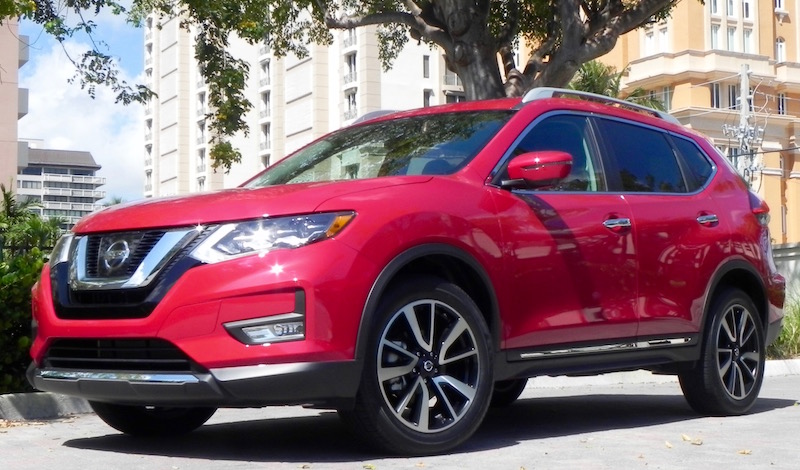
2018 NISSAN ROGUE CROSSOVER GETS PROPILOT TECHNOLOGY FOR SL MODELS 


Nissan followed up its redesign of its popular Rogue crossover with several midyear enhancements 2017, and the updates keep coming for 2018 with added technology that represents a step — albeit a baby one — to self-driving capability.


The system, dubbed ProPilot, is available on the top trim Rogue SL model as part of a $790 Platinum Package suite of features that also includes 19-inch wheels (replacing standard 18-inchers) and an electronic parking brake.

To activate ProPilot assist technology, you simply push a button on the right side of the steering wheel spoke, then set the desired speed for the adaptive cruise control for the system to kick in.

In addition to keeping your Rogue at a proper distance from the vehicle in front of you, ProPilot also gently helps keep you in your proper lane via a camera-based system that works in a variety of conditions.


Frankly, the technology isn’t all that ground-breaking. I have driven many vehicles that give you a warning, either by an annoying buzzer or by gently vibrating the driver’s seat, to let you know if you are drifting out of your lane, and even been in some will give your steering wheel a nudge to keep you aligned properly.

Those, however, were a bit too aggressive, and even ProPilot takes a bit of getting used to.


Probably the most important thing to note about the ProPilot Assist is the the word "assist." It does not turn the Rogue (or the Leaf) into a self-driving car.

You still must perform basic functions, like keeping your hands on the steering wheel and keeping track of traffic around you. You can’t haul out your cell phone and start dialing calls (though you can I guess if you have synced your phone through the Bluetooth system).

Frankly, other than the adaptive cruise control, I’m not sure I would opt to include ProPilot among the options I would pay extra for, especially with adaptive cruise control and lane departure warning now standard on the SL, but it's not like the cost runs into four figures.


It’s kind of like off-road capability. Even if you don’t use it, it’s nice to know it’s there.

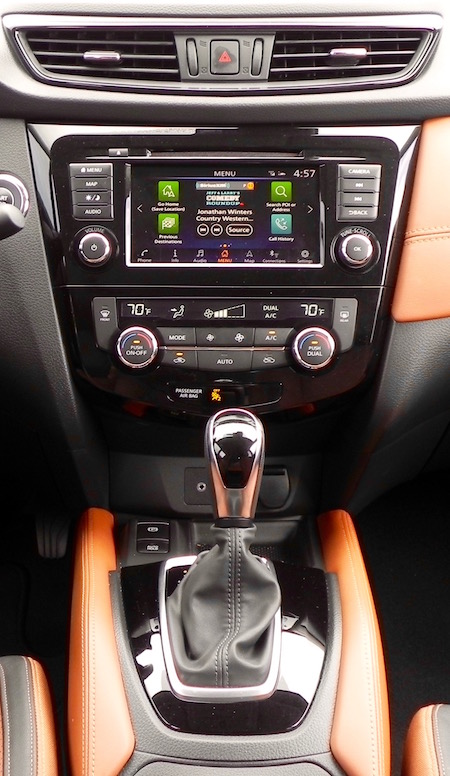
Other changes to the Rogue for 2018 are NissanConnect with Apple CarPlay and Android Auto and an additional USB port to all trim levels (S, SV, and SL) and standard Intelligent Cruise Control, Lane Departure Warning, Intelligent Lane Intervention and Automatic Emergency Braking with Pedestrian Detection for the SL grade.


S and SV trims also get some revised features and colors.

All three are powered by a 2.5-liter, 4-cylinder engine that is rated at 170 horsepower and 175 pound-feet of torque and mated with — dare we say it? — a continuously variable transmission.

Three driving modes are offered with Sport to enhance (a little) performance and Eco to save (a little) fuel along with standard or normal mode that earns mileage ratings of 25 miles-per-gallon city, 32 highway, and 27 combined.

Those are good figures and, according to the government, you will spend zero, yes zero, more dollars on fuel costs over a five-year period for the Rogue over other compact crossovers/SUVs.

But, thanks to that CVT, the fun driving quotient is very low.

The Rogue’s other qualities, however, weigh heavily in its favor.


The cabin design is very pleasing to the eye and the materials first-rate. Put an analog clock in the middle of the center stack and slap on Infiniti badging and it very easily could match up to offerings from its upscale siblings.

Price for the Rogue starts at $25,395 (including $975 destination and delivery) for front-wheel-drive S models. The SL with all-wheel drive starts at $33,385, and the SV trims sit in between. Hybrid models start at $27,615 for FWD and go up to $38,885 for SL models with AWD.


What I liked about the 2018 Nissan Rogue SL: The well-trimmed cabin is roomy and comfortable, and there's nice storage space (39.3 cubic feet) in the back with the elimination of the third row seating. The technology is plentiful and user friendly, especially for us non-geeks. And the exterior appearance doesn't take a backseat to any other vehicle.

What I didn't like about the 2018 Nissan Rogue SL: Nissan has refined the CVT to a fine point, but there is one thing it can't get away from. It's still a CVT. Whatever the engine might deliver in the way of performance, the CVT takes away from it.

Would I buy the 2018 Nissan Rogue SL? I basically have struck two vehicle types off my list of potential purchases: Plugin hybrids and vehicles with CVTs. Thankfully, this isn’t a plugin. If those features don't bother you, and you don't care about sporty performance in a crossover, then yes, the Rogue is a good choice. I might even overlook that it has a CVT next time I go vehicle shopping.


Tuesday, July 4, 2017


2017 ROGUE SPORT A SMALLER VERSION OF NISSAN’S POPULAR ROGUE CROSSOVER

Perhaps in an effort to capitalize on the popularity of the Rogue, which was the company’s No. 1 seller in 2016, Nissan has come out with a slightly smaller version of the compact crossover that it has dubbed the Rogue Sport.

It shares the same platform as its big brother and offers several of the same convenience and safety features — like Nissan’s Intelligent Cruise Control, Forward Emergency Braking with pedestrian detection, lane departure and blind spot warning, and rear cross traffic alert — as the Rogue.


LED headlights, a power sliding moonroof, Apple’s Siri Eyes-Free system, heated front seats, remote start, and Nissan’s Around-View monitor system are available on the Rogue Sport, just like on the full-size Rogue, and you also have a choice of front-wheel or all-wheel drive.

But this is no knockoff. The interior has a nice ambiance about it. There was no skimping on the Rogue Sport when it comes to styling or cabin comfort.

So what are the differences?


The most obvious, of course, is the size.

At 172.4 inches long, the Rogue Sport is about a foot shorter than the Rogue. This results in slightly less legroom in the second row for the Rogue Sport (33.4 inches to the Rogue’s 37.9), though the front legroom is virtually the same (42.8 in the Rogue Sport, 43.0 in the Rogue). At 104.2 inches, the Sport’s wheelbase is just over two inches shorter. 

The rear cargo area in the Rogue Sport is smaller, but actual capacity depends on the model.


The Rogue Sport S trim offers up to 22.9 cubic feet with the second row of seats upright and 61.1 with it folded compared to the Rogue’s 32.0/70.0, respectively.


The Divide-and-Hide stowage system, which gives you an area underneath the rear cargo floor to store items, is standard on SV and SL trims and trims storage capacity to 19.9 and 53.3 cubic feet overall.

The Sport’s width is virtually the same as the Rogue (72.3 and 72.4 inches), but the Rogue is about six inches taller than the 62.5-inch Rogue Sport.

All that said, you’d probably have a hard time singling out the Rogue Sport in the parking lot were it not for the “Rogue Sport” labeling at the left rear.

Even the wheels are close enough in size. The Rogue Sport S gets 16-inch steel wheels and the SV and SL get 17- and 19-inch alloy wheels. The Rogue offers 17s and 18s depending on the trim wth 19s as an option on the top-of-the-line SL.

Under the hood, the 2017 Rogue Sport comes with a 2.0-liter inline 4-cylinder engine that is rated at 141 horsepower at 6000 rpm and 147 pound-feet of torque at 4400. Numbers for the 2.5-liter 4-banger in the Rogue are 170/175, respectively, so yes, you’re going to get less of a kick from the Rogue Sport.


Mated to a CVT (continuously variable transmission) with sport mode, fuel economy for the Rogue Sport is 25 miles-per-gallon city, 32 highway and 28 combined with FWD, 24/30/37 for AWD. Those are nearly the same numbers as the Rogue (which with the mid-year enhancements it received is listed as a 2017.5 model).

As you might expect, the Rogue Sport does have an advantage when it comes to MSRP.


The Rogue Sport S with FWD starts at $21,420, and the most expensive Rogue Sport is the SL with AWD that opens at $27,420 before the $960 destination and delivery charge and options are added on.

MSRP for the full-size 2017.5 Rogue starts at $24,420 for the S FWD and runs on up to $31,710 for the SL AWD. Hybrid versions of the Rogue in all three trims run from $26,640 to $32,910.


What I liked about the 2017 Nissan Rogue Sport: The Rogue Sport shares its bigger brother’s attractive looks both inside and out. The front cabin is roomy, and operation of the NissanConnect system with navigation is easy enough, though responses to voice commands sometimes faltered. (No, I don’t want SXM 70s on 7. I want my Blue Collar guys on Channel 97!)

What I didn’t like about the 2017 Nissan Rogue Sport: It’s nice to have simulated manual gear shift points to provide a Sport mode with the CVT, but without paddle shifters, it’s somewhat of a wasted feature. A larger screen for the navigation monitor also would be nice.

Would I buy the 2017 Nissan Rogue Sport? Probably. I realize that’s a rather flimsy endorsement, but it’s not because the Rogue Sport isn’t a quality vehicle. It’s just that the subcompact SUV segment features some pretty stiff competition. There’s enough storage and room for five passengers, all right, especially for an empty nester, which is what the genre is all about, but I’d like a little more in the way of performance. It did seem to labor when I pushed it a bit. 

Wednesday, March 15, 2017


2017 NISSAN ROGUE SL COMES 

PACKED WITH LUXURY-STLE FEATURES


The line between entry level luxury cars and well-equipped so-called “affordable” vehicles seems to get more blurred every year as what were once exclusive features in the more expensive segment trickle down the line.

Oh, you may not get all the styling tweaks, and the cachet a luxury logo give you may be missing, but if that doesn't bother you, you may be able to save some bucks by going with the top-of-the-line offering from an “affordable” brand over the luxury choice.

One such example is the Nissan Rogue.

The 2017 Rogue SL is a good-looking vehicle inside and out and comes with a long list of features, many of them standard, that provide about all you would want in a crossover.

Among standard features are NissanConnect with navigation, 8-way power adjustable driver’s seat with lumbar support, a backup and surround-view camera with rear cross-traffic alert, heated front seats with position memory settings, blind-spot warning, Bose premium sound system, Bluetooth handsfree phone, dual zone climate control with second row vents, keyless entry and push-button start, a power liftgate that opens with the wave of your foot under the rear bumper when the key is near, and more.


With all-wheel drive (over front wheel) and a couple of option packages that included a power panoramic moonroof, LED headlights, adaptive cruise control, lane departure warning and prevention, forward emergency braking with pedestrian detection, 19-inch alloy wheels over the standard 18s, and tan leather-appointed seats with quilted insets, the Rogue I had for the past week had just about everything you might want in such a vehicle for a price that came in at $35,475.

That’s a jump of about $11,000 over the base Rogue S model but near the bottom of the price range for the compact SUVs in the luxury segment, and some of the lower-costing luxury models don’t offer all the features the Rogue SL does.


With such advantages, it’s little wonder that the Rogue has become Nissan’s bestselling model, outpacing even the popular Altima sedan. Nissan reported sales of 61,909 Rogues for the first two months of 2017 to 45,474 Altimas. According to figures from goodcarbadcar.com, that placed the Rogue No. 4 among all vehicles behind only three pickup trucks — the Ford F-Series, Chevrolet Silverado, and Ram — and just ahead of one of its chief competitors, the Honda CR-V.

Apparently, buyers like the new features Nissan added to the Rogue for 2017 over the 2016 model. Among the changes were new front and rear fascias with a new grille and revised taillight treatment, the motion-activated liftgate, three new colors, body enhancements to minimize road and wind noise, a redesigned center console, new sport mode shifter, and available memory seats and mirrors. Adaptive cruise control, which Nissan dubs “Intelligent,” also was added for this year as well as several safety features.

Cargo space is a generous 32 cubic feet behind the second row and features what Nissan calls its “Divide-N-Hide” system. You can remove sections of the rear floor to build shelves in the rear cargo area, giving up to 18 adjustable variations for stowage. (It’s not available with the optional third-row seats that are available only on the S and SL trims.)

So, yeah, there’s a lot to like about the 2017 Nissan Rogue.

Except …

Yes, you expected that, didn’t you?

Except for driving fun.


When it comes to performance, the Rogue does the job of getting from Point A to Point B but without much in the way of flair. Nissan added a hybrid powertrain to the Rogue lineup for 2017, but more common is a 2.5-liter 4-cylinder gas engine.  Its numbers — 170 horsepower and 175 pound-feet of torque — aren’t all that bad. They pretty much fall in the middle of the segment. But that engine is hooked up with a Continuously Variable Transmission (CVT) and even when switched to Sport mode, you’re not going to get much in the way of kicks in driving fun.

On the other hand, fuel economy is at the high end of the segment with EPA ratings of 25 miles-per-gallon city, 33 highway, and 27 combined, and that’s with AWD. It does run on regular unleaded, which is a break over most luxury models as well.


What I liked about the 2017 Nissan Rogue SL: It comes packed with lots of features, both technological and in comfort and convenience. The technology is user-friendly, though there is an extra step in the voice commands that would be nice to cut out.

What I didn’t like about the 2017 Nissan Rogue SL: I’d like a slightly bigger display screen for the navigation map, but my real bone to pick here is with the CVT. It can be noisy when pushed, and even in Sport mode or operated as a manual it doesn’t offer much in the way of performance. It would have been nice had there been paddle shifters to take advantage of the seven artificial shift points that Nissan features with its CVT.


Would I buy the 2017 Nissan Rogue SL? I would if I could get past the CVT issue. I really do like its looks, comfort and style.