Showing posts with label Muscle Car. Show all posts

Friday, June 8, 2018


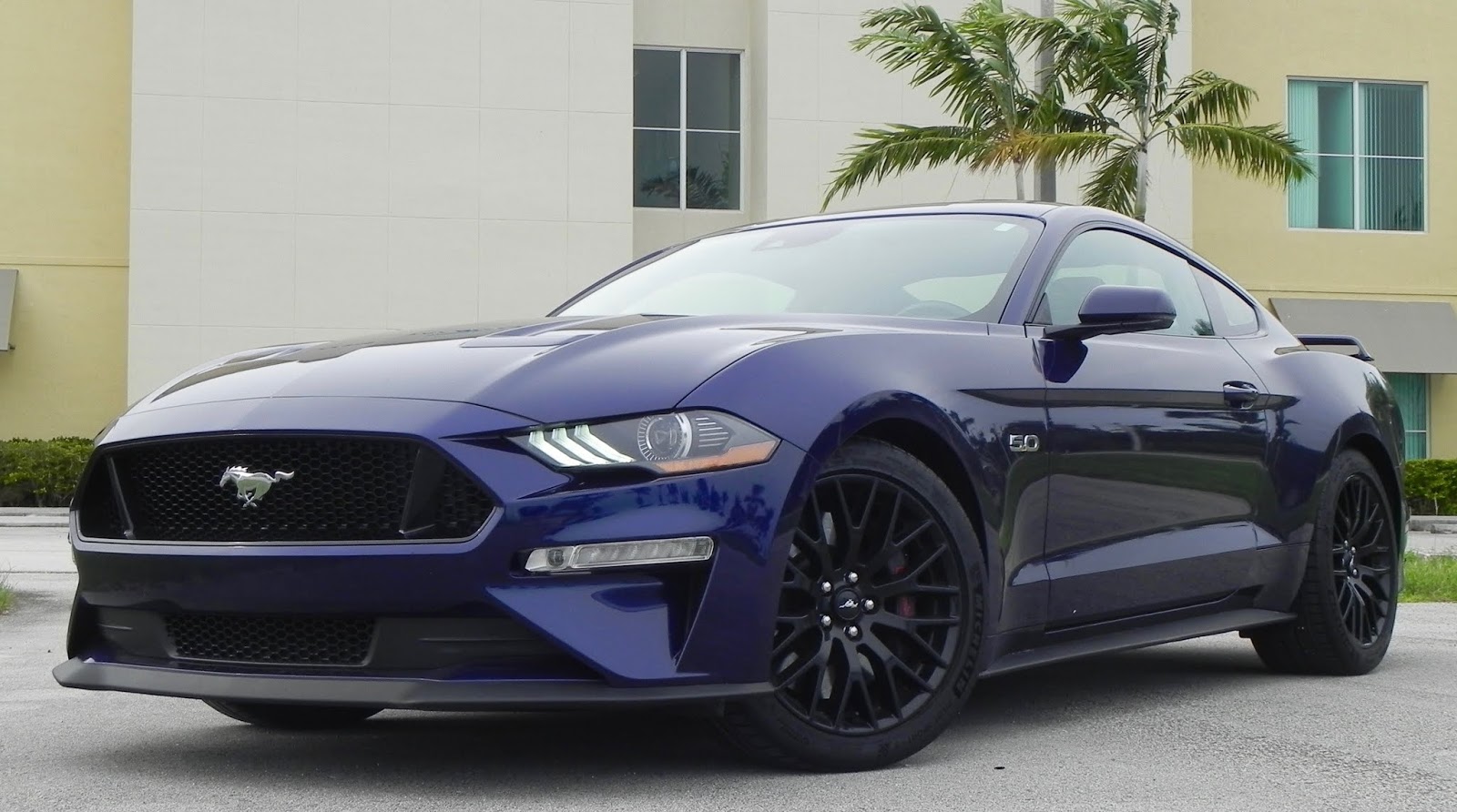
FORD GIVES ICONIC MUSTANG MID-CYCLE REFRESHING FOR 2018; THEY GOT IT RIGHT


Having moved it into its sixth generation with a makeover for 2015 that carried over the retro design theme first revealed a decade earlier, Ford has given the iconic Mustang a mid-cycle refreshing for 2018.


Included among new features the company notes are a more powerful 5.0-liter V8 engine that is mated with an all-new 10-speed automatic transmission, new driver-assist technologies like Pre-Collision Assist with Pedestrian Detection and SYNC Connect, as well as refreshed front- and rear-end designs that result in a more aggressive look while improving aerodynamics for more confident handling and improved fuel economy.

With Ford announcing it is pulling out of the sedan market, it will be up to the Mustang to carry the company’s load in the traditional coupe-sedan passenger vehicle segment once the Focus morphs into the Focus Active Crossover for 2019.

To which we say, Hooray!


Not necessarily for the disappearance of the Taurus, Fiesta, Fusion, and the Focus compact sedan but for the continued existence of the king of the Pony Cars, the Mustang.

An immediate success at its launching when 22,000 were ordered on the first day of sales on April 17, 1964, and two million sold by March 1966, the Mustang continues to be a fan favorite.


Ford reports that the Mustang has been the world’s most popular sports coupe for the last three years with the 2018 model playing a key role in that momentum.

Keeping things fresh while not forgetting its roots — as the company did with the Thunderbird  — is a key.


In addition to the changes already note, Ford also dropped the V6model from the 2018 lineup, leaving Mustang aficionados with a choice of a fuel-efficient turbo-4 (21 mpg city/31 mpg highway) or a robust 5.0-liter V8 that is rated at 460 horsepower and 420 pound-feet of torque that can get you from zero-to-60 mph in less than four seconds when in enhanced, drag strip mode, according to Mustang chief engineer Carl Widmann.

Those horsepower and torque numbers are up from the 435/400, respectively, of the previous V8 Mustang.


I drove the Ecoboost 4-banger convertible last summer (see the July blogs for my thoughts on it) and generally found it to be a very capable performer.

But let’s face it. Muscle Cars are about the big bang, and that’s why I would recommend the V8.


Of course, it’s more expensive with the Ecoboost I4 carrying a base MSRP of $25,680 while the GT Fastback checks in at $35,190. The more upscale GT Premium Edition adds another $4,000 to that number, but makes for a slightly more sophisticated vehicle than your standard Muscle Car. It’s just nice, period.

Adjustments for such functions as ambient interior lighting (you can personalize the colors) and exhaust sound ranging form quiet to track can be made through the information display in the middle of the instrument panel.

You can also change what info is displayed there. If you want your trip and fuel mileage displayed or prefer gauges to keep you updated on oil pressure and water temperature, you can set the display to that.


Among standard features on the GT Premium are leather seats and leather-wrapped tilt and telescoping steering wheel with cruise and audio controls, dual zone climate control, capless fuel filler, LED headlamps and tail lamps, LED fog lights, intermittent wipers, quad tip dual exhaust, push-button start, and a rear-view camera with guidelines.


Optional equipment includes adaptive cruise control, blind-spot warning with cross traffic alert, a Shaker 12-speaker sound system, 19-inch wheels, and a GT Performance Package. The latter adds $4,000 to the cost, but will help you get the most out of your ride.

What I liked about the 2018 Ford Mustang: The Ford people definitely got it right with this incarnation of the classic Pony Car. It looks fast even standing still, and the ability to tune the Performance Exhaust system to your liking (normal, sport, track, and quiet modes) via the digital instrument display is a great feature. It has a pretty good size trunk (13.5 cubic feet) for a coupe.


What I didn’t like about the 2018 Ford Mustang: The backseat is almost useless. It is suitable for children only, and not very big ones at that. The roof slant gives the Mustang a sexy profile but intrudes greatly on rear headroom.

Would I buy the 2018 Ford Mustang? Frankly, I probably would go for the convertible over the coupe, but if convertibles aren’t your thing, then the coupe style is the next-best thing.


Monday, October 30, 2017

YES, A MUSCLE CAR CAN HAVE FOUR DOORS; DODGE CHARGER DAYTONA SHOWS IT CAN!


Muscle Car aficionados and automotive purists may have been unhappy when Dodge resurrected the Charger as a four-door sedan instead of the two-door coupe from the 1960s and ’70s, but a little over a decade later, it seems to have worked out just fine.

The Charger in four-door form is the brand’s best-seller among coupes and sedans and actually is outselling the Durango crossover so far in 2017. Dodge reported sales of 9,230 Chargers for September to 6,207 for the Durango.

For the year to date, the Charger was holding a nearly 15,000 advantage in sales over the Durango through September.

With the Charger in four-door form, buyers who really want a Muscle Car but need transportation for the family have an easy decision.

They can have both!

As a full-size sedan, the Charger offers such family family features as a nice-sized trunk (16.5 cubic feet), room for three in the backseat (and two rear doors to give them easy access back there), and a 5-star overall safety rating from the government.

In SE or SXT trim, the Charger comes with a V6 Pentastar engine rated at 292 horsepower and 260 pound-feet of torque, which is adequate for most everyday driving situations. 

Call it the Clark Kent version.


But move up to V8 power, and the Charger becomes Superman.

The 2017 Dodge Charger Daytona I recently had the opportunity to drive for a week (yes, the name is taken from the Daytona 500; a Dodge Charger Daytona was the first stock car to break 200 mph, though it was at Talladega, not Daytona) is in the middle of the Charger lineup but definitely leans toward Muscle Car. It will take a nano-second after you push the star/stop button and those deep bass exhaust notes emanate from the rear to convince you of that.

Hey! Does this thing have a HEMI?

Of course, it does!

The Charger Daytona (and R/T trim) gets a 5.7-liter HEMI V8 that sends 370 horsepower and 395 pound-feet of torque to the rear wheels via an 8-speed automatic transmission with optional Sport mode or paddle shifters for manual gear selection. (All-wheel drive is optional on SE and SXT models.)

Not enough power?

You can always opt for the 6.4-liter HEMI V8 (485 hp, 475 lb.-ft. of torque) standard in the R/T Scat Pack, Daytona 392 and SRT 392 trims or the 6.2-liter supercharged beast (707 hp/650 lb.-ft.) in the Hellcat.

Too much of a fuel eater?

Well, the 5.7L V8 in the Daytona features what Dodge calls “fuel saver technology” that turns theV8 engine into a 4-cylinder operation when cruising at highway speed or operating under light conditions. That doesn’t make the Charger a Prius hybrid, but it does make for slightly better mileage (16 miles-per-gallon city, 25 highway, and 19 combined) than you might expect.

Recommended fuel is 89 octane for the 5.7-liter V8, though the company says regular is acceptable. (The V6 runs on regular 87 octane; premium 91 octane is recommended on the 6.4L V8, and the Hellcat V8.)

Obviously, with power numbers like those above, you’re never going to be lacking for punch when it comes to performance. But in addition to the straight-line get-up-and-go, the Charger handles corners well while delivering a firm, but not overly stiff ride, that has good road manners.


Some Muscle Cars can take, well, muscle to maneuver, but not the Charger. You may get the impression the Charger Daytona is about a half-acre wide when you look over the flat hood, which includes huge HEMI lettering over the large functional hood scoop, but it doesn’t drive that big.

Still, it is a full-size sedan, so the front especially is roomy, and the backseat offers just over 40 inches of legroom.


The Daytona also gets some extra styling touches, like heated and ventilated sport, suede/leather seats with “Daytona” embroidered on the backrests, special floor mats, a performance steering wheel, and extra stitching on the seats and door panels.

It’s not a luxurious interior, but is functional and nicely laid out.

The exterior, too, gets attention with prominent “Daytona” and “HEMI” markings and badges in several prominent spots (including the front grille), 20-inch black forged aluminum wheels, and a satin black performance spoiler.

There’s no mistaking this car when you are coming down the street either visually or audibly.


All that does come with a cost, though. You can get into a base Charger SE for just over $29,000 (when destination and delivery charges are thrown in), depending on your negotiating skills, of course. The Daytona with the 5.7-liter V8 starts at $40,985 and gives you pretty much all the fun that the Hellcat does for nearly $29,000 less.

The Daytona 392, which has the 6.4-liter V8, has a listed MSRP of 46,095, which is close to the listed $46,315 that was listed on the Monroney sticker for my test Daytona.

I will say that a price topping the $40,000 mark is rare territory for a Dodge, but if you're looking for performance in a full-size sedan/Muscle Car, the Charger is hard to beat.

What I liked about the 2017 Dodge Charger Daytona: The fun-to-drive quotient is pretty much off the char.  I also liked he optional UConnect 8.4 Nav system for the simplicity of its operation.

What I didn't like about the 2017 Dodge Charger Daytona: Rear vision is somewhat restricted. The interior, while not bad, could use a bit more refinement. 

Would I buy the 2017 Dodge Charger Daytona? Yes. It's a bit on the expensive side, but if you're considering a Charger, this is no time to skimp.


Wednesday, August 17, 2016


DODGE CHARGE R/T MATCHED 

WITH DODGE CHARGER HELLCAT


One of the last reviews I wrote for examiner.com this summer was on the Dodge Charger Hellcat. This is the vehicle that dropped a virtual nuclear bomb in the horsepower wars a couple of years ago by putting a 6.2-liter supercharged Hemi V8 under the Charger’s hood. At 707 horsepower, it became the most powerful sedan in the world.

With 650 pound-feet of available torque, the Hellcat zips from zero-to-60 mph in well under four seconds, and the website torquenews.com has reported a time actually quicker than that —  just 2.9 seconds.

Of course, there was more to the review than horsepower numbers and I really would like to give you a link to it. When they pulled the plug on examiner.com recently, however, they really pulled the plug and it’s not available any more. Maybe the Russians can find it.

The Charger Hellcat is well-equipped with lots of extras thrown in and roomy as well. One thing I noted in my review was that even with all those power, the Hellcat with its five-passenger capacity still could serve as a “family car,” though one not particularly fuel efficient.

But it also carries a base price tag of nearly $66,000 which, let’s face it, is a lot of money for a Dodge no matter how refined and fast it may be.

But you don’t have to spend that much to get the Charger’s Muscle Car looks and performance that lives up to the image.

Take the Charger R/T Blacktop I had this past week.


It’s equipped with a 5.7-liter naturally aspirated HEMI V8 that is rated at 370 horsepower and 395 lb.-ft. of torque that will scoot you from zero-to-60 in the neighborhood of five seconds, which is a sports-car like number in a full-size sedan. It carries a base MSRP of $34,890 (including destination and delivery), which is roughly half of what the Hellcat will set you back. (OK. A little more than half.)

(For the record, a couple of other Charger trims come with a 6.4-liter HEMI V8 that produces 485 horsepower with 475 lb.-ft. of torque going to the rear wheels, and the base SE and SXT trims come with a standard 3.6-liter V6 with ratings of 292 hp and 260 lb.-ft. — 300 and 264, respectively, with the Rallye Group package included.)

Fuel consumption for the 5.7-liter HEMI is rated at 16 miles-per-gallon city, 25 highway, and 19 combined, which according to the car’s computer is right at the numbers I was getting for my week. Mid-grade fuel is recommended, but Dodge says that regular is acceptable. Numbers for the Hellcat are 13/22 and premium fuel is recommended, so you come out a little ahead there as well.

All the engines, by the way, are mated to an eight-speed automatic transmission with manual gear selection capable via steering wheel-mounted paddles.

The R/T comes with a pretty wide variety of standard features, like anti-lock disc performance brakes, sport suspension, electronic stability and traction control, hill start assist, automatic headlamps, keyless Go system with push-button start, Dodge’s UConnect system with an 8.4-inch screen to operate telematic funcions, voice commands, and dual zone A/C.

My test vehicle had some option packages that added such features as a Beats Premium sound system, leather seats, HID projector headlamps, ventilated front seats and heated second-row seats, rear backup camera, park-assist system, and the Blacktop appearance package that features 20-inch polished and black painted aluminum wheels, black trim touches inside and out, navigation, and a leather-wrapped performance steering wheel.

Oh. And a black painted roof.

That ran the total MSRP to $41,070, which is still quite a bit less than what the Hellcat will set you back. Can you accept getting to 60 mph a couple of seconds slower? I can for that.

What I liked about the 2016 Dodge Charger R/T Blacktop: The looks are outstanding, and the performance is among the best, and not just in power. Handling is very nimble, and the quiet ride is firm but not overly stiff. The interior has been seriously upgraded with the cheap plastics of past cabins long gone. Backseat passengers can get 40.1 inches of legroom, only 1.7 inches less than those in the front. Trunk capacity is 16.5 cubic feet, which matches what you find in most others in the segment, including the Chrysler 300. Navigation, audio, etc. are very easy to operate.


What I didn’t like about the 2016 Dodger Charger RT Blacktop: Visibility is somewhat restricted by the large rear pillars and small rear windows. Seats could provide more support. A little more in the way of fuel economy would be nice, but if you want that performance, you’ve got to sacrifice something.


Would I buy this car: Yes. The R/T is as fun to drive as the Hellcat (more economical, too) and leaves you a lot more money to spend on extras.