NEW FOR 2021, KIA SELTOS SHOWS GOOD THINGS CAN BE FOUND IN SMALL PACKAGES
Kia has added another vehicle to its growing fleet, and to the surprise of nobody save, perhaps, a monk in far off Tibet, it is another crossover SUV.
Classed as a subcompact, the 2021 Kia Seltos — Seltos comes from Greek mythology, Celtos being the son of Hercules — slots in between the company’s popular Soul and Sportage at about the same starting price point as the company’s Niro crossover.
But while the Niro comes in hybrid, plugin hybrid, and all-electric forms, the Seltos is offered with conventional gasoline-fueled powertrains. LX, S, and EX trims get a 2.0-liter 4-cylinder engine and S 1.6T and SX trims a 1.6-liter turbo GDI 4-cylinder..
The former is rated at a so-so 146 horsepower and 132 pound-feet of torque while the 1.6 turbo delivers heftier numbers of 175/195, respectively.
The 2.0-liter engine is mated to a continuously variable transmission, the turbo to a 7-speed dual clutch tranny. Comfort, Smart, and Sport modes adjust throttle responses to your current mindset, Smart being somewhat of a combination of the other two as it adjusts to the way your are driving.
All-wheel drive also is available on the Seltos.
This review is based on the top-of-the-line SX that comes with the 1.6-turbo engine that in addition to the power numbers earned EPA ratings of 25 miles-per-gallon city, 30 highway and 27 combined.
It comes with the dual-clutch tranny, AWD and a laundry list of standard and included features. Among them are LED headlights and fog lights, LED daytime running lights and tail lights, heated front seats, leatherette and cloth seat trim, Bose premium sound system, 10-way power adjustable driver’s seat with power lumbar, leather-wrapped steering wheel and shift knob, keyless entry and push-button start, Smart (adaptable) cruise control, wireless phone charger, remote start, automatic temperature control, rear USB charge port, and a cargo cover.
In addition to the usual collection of seatbelts and air bags, safety systems include forward collision avoidance, blind-spot warning, rear cross-traffic alert, lane-keeping assist and lane-departure warning, driver attention warning (wake up, fool!), and high-beam assist. The rear view camera features dynamic guidelines to reflect your turning angle.
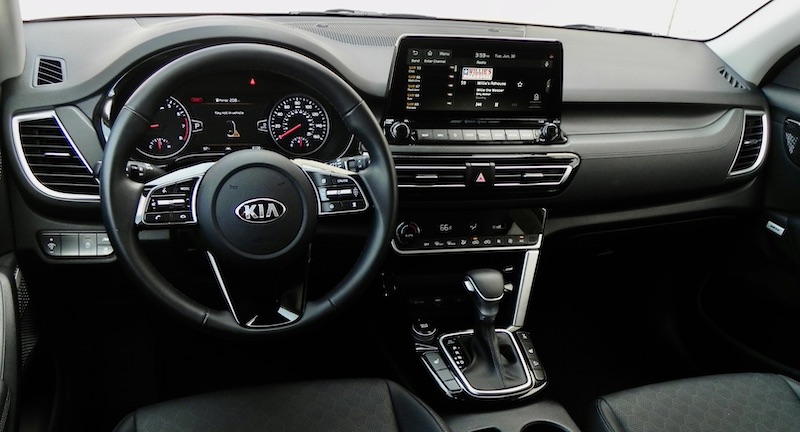
Infotainment features run via voice command or an 10.25-inch touchscreen and include navigation and a suite of features built in Kia’s UVO telematics that help you find where your parked your car and send emergency information.
The Seltos SX rides on standard 18-inch wheels and is 172 inches long with a wheelbase of 103.5 inches. Inside, front-seat riders get 40 inches of legroom while those in the back get 38.4. The Seltos seats five comfortably though getting three adults in the back could be a bit of a squeeze.
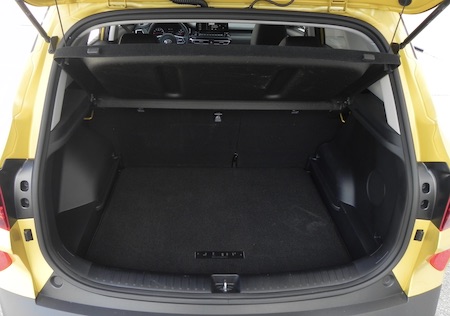
 Cargo room is a generous 26.6 cubic feet behind the second row and a spacious 62.8 cubic feet with the second-row seats folded.
The Seltos SX carries a starting MSRP of $27,890. Adding in a couple of extras like a special color, carpeted floor mats, and the $1,120 destination and delivery ran the bottom line for my test vehicle to $29,485. The base Seltos LX starts at just under $22,000.
 What I liked about the 2021 Kia Seltos: It’s surprisingly roomy overall, both for passengers and their stuff, especially for its class. The infotainment system is very user-friendly, and it responds readily to voice commands. The SX trim is on the expensive side but is well equipped. Navigation is standard and Bose Premium Sound is included at no extra cost in this top-of-the-line model. The 1.6-liter turbo packs a pretty nice punch and mileage is decent as well. The exterior styling is more mainstream than its slightly smaller, older Kia Soul sibling.
What I didn’t like about the 2021 Kia Seltos: The “Starbright Yellow” body color is not for me, and certainly not worth an extra $345. Ventilated front seats (not available) would be a nice addition. Also, for those who like to select gears automatically, paddle shifters could be more convenient to use than the shifter on the center console.
Would I buy the 2021 Kia Seltos? Yes. If you are in the market for a subcompact SUV, the Seltos definitely should be on your shopping list.
BREAKING FREE FROM A LOCKDOWN IN STYLE WITH NEW 2020 KIA STINGER FASTBACK
After nearly two months of self-imposed isolation for you-know-what with trips limited to the grocery and drug stores and takeout food runs, we managed to escape Miami over the Memorial Day weekend to visit our daughter and son and their families near his home in Tampa.
She drove down from Illinois while we had a comparatively short jaunt from our home to her rental house on Florida’s West Coast, which was in the early phases of the state’s re-opening as compared to where we were coming from.
Groceries and restaurants in Tampa weren’t requiring customers to wear masks, unlike in Miami which was still pretty much in total lockdown at the time.
Though the number of tables were limited, you could even eat in at a restaurant if you desired. It would be another week before that was being permitted on the Southeast Coast.
It was almost as if we had broken out from prison, or at least that was the feeling. What made it even better was the new, 2020 Kia Stinger sedan that our friendly media fleet servers delivered to our driveway the morning for our escape, er, trip.
Since it is in just its third year of production, you may not be familiar with the Stinger, but if you have been paying attention at all you should know about Kia and the high quality of vehicles it has been producing in recent years.
With the Stinger, Kia has packed a long litany of standard features in a classy, upscale package that fits in comfortably among traditional luxury vehicles from Europe.
Sporty performance? Check.
Rear-wheel drive? Check.
Lots of techno features? Check.
Premium audio? Check.
Navigation with touchscreen and voice controls? Check.
Room for five passengers and their stuff? Check.
Classy exterior? Check.
Upscale cabin? Check.
It was especially comfortable cruising on the interstate when I set the adaptive cruise control at the desired speed (OK, perhaps technically a bit over the posted limit) and let the technology take over.
Though a couple of instances it seemed like it slowed rather abruptly to adjust to the speed of the vehicle ahead, overall it operated rather smoothly. After slowing for a car or truck ahead, it picked right back up to my selected speed when I moved to the left lane to make a pass.
The Stinger is available with either a turbocharged 4-cylinder or a twin-turbo V6 engine and either rear-wheel or all-wheel drive. The base model GT-Line gets the 4-banger and starts at $34,125 including the destination and deliver charge.
For my trip, I had the GT2 RWD which has the 3.3-liter V6 and starts at $50,200, putting it at the top of the heap. Each engine is mated to an 8-speed automatic transmission with paddle shifters, though gear ratios vary slightly to match the specific engine.
The 4-cylinder engine is rated at 255 horsepower and 260 pound-feet of torque and earns EPA ratings of 22 miles-per-gallon city, 29 highway, and 25 combined with RWD and 21/29/24 with AWD drive.
The V6 is standard in GT, GT1, and GT2 trims and delivers more performance at 365 hp and 376 lb.-ft. but is thirstier with mileage numbers of 17/25/20 for both RWD and AWD models.
Standard equipment on my test Stinger GT2 included a surround-view camera, head-up display, Harman Kardon Premium audio, navigation with an 8-inch touchscreen, Android Auto and Apple CarPlay, a wireless charger, push-button start, Nappa Leather trim, heated and ventilated front seats, tilt-and-telescoping steering wheel, multi-color LED mood interior lighting, adaptable (Smart) cruise control, blind-spot and rear cross-traffic warning, driver attention warning, LED headlights with high-beam assist, a power sunroof, power rear deck lid opener, and forward collision warning.
The Ceramic Silver Paint (the second consecutive vehicle I had that reminded me of Navy gray fleet vehicles) and a cargo mat ran the total for my test vehicle to $51,815.
The Insurance Institute for Highway Safety awarded the Stinger as a Top Safety Pick recognition earlier this year.
One thing I should note: Kia refers to the Stinger as a “fastback sport sedan” and that is what it looks like, but but technically it is a hatchback, which is good. Opening the rear liftgate provides a wide opening for up to 23.3 cubic feet of rear storage room. That’s more than double that of many of its direct competitors.
What I liked about the 2020 Kia Stinger GT2 RWD: The infotainment system is both very plentiful in the way of standard features (like navigation) and all are very user-friendly. The “Smart” (or adaptive) Cruise Control is very effective and easy to adjust. The interior is upscale and the overall ride is very comfortable and peppy even when driving in Eco mode.
What I didn’t like about the 2020 Kia Stinger GT2 RWD: Fuel economy is only so-so. Hard to find fault with anything else!
Would I buy the 2020 Kia Stinger GT2 RWD?: Definitely, yes. The Stinger offers everything you want in a luxury sedan except perhaps brand cachet. It has lots of room for passengers and their stuff and plenty of infotainment functions as standard. Pricing is very competitive in its class.
KIA GOES ALL OUT IN LUXURY WITH 2019 FULL-SIZE K900 SEDAN
At one time, and not all that long ago, the notion of spending $60,000 on a Kia may have been taken as a joke. Three or four Kias, yes, but one?
Well, last month, according to figures announced by the South Korean company, 32 people apparently paid at or near that much for the company’s flagship sedan, the K900, which was 10 more than the previous November and 17 more than October.
A sale a day is minuscule figure by pretty much any automotive measure, of course, but say this about those buyers: They got their money’s worth.
Redesigned and moving into its second generation, the 2019 K900 full-size luxury sedan is very much worth a look for open-minded shoppers who care more about the entire vehicle rather than just what mascot might adorn its hood.
Launched in late 2013 as a 2014 model in conjunction with its 20th anniversary in the U.S. market, the K900 was never seen to be a big seller but instead as a symbol about what Kia could do once it put its mind to it.
It was the company’s first rear-wheel drive sedan and came complete with a long list of standard equipment and features that put it apart from other Kia products.
“It demonstrates what Kia is capable of and will help redefine what the Kia brand stands for,” Michael Sprague, executive vice president, marketing & communications for Kia North America, said in a release at the time.
Redesigned and moving into its second generation, the 2019 K900 is sold in only one trim dubbed “Luxury” — which to me seems a bit overkill in terminology — with only one engine option.
With a V8 option no longer available, a 3.3-liter, twin-turbocharged V6 becomes the only power choice. Mated to an 8-speed automatic transmission and with 365 horsepower and 376 pound-feet of torque, it has enough punch to handle most driving situations without pressing.
You can adjust driving mode from Comfort to Eco, Sport, and Smart (which adjusts to your driving style) or configure your on mode for the Custom setting. Paddle shifters are standard for manual gear selection.
Timers for www.zeroto60times.com clocked the 2019 K900 at 5.1 seconds from zero to 60 mph, which is isn’t the quickest in its class but respectable for a vehicle of its size (201.6 inches long with a curb weight of 4,662 pounds.
The power is delivered smoothly to all corners with standard all-wheel drive. Fuel mileage (premium fuel recommended) is 18 miles-per-gallon city, 25 highway, and 21 combined.
Though only one trim is offered, it comes with a long list of standard equipment for the base MSRP of $60,895 (including $995 destination and delivery) that includes a power tilt-and-telescoping steering column, a navigation system with a wide, 12.3-inch screen, a cool analog clock, genuine wood interior accents, Nappa leather seating surfaces with a 20-way power adjustable seat for the driver and 16-way power adjustable for the front passenger with 4-way lumbar support for each.
LED headlights, a surround-view camera, Smart key with push-button start, adaptable cruise control, forward collision alert, and lane-keeping assist also are included.
A blind-spot view monitor that pops up when turn signals are activated gives you a look at what may be coming up beside you via an image projected from either side mirror to the either the tach or speedometer gauges.
To further upgrade the K900, a single option package is offered for an extra $4,000 and focuses more on the comfort of the rear-seat riders. It includes tri-zone climate control, power adjustable rear seats, ventilated rear outboard seats, a premium headliner, and a wireless charging pad for the rear seats.
Those in the back already get 38 inches of legroom, so unless they are often riding along and art particularly demanding, you can probably get along with those extras.
What I liked about the 2019 Kia K900: There are plenty of infotainment features that are very user friendly. The map on the large display screen easily can be zoomed in or out, and it is easy to see at a glance. A plethora of safety features are included as standard, including the blind-spot review monitor gives you a clear indication of what traffic may be coming up at you in the direction you are about to turn.
What I didn't like about the 2019 Kia K900: Not a whole lot to mention here. The trunk could be bigger considering its class, but at 15.4 cubic feet it’s not exactly what you would call small either. The lane-keeping system is a bit overly aggressive.
Would I buy the 2019 Kia K900? Yes. Like its “cousin” the Genesis, the K900 offers all the luxury features you want in an attractive package that lets you save several thousand dollars off the cost of a traditional luxury car.


 Cargo room is a generous 26.6 cubic feet behind the second row and a spacious 62.8 cubic feet with the second-row seats folded.
 What I liked about the 2021 Kia Seltos: It’s surprisingly roomy overall, both for passengers and their stuff, especially for its class. The infotainment system is very user-friendly, and it responds readily to voice commands. The SX trim is on the expensive side but is well equipped. Navigation is standard and Bose Premium Sound is included at no extra cost in this top-of-the-line model. The 1.6-liter turbo packs a pretty nice punch and mileage is decent as well. The exterior styling is more mainstream than its slightly smaller, older Kia Soul sibling.


