Tuesday, November 8, 2011

NOTHING TO SEE HERE, MOVE ALONG, NOTHING TO SEE

I had a 2012 Nissan Versa to drive this week and was planning on taking some pictures, as usual, and giving you loyal readers my opinion of this inexpensive entry-level sedan that the Japanese automaker has packed with numerous standard features for its class.
The operative words here are “had a 2012 Nissan Versa” and “was planning.”
To explain, I was on my usual Tuesday routine of heading to the University of Miami football press conference where coach Al Golden would feed us the usual B.S., er, I mean give us insights into the upcoming opponent for the Hurricanes, in this case Florida State this Saturday in Tallahassee.
As I tooled along expressway a couple of minutes behind schedule, I debated whether I should take my usual back way or take the expressway all the way out to Dixie Highway. Dixie Highway (U.S. 1) could be quicker, unless I ran into heavy traffic, always a possibility, if not a likelihood at noon time.
My usual back way didn’t have such a risk with traffic. So I decided that’s what I would do.
Wrong choice.
I eased off the expressway and as I sailed down the ramp I saw to my good fortune that the light at the bottom had just turned green. Sometimes Providence smiles on people in a hurry.
In this case, though, Providence was playing a mean trick.
For though I saw one car to my left on the cross street at the bottom of the ramp had stopped, my view of the closer lane was blocked by the roadway itself.
Just as I reached the street, I saw a Chrysler Town & Country to my left, and it wasn’t stopping. Though my foot was already on the brake to slow it, stomping on it didn’t get the Versa stopped in tie and the minivan clipped its front end.
No, I wasn’t hurt, obviously, or I likely wouldn’t be writing this now, and neither was the other driver. His vehicle came to a stop on down the street and he got out and ran back to check on me.
I told him I was okay, and we both pulled our vehicles off the right-of-way. I don’t know how it is where you live, but that’s what you do down here when nobody at the scene is hurt.
I called the press fleet manager to inform him of the accident, and while on the phone the other driver came up to me with an unusual request. He wanted to get his girlfriend, who owned the minivan and lived just minutes away, to come over before the police arrived so she could say she was driving.
Why?
Because, he explained somewhat nervously, he didn’t have a driver’s license. And he was here illegally and had been for six years.
Imagine running across an illegal alien who doesn’t have a driver’s license in Miami. What are the odds?
But it wasn’t a triple play. Thanks to his girlfriend, he did have insurance. Not that that mattered to me. One of the great advantages of driving a press fleet car is that when something like this does happen, the company pretty much takes care of everything.
Not that I have a lot of experience in such matters.
The remarkable thing is that the police didn’t take too long to arrive to take down the report, and the tow truck he called arrived rather quickly as well. He was only a safety officer and doesn’t have arrest power, but he did talk with privately with the other driver and his girl, who had come over anyway. What was said I don’t know.
The officer just took my papers and I explained to him that it was a press fleet vehicle and owned by the manufacturer. He didn’t even ask me what had happened or how the accident had occurred, which, looking back on it, seems odd now.
I had expected a long wait for both really, but maybe there wasn’t going on around the county at the time. My wife had barely gotten there to pick me up before the tow truck arrived.
One of the guys in the tow truck took the info on where to drop the car, the other threw the front fascia, which had been ripped off, into the backseat, and they jacked up the car and were gone in minutes.
If you still would like a review, I must say I was impressed with the way the damage was confined to the front end, though that was more due to the way the accident occurred. The airbags didn’t even go off.
It wasn’t until later in the evening that I got to thinking that if I had been just a tenth of a second or so quicker into that intersection, the guy in the Town & Country would have T-boned me. I’m not sure how the Versa would have held up to that, and I’m glad I didn’t have the opportunity to find out.
As for this damage from this incident, my guess, considering the car’s low cost, would be that this particular Versa would have been totaled and headed for the crusher even if it wasn’t a pre-production prototype, which this one was.
And as for the press conference, I missed it in person but watched a replay later on the athletic department’s website. Golden said the Hurricanes were excited with the opportunity to play Florida State but that it would be a great test.
I didn’t need any more tests this day.

Thursday, November 3, 2011

ONE BAD PUN, THREE GOOD SUVs

As the farmer said as he stomped on the tomato, it’s catch-up time!

Hope I didn’t lose you there. Never could resist a bad pun, which is a redundant term if I ever heard one.
The aim today is to cover three vehicles that I have driven over the last couple of months which, to keep it simple, I will call SUVs, ignoring whether they are the more trendy crossovers or trucks.


I’m not really sure how many people know the difference or care. To many, if it sits upright and has a liftgate at the rear instead of a trunk, it’s an SUV. Doesn’t matter if it can handle the Rubicon Trail or just a gravel parking lot, it’s still an SUV in common parlance.

So I’m going to treat the BMW X3, the Cadillac SRX, and the Dodge Durango all at once. One wouldn’t necessarily group those particular three together, though they are pretty much in the same price range (from mid-$30s to mid-$40s, plus options).
And this is my blog, and I’m not only the writer, but the editor as well.
So here goes.
The Cadillac SRX hasn’t gotten the attention over the years that its big brother, the Escalade, has, mostly because it didn’t catch on right away with the hip hop music crowd. But apparently it has caught on with someone because it has become one of the company’s big sellers.
It’s easy to see why.
It has gotten some significant upgrades from the previous generation models and now features a 3.6-liter V6 engine with a six-speed automatic transmission with “Eco” mode. When you want the advantage of its fuel saving ability, you simply leave it in Drive.
If you want performance, you shift the console lever over to Sport. You can then select gears manually if you want, but you don’t have to. It still operates as an automatic but with different shift points.
The government rates the fuel mileage for the SRX at 17 city, 24 highway, and Cadillac says Eco mode can improve those figures about a mile per gallon.
I’ve always kind of wondered why if an “Eco” mode is promoted as a fuel saver that testing isn’t done separately to give us two sets of numbers, but it isn’t. Probably not worth the effort.

Any way, the SRX delivers enough performance (308 horsepower, 265 pound-feet of torque) to satisfy most drivers in the genre.
The SRX’s strength is in its interior. The quality of materials used in the cabin is of the highest grade, and placement of controls is very user-friendly.
On models equipped with navigation (optional in Luxury trim, standard in Performance and Premium), many of the functions operate off a touch screen that rises from the center stack and can be lowered with the push of a button.
As one who is constantly flitting about the radio dial from Satellite to FM to even AM (there has to be somebody listening to it, and I’m the guy), I find the audio controls on GM models to be very nicely arranged and easy to operate. Since I usually have a car for just a week, I sometimes don’t bother to program presets on the dial, which probably would help ease the operation even more.
If it’s performance you want in addition to the capability of handling five adults plus luggage, then you need to take a look at the X3. As BMW is known for, this is a vehicle that gives you immediate response when you hit the accelerator.
That was the thing I noticed right off, and I was in the xDrive28i, which is the non-turbocharged version of the 3.0-liter inline-6 engine. It pumps out 240 hp and 221 lb.-ft. of torque to all four wheels via an eight-speed automatic transmission. I can imagine what the turbo xDrive35i with its 300  hp and 300 lb.-ft. of torque must be like.
Yet fuel economy checks in a slightly better than the SRX with figures of 19/25 in the xDrive28i and 19/26 for the xDrive35. There are other factors involved in that, but one is the difference in weight. Curb weight for the X3 is 4,112 pounds and for the SRX it’s 4,277.
The X3, too, has gone through some refining since it was introduced for the 2004 model year. That shouldn’t come as a surprise because that’s what engineers and designers are paid to do -- take a product forward, not backward. (As I sit in on presentations where improvements on a new model are extolled to the detriment of the preceding generation, one thought keeps going through my mind: Is this the car that you will be calling a piece of crap in five years?)
Frankly, I don’t remember ever driving the X3 seven years ago (I’ve slept since then) and even if I had, I still probably wouldn’t remember it unless it was exceptionally bad. So I can’t do a direct comparison.
What I can say is that the ride in the X3 is extremely comfortable and smooth, and, as noted earlier, the engine’s response is exceptional.
What I can’t figure out is why German engineers are so intent on putting in technology that doesn’t make life all that much simpler but complicates it. I’m not talking about iDrive here, which has been modified so that it doesn’t take an instruction sheet to operate it any more. I got the hang of the knob on the X3’s center console right off the bat, though about the only thing I used it for was to change radio stations.

But take turn signals. Whoever came up with the idea of having a lever stick out from the left side of the steering came up with something that really needed no further embellishment. You want to turn left, you flick it down and after you make your turn, it clicks back into place. Turn right, tap it up and again, when the turn is completed, it snaps back into place.
For whatever reason, BMW now has it so that when you tug (or push) on the stalk, it snaps immediately back into place. Oh, the lights in front and back continue to blink just as before, but the thing is, if you don’t move the stalk past the first click, it gives the lights just three blips, which is for changing lanes. To keep the signal on until you complete your turn, you have to push or pull the lever all the way down (or up).
Now I’m not saying that’s all that complicated because it’s not. It’s not nearly as bothersome as what BMW’s fellow Teutonic countryman, Mercdes-Benz, does by putting the cruise control lever high up on the steering wheel column so it gets in the way of the turn signal.
I’m just asking here: What’s the point?
BMW engineers have fiddled with turn signals that work perfectly fine just because they can? That would be my guess.
The same thing goes with the way the gear shift lever in the console works, too. It took me a minute to figure out that to shift our of park, I had to hold the button on the side of the knob while making the shift, not just press it and let go.
Those are not complete turnoffs, by the way. The X3 is still a solid vehicle.
Now we come to the Dodge Durango.
In the past, the Durango never would have fit into any piece about SUVs that started off with an SRX and X3.
But Dodge has taken the Durango to a new level -- you’ve probably seen the ads on TV heralding its return after a one-year production hiatus -- and now this is a vehicle worthy of consideration for those who usually do their shopping in higher climes.

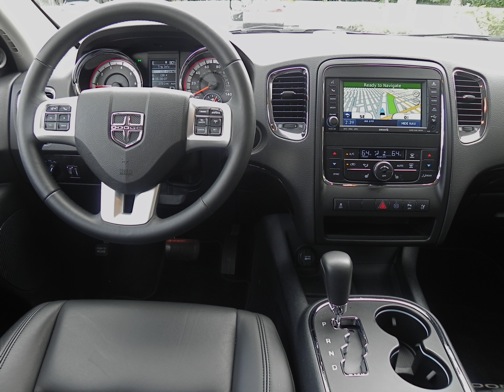
The first thing I noticed about it was its upgraded interior. Gone are the hard, cheap plastics from prior Durango models, replaced by soft-to-the-touch materials typical of more expensive vehicles.


The cabin is roomy and functional, and, unlike the SRX and X3, offers third-row seating. And it doesn’t take a contortionist to get back there either. The third and second row seats also easily fold to provide up to 85 cubic feet of cargo capacity.

With a towing package as well, the Durango is a workhorse that looks like a thoroughbred.

It runs well, too. I’d place it between the SRX and X3 in straight-line speed, but its handling was good.
Dodge offers several different power-train combinations on the Durango. The Crew version I drove had a 3.6-liter V6 under the hood mated with a five-speed automatic transmission with rear-wheel drive. That is rated at 290 hp and 260 lb.-ft. of torque with fuel mileage at 16/23.
You also can get versions of the Durango with power supplied by a 3.6-liter V8 with hp and torque power figures of 360 and 390, respectively, and EPA ratings of 16/22. Also available on some of the five trim levels is all-wheel or four-wheel drive.
I mentioned price earlier, putting all three of the vehicles mentioned in the mid-$30K to mid-$40K levels. The Durango is a bit less expensive than the other two with the Express trim starting at under $30,000.
When you start adding optional equipment, though, the price of the Duango gets up there pretty quick.
The Crew starts at $33,195, but adding such items as navigation,  rear-seat DVD entertainment, a technology group that includes forward collusion and blind-spot warning systems, and navigation and rear-view camera ran the final price up to $43,825.
The X3, which did not have navigation but did have a cold weather package (for Yankees), checked in at $43,875, and the SRX, which did have navigation and a dual-screen entertainment system, carried an MSRP of $46,295.
Of the three, the SRX was a 2012 model, the X3 and Durango 201ls.
There. Now I’m not completely caught up, but I’m better off than that tomato.

Saturday, October 29, 2011

CARDINALS TOP OFF GREAT WEEK

This is auto show week, which means not just the opportunity to look over a field of great new vehicles but also to enjoy many residual benefits as well.
There probably is not a better example of how overprivileged automotive media can be than the week of the South Florida International Auto Show in Miami Beach.
Many PR folks from auto manufacturers are in town with their expense accounts aching to be emptied.
So it was dinner with Mazda poolside at the Raleigh Hotel in Miami Beach on Wednesday night.
Lunch with Subaru at Smith & Wollensky in South Beach with a  preview of the company’s new Impreza on Thursday.
Dinner on Thursday night with Mark Fields, president of Ford of the Americas, at Morton’s in Miami Beach. I should rephrase that. It makes it sounds as if Mark and I were the only ones there. There were 15-20 or so in attendance, though I didn’t count and a few at the table were Ford folks.
On Friday, we had our own media association (Southern Automotive Media Association) luncheon the auto show, attended by more than a hundred members, media, and others there for the media day events, which were capped off by not just one but two cocktail receptions later that afternoon.
And tonight there is another awards presentation and reception hosted by the company of SAMA members Tony and Woodie Lesesne, also at the Miami Beach Convention.
But what really set the week apart from past auto show weeks, for me any way, was the Cardinals’ victory in the World Series.
CELEBRATION + PARADE
I didn’t think the baseball playoffs could top the way the regular season ended, with four teams (among them the Cardinals) contending for the last two playoff spots. But the way this World Series went may have matched that (but maybe not if you’re not even a Cardinal fan).
That thing that baseball’s World Series week has over the Super Bowl is that the week is one full of games, especially if the Series goes seven games as this one did. Super Bowl week, for all the hoopla, is 80 percent talk, much of it meaningless or over-analyzation, and 20 percent action.
Baseball has it over both the NBA and NHL championship weeks as well because of the game itself.
Consider Game 6 of the Series. The Cardinals went into the last of the ninth inning down two runs and needing a win to stay alive. They were down to their last strike when David Freese tripled in those two runs to tie it.
They were down two runs again in the last of the 10th inning and again were down to their last strike when Lance Berkman singled in the tying run.
Then Freese won it with a home run in the last of the 11th.
That kind of drama is hard for other sports, run on a clock, to match. There comes a point when there simply isn’t enough time for the trailing team to overcome a deficit of more than one score. That just isn’t so in baseball. With a time limit, the Rangers would have won in six games.
The Cardinals were down to one strike not once but twice when facing a two-run deficit and still won. (Some team in the regular season overcame a nine-run deficit in the last inning, but I don’t remember which one.)
It’s a cliche, but it’s true. The game isn’t over until the last man is out, not when time is out.
The only thing about the Cardinal win is that I felt for both ex-pitching great Nolan Ryan, the Rangers president and owner, and Rangers manager Ron Washington. They deserve a title, too. Ryan has been one of baseball’s good guys, and Washington was fun to watch.
I hope they can get to a third consecutive World Series and win next year.
Unless they are playing the Cardinals of course.

Friday, October 21, 2011

WHEN THE SCHICK HITS THE FAN


As I was shaving the other day, I got to thinking about, well, shaving.
Never say I don’t take on the big issues of the times.
Any way, what I was thinking was that I didn’t think this electric razor was really doing its job. There still seemed to be quite a lot of stubble under my chin and on my cheeks no matter how many times I went over them.
Which led to the thought that perhaps it was time to replace the workings inside the razor. But I wasn’t what store, if any, carried this particular model, which would mean I would have to search the Internet, which is what I think I did the last time I replaced the little round clippers inside, which was a long time ago.
Which probably explains their dullness.
So then I thought: Maybe I should go back to a razor and shaving cream.
I used to use one of the little disposable razors and shaving cream, but I got away from them because I didn’t like it when I nicked myself. I didn’t do it all that often, only when I was in a hurry.
But a razor and shaving cream would do a better job than this electric, no doubt.
But do they allow razors through security at the airport these days? And what about the shaving cream can. Does it have to be less than three ounces to pass inspection? I don’t know. I suppose so, but one never knows for sure with the government.
A lot of guys aren’t concerned with these issues because they don’t shave. They have beards, like “The Most Interesting Man in the World” in the Dos Equis ads.
Some time back I saw a picture of an old friend who I grew up with way back when. (No, not before there were electric razors.) He has a full beard now and I wouldn’t recognize him if he walked up to my front door. From the picture I saw, his beard is pure white and covers all his face, like whipped cream.
Which is appropriate because when we were growing up his dad owned the best bakery in town.
I’ve been thinking I should call him up and invite him to go to Key West for Hemingway Days. Of course, our wives would have to go as well. You don’t want to go to Key West with another guy. Not that there’s anything wrong with that. I’m just saying.
Back to beards.
I don’t think I could stand a beard, even if I could grow one, which I probably couldn’t. If I go a day or two without shaving, I get uncomfortable. My face itches,even though there’s not that much there to itch.
I don’t have much in the way of facial hair, and what is there has always been very light in color. I was what they call a “towhead” when I was little, though I didn’t stay that way.
One time when I was first married, I decided I would grow a mustache. I should say, “try to” because I couldn’t get much going.
“You should go wash your face,” my wife said.
All the other guys in the office then decided they would grow mustaches, too, and pretty soon they all had Tom Selleck-like growths above their lips while I was sitting there looking like I had just drunk a glass of milk, and not even chocolate milk at that.
Between my lip and my nose, pretty much nothing. Except on occasion an itch.
So a beard would be out of the question today, even if I could stand it.
But I’ve got to do something about this electric razor.
Do they still make those Bic disposables?

Friday, October 14, 2011

STUPID IS AS STUPID SAYS

This will be a short blog today because I am overwhelmed with sports assignments this week. In addition to the usual football stuff, I have due next week 22 college basketball previews.
I really want to get to the reviews on vehicles I have driven recently. They are the Dodge Durango, the Cadillac SRX, and the Chevy Camaro SS 45th Anniversary Special Edition Package. Pretty nice vehicles all in their own way.
I want to have time and not skimp on them, though.
But I have had one question that has been going through my mind recently, and it bumps up against my previews vow not to get political in this blog.
I just can’t help it. Try to look at it in a non-political way.
The question is this:
Is Nancy Pelosi really as dumb as she seems?
I mean, she keeps getting elected and elected again and again (of course, in California, which explains a lot) so she can’t be a complete moron, can she?
Yet, every time she opens her mouth out comes something really stupid. Today because they voted against having abortions paid for by Obamacare, she said Republicans want women to die on the floor.
Ummm, Nancy. From reports I have seen, a dozen or so Democrats also voted against the bill.
She may have had said this before the vote was actually taken -- it’s a bit unclear -- but either way, it is a stupid thing to say.
I’d put it right up there behind the we-have-to-pass-this-bill-to-find-out-what’s-in-it comment she made when lobbying for the healthcare bill.
Yes, she is just stupid.

Sunday, October 9, 2011

THERE IS NO SUNSHINE IN COLLEGE FOOTBALL

I don't know how many of you follow college football all that closely, but something really remarkable happened Sunday.
Yes, Sunday. The day after all the games.
The Associated Press poll came out and no team from the state of Florida was ranked in the Top 25.
None. Nada. Zilch.
This the first time since December 6, 1982, that that has happened. That was the last poll of the regular season. In the poll following the 1982 bowl games, Florida State popped in at No. 13.
Thus began a streak of 472 consecutive weeks of rankings that included at least one of the state’s traditional Big Three.
Over that span, the state that produced 10 AP/BCS national champions (Miami five, Florida three, and Florida State two). Going back to 1999, when Florida State won its second title, Miami has won one and should have won another, and Florida has won two.
After Miami won the 2001 BCS championship, I was asked to do a piece for some publication about the dominance of Florida football.
I don’t remember my exact words, but my general theme was this: “Get used to it. One of the state’s Big Three is going to be in the title picture pretty much every year.”
And now not one of them can even make the Top 25.
Get me rewrite on the phone.
So, what the hell happened here?
A lot.
Start with coaching changes.
Not one of the coaches who won those titles is on the field this year at a Florida School. Urban Meyer, who won twice at Florida, is analyzing college football for ESPN.
Bobby Bowden, who won two titles at Florida State, is enjoying retirement. (I hope.)
And Larry Coker, who won the 2001 championship at Miami and was fired after the 2006 season, has started the football program at Texas-San Antonio.
Will Muschamp is in his first year at Florida and has just seen his Gators lose big the last two weeks to Alabama and LSU, which kind of indicates how far the recruiting fell off at Florida in Meyer’s last couple of years.
Jimbo Fisher is in just his second year at Florida State and just saw his Seminoles lose to traditional ACC doormat Wake Forest. He was around in Bobby Bowden’s last season as the head-coach-in-waiting, so he still bears some of the responsibility for whatever the dropoff in talent level has been.
Miami is on its second coach since it fired Coker, Randy Shannon having been let go after last season. His replacement, Al Golden, nearly saw his Hurricanes win at Virginia Tech last Saturday but is off to a 2-3 start in his first year.
Maybe better things will be in the future for all three, but it will take some work.
Besides the coaching changes, the other big difference since the 1980s and 1990s is that the state’s traditional Big Three aren’t the only kids on the recruiting block.
Sure, other schools from up north have always come to Florida to harvest the fertile recruiting ground in the state.
But more recently, South Florida (USF) and Central Florida (UCF) have been competing for the homegrown talent as well as the Gators, Seminoles, and Hurricanes. They don’t get the numbers when it comes to top prospects, but if they get one or two, that depletes the rosters of the Big Three.
And they will get those one or two or even three or four or more.
USF is in Tampa and in the last three years has notched wins over Florida State and Miami and started off this year with a win at Notre Dame. That gets the attention of kids who weren’t around when Howard Schnellenberger said he was roping of the “state of South Florida” and keeping in Miami area recruits for the U. (Well, he never really said the U. That is a recent thing.)
USF also has a charismatic and talkative coach at the helm in Skip Holtz, son of Lou. That’s a big help in attracting attention.
UCF is Orlando and doesn’t have a win over Miami, Florida, or Florida State, but it did beat Georgia last year in a bowl game to get in the final AP rankings for the first time, and the Knights could be in the mix to join the Big East Conference.
Both USF and UCF are also huge universities with relatively new facilities.
So, just like Miami, which is surrounded by top 100 prospects no more than a short drive away from the Coral Gables campus, both USF and UCF are going to have a shot at keeping some of the Tampa and Orlando kids at home to play for them in the future.
Plus, in addition to USF and UCF, there are two other schools in the South Florida area, Florida International and Florida Atlantic, that could siphon off a kid or two. FIU has a receiver and kick returner, T.Y. Hilton, who could probably play anywhere in the country.
And those two schools, as low as they are in the college football order of things, have something that their close neighbor, Miami, doesn’t have: An on-campus stadium.
So the absence of a Florida team from the national polls likely is going to be a temporary thing. 
Florida will get back rather quickly if it can beat Auburn and Georgia in its next games.
Florida State has four games coming up it likely will win -- Duke, Maryland, North Carolina State, and Boston College.
Miami has a one-loss North Carolina team and an unbeaten Georgia Tech coming up, but if it plays like it did at Virginia Tech, could win both. That would get the Hurricanes back in the polls.
Then Miami and Florida State are set to play on Nov. 12 in Tallahassee. Florida State plays at Florida on Nov. 26.
I don’t look for any of these three to stay out of the polls for long. And my gut feeling is that one, or even two, of them will make a significant jump back to the top of the polls within the next couple of years.
But I have been wrong before. Like when I wrote college football fans better get used to seeing one of them competing for the national title every year. 

Thursday, October 6, 2011

CATCH A Z (NOT ZZZZZZ)


When it was reintroduced to the U.S.market nearly 10 years ago after a six-year absence, Nissan’s 350Z represented one of the best bargains -- I would say best period, but don’t want to get into that debate here -- among sports cars available.
It offered everything you would want in a sports car -- looks, horsepower, handling, rear-wheel drive, big wheels, and plain ol’ fun behind the wheel in a two-passenger package -- and at an affordable price.
Two versions of the multi-tiered lineup for the 2003 model year started at under $30,000, one of them for under $27,000.

Two of its four chief competitors -- the BMW Z3 and the Honda S2000 -- started above the $30,000 mark. Two others -- Toyota’s MR2 and Mazda’s Miata -- cost less but their four-bangers didn’t match the power the Nissan Z got from its V6 engine.
Needless to say, the Z’s return was a welcome one.
Nearly a decade later, the Z costs a bit more and has grown from the 350 designation to the 370Z. But it still is a bargain and hasn’t lost any of the qualities that have made the Z an automotive icon since its unveiling as the Datsun 240Z more than 40 years ago.
The starting price for the base 2011 370Z in coupe form is less than $32,000, which gets you things like 18-inch wheels, cruise control, power windows, Nissan’s Intelligent Key system, cloth bucket sport seats, etc. The Touring and Nismo trims add fetures like leather and suede seats, Bluetooth, power seat adjustments and more but jack up the starting MSRP to the mid-$30,000 range (Touring) and just over $40,000 (Nismo).
My recent experience with the Z was the 2011 370Z roadster. It comes in two trims, the base, which starts at just over $38,000, and the Touring, with a starting price tag of just over $42,000.

Oh-oh. We’re not so much a bargain now, are we?
You may think not, until you look at the price of some of the high performers in the sports car segment. Then the Z still looks pretty good. (By the way, don’t bother looking for the Honda S2000 or the Toyota MR2. They’re available only on used car lots these days, and the Z3 is now the Z4. But you gotta love that Miata!)
Of course, it’s not just the fact that the Z is a bargain (in coupe or convertible form) that makes it special.
It would still be a good buy even if the price were jacked up, not into six-figure range but up there just below some of the offerings from Teutonic competitors. Not that I’m suggesting anything here. Just saying.
The Z comes with a 3.7-liter V6 under the hood that sends 332 horsepower and 270 pound-feet of torque to the rear wheels. Considering the curb weight is less than 3,500 pounds, that’s a pretty good power-to-weight ratio.
Two transmissions are offered, a six-speed manual (my choice) and a seven-speed automatic. With the optional Sport Package, the six-manual is available with Nissan’s SynchroRev Match. This system automatically controls and adjusts engine speed when shifting to the speed of the next gear selection. In other words, it automatically “blips” the throttle for you to smooth out shifts.
I’m not saying that’s good or bad, but hey, if you need something like that, why not just opt for the automatic? You can still select gears and up- and down-shift with steering wheel-mounted paddles or the shifter on the console.
All that combination of power, weight, and transmission delivers fuel economy ratings of 18 miles-per-gallon city, 26 highway for the coupe and 18/25 with the roadster. Premium fuel is recommended, and I wouldn’t use anything else.
That’s all nice, but what I really like about the Z is that it looks like a sports car inside and out. It has a firm, muscular stance  with rounded lines up front and a hefty rear end. Sounds like a sports car, too, with the dual exhausts emitting a pleasant hum.
The roadster comes with a soft top, which is easy enough to operate, though it doesn’t look quite as good with the top up as it does down, which is usual with ragtops. I always did like topless models. (Rim shot!)

The Touring model comes with heated and cooling ventilated leather seats as standard, which also added to the ambiance of the one I drove. High-quality materials are used throughout the cabin, including faux suede inserts on the door panels. Nice touch.
I found the controls for the navigation system, A/C, and radio easy enough to operate. In fact, the only control I had trouble with was the button to open the trunk. It took me a while to find it. It is just above the license plate and kind of tucked under the trunk lid, and it wasn’t obvious to my touch the first time I tried to open it.
But then, there’s not a lot of room back there any way, what with the cloth top folding back and covered with a body-colored tonneau, an operation that takes about 20 seconds.
This is a sports car, remember. Not a U-Haul.
The Z corners quite nicely with no body roll to speak of. I didn’t get the opportunity to take it out on the track, but I did cut turns as sharply and quickly as I could just to see how it handled.
I love to make a quick turn and accelerate as rapidly as possible, then level off the power just at the speed limit to frustrate any cop who might be watching with ticket book in hand.
Overall, the 370Z has a lot more to offer than just its competitive pricing. It stands very well on its own merits against just about any challenger, save one of the Super Cars. For competing in that class, you need to call on another member of the Nissan family, the GT-R.
If you wonder what I mean by that, just check out www.youtube.com/watch?v=uDP7Pty8Qnw.