Showing posts with label Dodge. Show all posts

Wednesday, January 29, 2020


DODGE CHARGER SRT HELLCAT WIDEBODY REMAINS THE BEAST AMONG MUSCLE CARS


At a time when some automakers are giving up on sedans or least pushing their SUVs/crossovers to buyers seeking family transportation, Dodge seems to be taking a different approach.

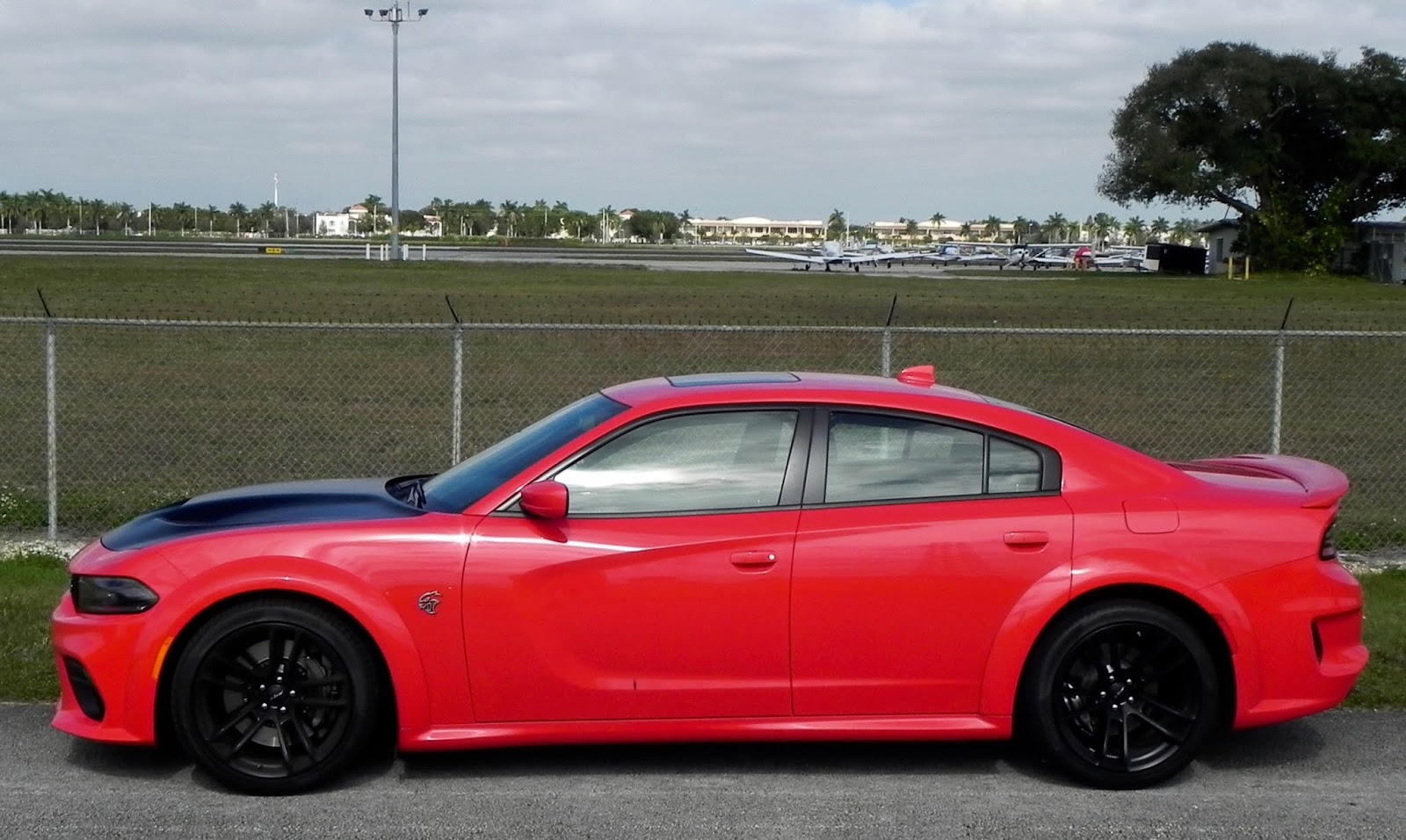
Since bringing back its famed Charger as a 2006 five-passenger large sedan after killing off the coupe version in 1987, the automaker has expanded the Charger portfolio from two versions (SE and R/T) to five trim levels for 2020 with the outrageous 707-horsepower SRT Hellcat sitting at the top of the class.


And it is getting some upgrades for 2020. A new Widebody Package that is standard on the Hellcat and available on the Scat Pack trim features new front and rear fascias with integrated fender flares that add 3.5 inches of width over the wider wheels and tires (Hence the “Widebody” tag.).

That provides more room for 20- by 11-inch wheels that are shod with wider and stickier Pirelli 305/35ZR20 tires than were on its predecessor. Dodge trumpets that that combination, “paired with new competition suspension tuning with Bilstein three-mode adaptive damping, produces even more grip, delivering improved performance on the street, strip and road course, making this the quickest and best handling production Dodge Charger SRT Hellcat ever.”


As if 707 horsepower isn’t enough, the 6.2-liter HEMI V8 in limited production Daytona 50th Anniversary Edition models get a boost to 717 hp with torque at 650 pound-feet.

Dodge says that the 2020 Charger SRT Hellcat — the “SRT” stands for “street racing technology” — is the “the quickest and best-handling production Dodge Charger SRT Hellcat ever.”


As evidence, how about a zero-to-60 mph time of 3.6 seconds, quarter mile in 10.96, and .96g lateral grip on the skid pad.

The 8-speed manual transmission offers manual gear selection via steering wheel-mounted paddle shifters. Drive Modes are pre-configured for Sport, Track and Default settings, and Custom Mode lets the driver select their preferred settings.


Charger SRTs come with rear-wheel drive as standard. All-wheel drive is available on some other Charger models.


Even with the emphasis on performance, the Charger SRT Hellcat is civilized enough to seat five passengers comfortably with 40.1 inches of legroom, 57.9 inches of shoulder room, and 36.6 of headroom in the back.


The seats are comfortable providing for a smooth ride experience, but with the rumbling exhaust, it is anything but quiet. Ventilated Laguna leather seats with the Hellcat logo are standard on the SRT Hellcat and come in black, black/sepia, black/demonic red colors.

The cabin probably isn’t as refined as you will find in luxury sedans with their genuine wood and brushed aluminum inlays, but it’s not the bleak, spartan interior typical of past Muscle Cars either. It would be nice, perhaps, if there were a bit fewer hard plastic surfaces.


The UConnect 4C infotainment system on the SRT Hellcat is one of the friendliest around and features a nice-sized 8.4-inch touchscreen display screen as well as knobs for operating such basic functions as audio adjustments and climate control. Apple CarPlay, Android Auto, and satellite radio are included.

Also available is an upgraded UConnect 4C system with navigation.

Pricing for the Charger SRT Hellcat Widebody starts at $71,140 or more than double the $31,359 for the base Charger SXT. Both numbers include a hefty $1,495 destination and delivery charge, and the SRT Hellcat also is levied a $2,100 gas guzzler fee.

The bottom line on my test vehicle was $78,320.

What I liked about the 2020 Dodge Charger SRT Hellcat Widebody: Infotainment features are very user-friendly, and the display screen is of good-size. Obviously, the power is something to enjoy, and the interior is roomy. So is the trunk.

What I didn’t like about the 2020 Dodge Charger SRT Hellcat Widebody: Fuel mileage, as expected, is very poor. Premium fuel is required for the Hellcat, and EPA mileage figures are among the lowest I’ve seen in a while at 12 miles-per-gallon city, 21 highway, and 15 combined. Numbers from the computer readout on my test vehicle stayed mostly at 11-12 mpg and change and barely touched 13.

Would I buy the 2020 Dodge Charger SRT Hellcat Widebody? Mixed feelings here. I’d love to have one, but it’s not a great everyday vehicle for sure. Finding a spot where you can “stretch its legs” to full performance is virtually impossible outside the race track. But if you can afford a $70,000 toy, you won’t be disappointed.


Friday, February 16, 2018

DODGE MAKES DURANGO SRT LATEST COMPETITOR IN HORSEPOWER WARS


At a time when every manufacturer seems to be adding hybrid drivetrains to about every model they put out, electric cars are seen as the future, and self-driving vehicles (ugh) are getting closer and closer to practicality, it’s refreshing, even encouraging, to see that some automakers have yet to drop out of the horsepower wars.

They continue to up the ante when it comes to performance, and I’m not speaking here of strictly sports cars or so-called “sports” sedans and coupes.

Dodge, which gave us the 707-horsepower, Hellcat versions of its Charger and Challenger sedan and coupe, has given the SRT treatment to its Durango SUV for 2018, a 475-horsepower behemoth that the company bills as the most power three-row SUV on the market today.


Equipped with a 6.4-liter HEMI V8, the Durango SRT 392 is rated at 470 pound-feet of torque at 4300 rpm that moves its 5,550 pounds from zero to 60 mph in just 4.4 seconds, according to company clockers. It is mated with an 8-speed automatic transmission with paddle shifters and a sport mode that increases shift times and delivers up to 65 percent of the power in the all-wheel-drive configuration to the rear wheels.

It has up to seven driving modes, including a Track Mode that favors the rear wheels with 70 percent of the available torque.


Yet it still retains the things you buy an SUV for, which is seating capacity (6), towing power (a best-in-class 8,700 pounds with a special package), and 17.2 cubic feet of storage space behind the third row, 47.7 behind the second.

In a news release, Tim Kuniskis, head of Passenger Cars Brands, Dodge, SRT, Chrysler and FIAT – FCA North America, says “This is what you get when you take everything great about the Durango and combine it with the performance of the Charger SRT: a 12-second quarter mile, 8,700-pound-toy hauling, three-row muscle car.”

He might have meant “tow,” not “toy,” but either works I guess.

What Dodge has done with the Durango SRT 392 (392 refers to the engine displacement of 392 cubic inches, SRT for Fiat Chrysler’s Street & Racing Technology division) allows you to have your automotive cake and eat it, too. It’s a fully functional family vehicle that also gives you a thrilling driving performance.

It gave me the feeling behind the wheel that not only could I crush anything in front of me, I could outrun it as well.


About the only thing it lacks is the fuel economy you might like for your family vacation. It is rated at 13 miles-per-gallon city, 19 highway, and 15 combined with premium 91 octane fuel recommended.

Dodge hasn’t forgotten the amenities. Leather front seats are power-adjustable eight ways and are ventilated as well as heated. A Beats premium sound system is standard as well as both Apple CarPlay and Android Auto.

The UConnect 4C Nav system features an 8.4-inch display screen, always a welcome feature for those who like to see everything at a glance. Second-row captain’s chairs are heated. The standard 20-inch wheels are shod with run-flat Pirelli tires.

That and more is included in the past MSRP of $62.995. Adding in options like special Laguna leather seats, an optional package that includes adaptive cruise control, blind-spot and cross-traffic detection, and full-speed forward collision warning, special SRT interior appearance touches, a second-row console, a power sunroof and the $1,095 delivery charge ran my test Durango SRT up to $75,550, which is a lot more than I ever thought I would see on a Durango widow sticker in my lifetime.


But the availability of three-row SUVs with anything approaching the performance the Durango SRT 392 delivers could run you into the six figures so in that the Durango SRT could be considered a bargain.

What I liked about the 2018 Dodge Durango SRT 392: Obviously, the power is a big draw, and the interior is classy as well with lots of soft-touch and nicely textured materials. Spartan was the adjective that used to come to mind to the interiors of many previous Dodge models, but not so much any more. It’s not perfect, but it’s getting there. The UConnect infotainment systems remains one of the most pleasant to use.


What I didn’t like about the 2018 Dodge Durango SRT 392: Fuel economy leaves a lot to be desired, but then you’ve got to sacrifice something to get all that power.

Would I buy the 2018 Dodge Durango SRT 392? Let’s face it. It’s out of range for my personal budget and I don’t need a three-row SUV. But if that’s not the case with you, I’d say go for it. 

Monday, October 30, 2017

YES, A MUSCLE CAR CAN HAVE FOUR DOORS; DODGE CHARGER DAYTONA SHOWS IT CAN!


Muscle Car aficionados and automotive purists may have been unhappy when Dodge resurrected the Charger as a four-door sedan instead of the two-door coupe from the 1960s and ’70s, but a little over a decade later, it seems to have worked out just fine.

The Charger in four-door form is the brand’s best-seller among coupes and sedans and actually is outselling the Durango crossover so far in 2017. Dodge reported sales of 9,230 Chargers for September to 6,207 for the Durango.

For the year to date, the Charger was holding a nearly 15,000 advantage in sales over the Durango through September.

With the Charger in four-door form, buyers who really want a Muscle Car but need transportation for the family have an easy decision.

They can have both!

As a full-size sedan, the Charger offers such family family features as a nice-sized trunk (16.5 cubic feet), room for three in the backseat (and two rear doors to give them easy access back there), and a 5-star overall safety rating from the government.

In SE or SXT trim, the Charger comes with a V6 Pentastar engine rated at 292 horsepower and 260 pound-feet of torque, which is adequate for most everyday driving situations. 

Call it the Clark Kent version.


But move up to V8 power, and the Charger becomes Superman.

The 2017 Dodge Charger Daytona I recently had the opportunity to drive for a week (yes, the name is taken from the Daytona 500; a Dodge Charger Daytona was the first stock car to break 200 mph, though it was at Talladega, not Daytona) is in the middle of the Charger lineup but definitely leans toward Muscle Car. It will take a nano-second after you push the star/stop button and those deep bass exhaust notes emanate from the rear to convince you of that.

Hey! Does this thing have a HEMI?

Of course, it does!

The Charger Daytona (and R/T trim) gets a 5.7-liter HEMI V8 that sends 370 horsepower and 395 pound-feet of torque to the rear wheels via an 8-speed automatic transmission with optional Sport mode or paddle shifters for manual gear selection. (All-wheel drive is optional on SE and SXT models.)

Not enough power?

You can always opt for the 6.4-liter HEMI V8 (485 hp, 475 lb.-ft. of torque) standard in the R/T Scat Pack, Daytona 392 and SRT 392 trims or the 6.2-liter supercharged beast (707 hp/650 lb.-ft.) in the Hellcat.

Too much of a fuel eater?

Well, the 5.7L V8 in the Daytona features what Dodge calls “fuel saver technology” that turns theV8 engine into a 4-cylinder operation when cruising at highway speed or operating under light conditions. That doesn’t make the Charger a Prius hybrid, but it does make for slightly better mileage (16 miles-per-gallon city, 25 highway, and 19 combined) than you might expect.

Recommended fuel is 89 octane for the 5.7-liter V8, though the company says regular is acceptable. (The V6 runs on regular 87 octane; premium 91 octane is recommended on the 6.4L V8, and the Hellcat V8.)

Obviously, with power numbers like those above, you’re never going to be lacking for punch when it comes to performance. But in addition to the straight-line get-up-and-go, the Charger handles corners well while delivering a firm, but not overly stiff ride, that has good road manners.


Some Muscle Cars can take, well, muscle to maneuver, but not the Charger. You may get the impression the Charger Daytona is about a half-acre wide when you look over the flat hood, which includes huge HEMI lettering over the large functional hood scoop, but it doesn’t drive that big.

Still, it is a full-size sedan, so the front especially is roomy, and the backseat offers just over 40 inches of legroom.


The Daytona also gets some extra styling touches, like heated and ventilated sport, suede/leather seats with “Daytona” embroidered on the backrests, special floor mats, a performance steering wheel, and extra stitching on the seats and door panels.

It’s not a luxurious interior, but is functional and nicely laid out.

The exterior, too, gets attention with prominent “Daytona” and “HEMI” markings and badges in several prominent spots (including the front grille), 20-inch black forged aluminum wheels, and a satin black performance spoiler.

There’s no mistaking this car when you are coming down the street either visually or audibly.


All that does come with a cost, though. You can get into a base Charger SE for just over $29,000 (when destination and delivery charges are thrown in), depending on your negotiating skills, of course. The Daytona with the 5.7-liter V8 starts at $40,985 and gives you pretty much all the fun that the Hellcat does for nearly $29,000 less.

The Daytona 392, which has the 6.4-liter V8, has a listed MSRP of 46,095, which is close to the listed $46,315 that was listed on the Monroney sticker for my test Daytona.

I will say that a price topping the $40,000 mark is rare territory for a Dodge, but if you're looking for performance in a full-size sedan/Muscle Car, the Charger is hard to beat.

What I liked about the 2017 Dodge Charger Daytona: The fun-to-drive quotient is pretty much off the char.  I also liked he optional UConnect 8.4 Nav system for the simplicity of its operation.

What I didn't like about the 2017 Dodge Charger Daytona: Rear vision is somewhat restricted. The interior, while not bad, could use a bit more refinement. 

Would I buy the 2017 Dodge Charger Daytona? Yes. It's a bit on the expensive side, but if you're considering a Charger, this is no time to skimp.


Thursday, May 18, 2017


2017 DODGE DURANGO A FAMILY FRIENDLY SUV WHEN IT COMES TO HAULING CAPABILITY


One of the most appealing things about an SUV is its cargo hauling capability.

You’ll find it listed among the top 10 attributes potential buyers give as their reason for shopping in the segment. (The website thoughtco.com lists cargo capacity as the No. 8 reason to buy an SUV right behind “dogs love SUVs” and “SUVs are better in a flood” and ahead of “SUVs have a commanding seating position.”

Which is why if you are considering an SUV or one of its crossover cousins you might want to include the Dodge Durango on your list. When it comes to providing passengers with nice room for themselves and their stuff, the Durango is among the best in its class. Even those riders relegated to third-row seats get decent space.

Launched 20 years ago as a midsize SUV built on the Dodge Dakota platform, the Durango grew a bit as it moved into its second generation as a 2003 model and after taking a year off from production, the 2011 model added a third row of seats in moving the Durango into its third generation.


The Durango was updated for 2014 and for 2017 a new trim level dubbed the GT is being introduced to replace the Limited model in the Durango lineup to go with the base SXT, SXT-Plus, Citadel, and R/T trims.

Late this year, the company also will have in showrooms an SRT version as a 2018 model packing a 6.4-liter HEMI V8 that pumps up performance to 475 horsepower and 470 pound-feet of torque. The company says it will have a towing capacity of 8,600 pounds and a zero-to-60 time of under 4.5 seconds, which is borders on the unbelievable in a vehicle that offers three rows of seating.

But getting back to what I first was talking about, which was hauling stuff and not hauling you-know-what, the Durango provides passengers with good room in all three rows (38.6 inches of legroom for the second row, 31.5 inches for the third). With optional captains’ chairs ($995) in the second row instead of the usual 60/40 split bench seat, third-row occupants also pick up a little more knee room from the open space in the middle. It just seems less cramped.

And it doesn’t skimp on cargo space. With the two third-row seats in place, capacity in the far back is 17.2 cubic feet, good to handle a standard grocery run. Fold them flat and that opens up to 47.7 cubic feet. Maximum cargo space with the second row folded is 84.5 cubic feet, which is surpassed by only the biggest full-size SUVs on the market today.

Encompassing all that space is an interior that I would describe as “spartan sophisticated” that complements a bold, in-your-face exterior. By that I mean a cabin that doesn’t hit the level of luxury but with leather trimmed bucket seats (either Capri leather or Nappa leather is standard on all but the SXT trim, which gets mesh cloth), a leather-wrapped steering wheel that is pleasant to the touch, rear-park assist and backup camera and a version of the company’s UConnect telematics, including one that features navigation (again standard on the upper trims), the Durango is pleasing to the eye if not luxurious.

Such options as a Customer Preferred Package that included Beats premium audio, navigation, and power sunroof and power rear lift gate plus a rear entertainment center, trailer tow group, safety features like blind spot and cross path detection, and a power tilt-and-telescoping steer wheel nicely topped off the features of the Durango GT that served me for a week.

Mechanically, the Durango offers two different engines.

A 3.6-liter Pentastar V6 engine (295 horsepower, 260 pound-feet of torque) is standard for the SXT, GT, and Citadel trims and a 5.7-liter HEMI V8 (slightly smaller than what will be in the SRT and tuned to 360 hp and 390 lb.-ft. of torque) is standard on the R/T and available on the Citadel.

An 8-speed automatic transmission with steering wheel-mounted paddle shifters for manual gear selection is standard on all trims, and all trim lines are available with all-wheel drive in addition to the standard rear-wheel configuration. Towing capacity is 6,200 pounds for V6 models with either RWD or AWD, 7,400 for RWD V8s and 7,200 for AWD V8s.

As for fuel mileage, the V6 is rated at 19 miles-per-gallon city, 26 highway, and 21 combined with RWD and 18/25/21 with AWD. Figures for the V8 are 14/22/17 with RWD, 14/22/17 with AWD. Considering the V6 provides adequate punch for everyday tasks, I’d go with that over the V8. And if you really want that extra power, just save up over the next few months while waiting for the SRT.


MSRP for the Durango starts at just under $30,000 for the SXT and runs to nearly $45,000 for the R/T V8 with AWD. The GT that I had featured AWD and started at $40,095 but with all the extras added, plus the destination and delivery charge of $1,095, it topped out at $49,065.


The low end is a bargain but, of course, lacks many of the features that give the Durango some advantages over its competitors. The high end is just that — high end.

What I liked about the 2017 Dodge Durango GT: It doesn’t have the feel of a vehicle of its size when it comes to handling, and the ride is comfortable and quiet. The real plus is the simplicity of operation of infotainment systems like audio and navigation. Very, very intuitive. Also, you can turn off the annoying start-stop system that shuts down the engine when you come to a complete stop.

What I didn’t like about the 2017 Dodge Durango GT: The center console is on the small side, especially for an SUV, and doesn’t offer as much in the way of stowage as the optional second-row console ($300) that rests between the two captain’s chairs.

Would I buy the 2017 Dodge Durango GT: I don’t have the need personally for a three-row SUV, but yes, I would at least take a look if I were shopping in the segment.


Wednesday, August 17, 2016


DODGE CHARGE R/T MATCHED 

WITH DODGE CHARGER HELLCAT


One of the last reviews I wrote for examiner.com this summer was on the Dodge Charger Hellcat. This is the vehicle that dropped a virtual nuclear bomb in the horsepower wars a couple of years ago by putting a 6.2-liter supercharged Hemi V8 under the Charger’s hood. At 707 horsepower, it became the most powerful sedan in the world.

With 650 pound-feet of available torque, the Hellcat zips from zero-to-60 mph in well under four seconds, and the website torquenews.com has reported a time actually quicker than that —  just 2.9 seconds.

Of course, there was more to the review than horsepower numbers and I really would like to give you a link to it. When they pulled the plug on examiner.com recently, however, they really pulled the plug and it’s not available any more. Maybe the Russians can find it.

The Charger Hellcat is well-equipped with lots of extras thrown in and roomy as well. One thing I noted in my review was that even with all those power, the Hellcat with its five-passenger capacity still could serve as a “family car,” though one not particularly fuel efficient.

But it also carries a base price tag of nearly $66,000 which, let’s face it, is a lot of money for a Dodge no matter how refined and fast it may be.

But you don’t have to spend that much to get the Charger’s Muscle Car looks and performance that lives up to the image.

Take the Charger R/T Blacktop I had this past week.


It’s equipped with a 5.7-liter naturally aspirated HEMI V8 that is rated at 370 horsepower and 395 lb.-ft. of torque that will scoot you from zero-to-60 in the neighborhood of five seconds, which is a sports-car like number in a full-size sedan. It carries a base MSRP of $34,890 (including destination and delivery), which is roughly half of what the Hellcat will set you back. (OK. A little more than half.)

(For the record, a couple of other Charger trims come with a 6.4-liter HEMI V8 that produces 485 horsepower with 475 lb.-ft. of torque going to the rear wheels, and the base SE and SXT trims come with a standard 3.6-liter V6 with ratings of 292 hp and 260 lb.-ft. — 300 and 264, respectively, with the Rallye Group package included.)

Fuel consumption for the 5.7-liter HEMI is rated at 16 miles-per-gallon city, 25 highway, and 19 combined, which according to the car’s computer is right at the numbers I was getting for my week. Mid-grade fuel is recommended, but Dodge says that regular is acceptable. Numbers for the Hellcat are 13/22 and premium fuel is recommended, so you come out a little ahead there as well.

All the engines, by the way, are mated to an eight-speed automatic transmission with manual gear selection capable via steering wheel-mounted paddles.

The R/T comes with a pretty wide variety of standard features, like anti-lock disc performance brakes, sport suspension, electronic stability and traction control, hill start assist, automatic headlamps, keyless Go system with push-button start, Dodge’s UConnect system with an 8.4-inch screen to operate telematic funcions, voice commands, and dual zone A/C.

My test vehicle had some option packages that added such features as a Beats Premium sound system, leather seats, HID projector headlamps, ventilated front seats and heated second-row seats, rear backup camera, park-assist system, and the Blacktop appearance package that features 20-inch polished and black painted aluminum wheels, black trim touches inside and out, navigation, and a leather-wrapped performance steering wheel.

Oh. And a black painted roof.

That ran the total MSRP to $41,070, which is still quite a bit less than what the Hellcat will set you back. Can you accept getting to 60 mph a couple of seconds slower? I can for that.

What I liked about the 2016 Dodge Charger R/T Blacktop: The looks are outstanding, and the performance is among the best, and not just in power. Handling is very nimble, and the quiet ride is firm but not overly stiff. The interior has been seriously upgraded with the cheap plastics of past cabins long gone. Backseat passengers can get 40.1 inches of legroom, only 1.7 inches less than those in the front. Trunk capacity is 16.5 cubic feet, which matches what you find in most others in the segment, including the Chrysler 300. Navigation, audio, etc. are very easy to operate.


What I didn’t like about the 2016 Dodger Charger RT Blacktop: Visibility is somewhat restricted by the large rear pillars and small rear windows. Seats could provide more support. A little more in the way of fuel economy would be nice, but if you want that performance, you’ve got to sacrifice something.


Would I buy this car: Yes. The R/T is as fun to drive as the Hellcat (more economical, too) and leaves you a lot more money to spend on extras.